
Key Points
Much of the hype surrounding Space Exploration Technologies (NASDAQ: SPCX), better known as SpaceX, has died off in the weeks since its initial public offering (IPO). Though it still carries a $1.6 trillion market cap, which is good enough to rank it among the world’s 10 largest companies, its stock now trades well below where it IPOed, and some investors may be wondering if it’s smart to buy the dip.
As a comparison, I’m choosing the stalwart of the AI build-out: Nvidia (NASDAQ: NVDA), a megacap that has strong growth and is actually priced at a reasonable level. If SpaceX can outperform Nvidia in several categories, it will speak to how good an investment it is.
Where to invest $1,000 right now? Our analyst team just revealed what they believe are the 10 best stocks to buy right now, when you join Stock Advisor. See the stocks »
Let’s consider which is the better buy for your portfolio now.
Image source: Getty Images.
SpaceX’s business is broader than Nvidia’s
Nvidia makes powerful graphics processing units (GPUs) that are mostly getting scooped up for new data centers. While the chipmaker has developed a major product ecosystem around these computing units and is breaking into different computing industries, its focus remains on parallel processors for data centers.
On the flip side, SpaceX has a broader business. While its space exploration and payload delivery business are what most investors recognize, its biggest and most profitable unit is its Starlink satellite broadband service. Additionally, SpaceX also owns xAI. This gives it exposure to the AI build-out through xAI, the maker of the Grok large language model (LLM) and the owner of X, formerly known as Twitter. So, SpaceX could also be viewed as a social media company.
That wide array of segments may make it too broad a business in some ways. But it also offers it the potential to be a bit more stable than Nvidia. Should anything happen that slows down investment in AI infrastructure, Nvidia could be in a world of trouble, while SpaceX would feel less pain. As a result, I’m giving the business category win to SpaceX.
Winner: SpaceX
Nvidia’s growth is hard to keep up with
SpaceX hasn’t reported any 2026 growth figures yet, so we have to measure it based on last year’s growth rates. In 2025, its xAI division grew at a 22% pace, its connectivity division’s revenues increased at a 50% rate, and the space division only grew at an 8% clip. Overall, that equated to a 33% growth rate. While that’s a strong and growing company, it doesn’t hold a candle to Nvidia’s growth.
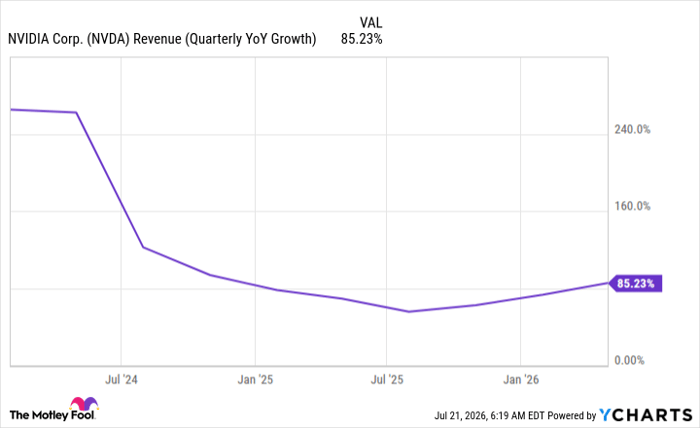
NVDA Revenue (Quarterly YoY Growth) data by YCharts.
With Nvidia expected to grow revenue by 82% this year and by 42% for next year, it easily beats out SpaceX as the faster-growing business.
Winner: Nvidia
SpaceX has a sky-high premium
SpaceX is not profitable, so investors need to use the price-to-sales (P/S) ratio to value the stock. During 2025, it generated $18.7 billion in revenue. At today’s $1.57 trillion market cap, that equates to a P/S ratio of 84. That’s expensive, and honestly, a bit absurd considering SpaceX’s growth rates.
Comparatively, Nvidia, which is fully profitable and growing faster, is much more reasonably valued.
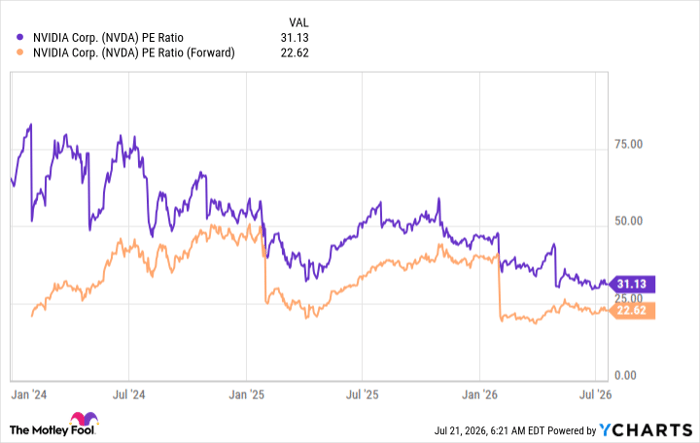
NVDA PE Ratio data by YCharts.
Nvidia trades for 31 times trailing earnings and 23 times forward earnings. SpaceX has a long-term goal of bringing its profit margin to 45%. If it could instantly snap its fingers and achieve that, it would be trading now at 186 times earnings. That makes Nvidia about a sixth the price of SpaceX right now, which tells investors just how cheap Nvidia is, or how expensive SpaceX is, or both.
Either way, Nvidia gets the win here as well.
Winner: Nvidia
Should you buy stock in Space Exploration Technologies right now?
Before you buy stock in Space Exploration Technologies, consider this:
The Motley Fool Stock Advisor analyst team just identified what they believe are the 10 best stocks for investors to buy now… and Space Exploration Technologies wasn’t one of them. The 10 stocks that made the cut could produce monster returns in the coming years.
Consider when Netflix made this list on December 17, 2004… if you invested $1,000 at the time of our recommendation, you’d have $369,577!* Or when Nvidia made this list on April 15, 2005… if you invested $1,000 at the time of our recommendation, you’d have $1,301,557!*
Now, it’s worth noting Stock Advisor’s total average return is 908% — a market-crushing outperformance compared to 208% for the S&P 500. Don’t miss the latest top 10 list, available with Stock Advisor, and join an investing community built by individual investors for individual investors.
*Stock Advisor returns as of July 23, 2026.
Keithen Drury has positions in Nvidia. The Motley Fool has positions in and recommends Nvidia. The Motley Fool has a disclosure policy.
The views and opinions expressed herein are the views and opinions of the author and do not necessarily reflect those of Nasdaq, Inc.