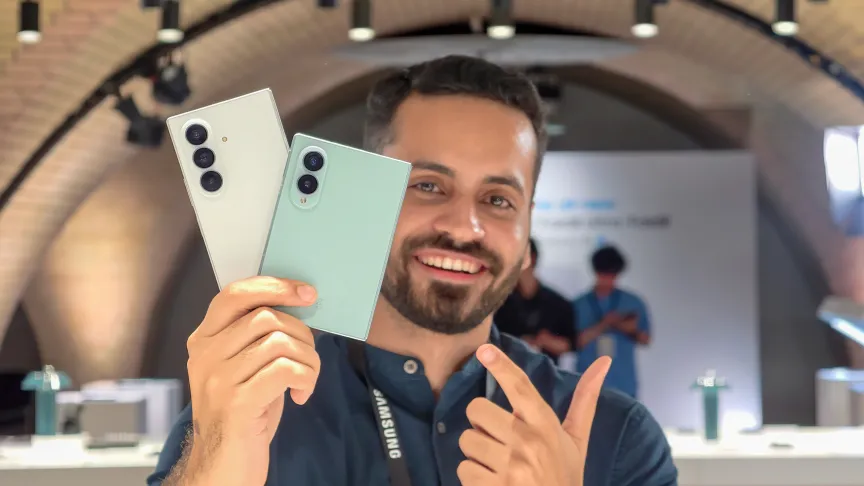
Samsung announced its next generation of folding phones at the Galaxy Unpacked July 2026 event. The Fold 7 successor is now the Galaxy Z Fold 8 Ultra while the all-new Galaxy Z Fold 8 shows off a shorter and wider design.
The two new Samsung book-style foldables have plenty going for them. There are subtle experiential upgrades, brighter displays, and for the first time, silicon-carbon anode batteries for bigger cell capacities in a thin design.
However, the Galaxy Z Fold 8 and Fold 8 Ultra remain among the most expensive phones on the market at $1,900 and $2,100 for 256GB of storage, respectively. So the question becomes which design is more useful for you?

According to Samsung, the Galaxy Z Fold 8 is “built for discovery,” whereas the Fold 8 Ultra remains the “foldable built for maximum productivity.” In simpler words, one is made for the more casual audience for webscrolling and streaming. The other might be better suited for working in web browsers and documents, and includes a more advanced camera system.
I got hands-on with the new Samsung foldables, and the Galaxy Z Fold 8 surprised me in ways I didn’t expect. It is my favorite product in the lineup, but the Fold 8 Ultra still holds its own.

New experimental upgrades and similarities
Samsung has upgraded the design in a few likable ways on its Galaxy Z Fold 8 and Fold 8 Ultra. There’s a new titanium plate on the inside to strengthen the display and balance the hinge mechanics, says Samsung. Theoretically, it should result in a smoother, lighter and more natural unfolding experience.
Practically, it is combined with subtle changes to the sides of the phones. Last year, the Fold 7 had completely flat sides, so there was no grip for the thumbs to unfold the device. In comparison, the Fold 8 and Fold 8 Ultra have thinner sides beyond the screen borders. So, the inner screen folds completely shut but leaves space for your thumbs to get a better grip and unfold the device.
The Galaxy Z Fold 8 pops open after a certain angle (about 100 degrees), while the Ultra can stay propped up at 110 degrees. When asked, a Samsung representative told me it doesn’t expect the wide-fold owners to use the fold in the prop-up position, so they made sure it pops open for easier usability.

The phone-maker has also added another experiential design change that I’ve been waiting for years: an anti-reflective coating on the folding screens. Both the Galaxy Z Fold 8 and Fold 8 Ultra have it built into their non-removable screen guard on top of the folding display.
As a result, readability and legibility under direct light and harsh lighting conditions are much better than previous-gen models. I loved this feature on the Oppo Find N5 and Find N6, and I’m glad it’s expanding to more foldables.
According to Samsung, the folding screen’s reflectivity has been reduced by 5% (versus the Fold 7). I couldn’t test the claims, but I compared both phones with my Fold 7 under direct artificial light, and there was a noticeable difference. The new models were easier to read, and their matte finish looked pleasing to my eyes.

Design and display
I was skeptical about the Fold 8’s in-hand feel before going into the demo, but it remained comfortable to hold and use, thanks to the thin and light design.
At 201 grams, the Fold 8 is the lightest Galaxy Z Fold made by Samsung to date (the Ultra isn’t far away at 215 grams). The wide model is slightly thicker at 9.7mm when folded (versus 8.9mm on the Ultra) and 4.5mm when unfolded (vs. 4.1 on the Ultra). Regardless, both of them are some of the thinnest and lightest folding phones you can buy right now.
Both screens on the two folding phones have AMOLED panels with a 120Hz variable refresh rate and 3,000 nits of brightness. They majorly differ in aspect ratios, which leads to a drastically different experience.
The Galaxy Z Fold 8 has a 5.5-inch cover screen in a 10:16 aspect ratio. It is a lot shorter than the Fold 8 Ultra’s 6.5-inch display with a taller 21:9 aspect ratio. If you want a slab phone-like experience, the Ultra is the way to go. However, the Fold 8 feels like a small pocket book when browsing the web. It’s a new experience to view content.

You’ll notice a bigger difference once you unfold the phones. The Galaxy Z Fold 8 has a 7.6-inch 4:3 screen, whereas the Ultra offers a squarish 8-inch 20:18 folding display. In my 90-minute demo, I used both devices to browse the web, watch Instagram Reels and new movie trailers on YouTube. I liked using the Fold 8 more because it feels like the best of both worlds.
For video consumption, you get less letterboxing (black borders on top and bottom), and when you want to read, you can simply hold it in portrait orientation to get a 3:4 screen. However, the punch-hole selfie camera could be more distracting here. Depending on how you hold it, it could be located on the upper half of the left side or the lower half of the bottom-right. I’m not sure how distracting it would be while reading in daily use, but it was noticeable enough to get a mention here.
I like Fold 8’s aspect ratios more than the Ultra’s productivity-focused design. However, the Ultra sibling will give you more space to type in split-screen multitasking.

Cameras
The Galaxy Z Fold 8 has one less camera than the Fold 8 Ultra. You get two 50-megapixel (main and ultrawide) sensors. The Fold 8 Ultra has three cameras: a 200-megapixel main camera, a 10-megapixel telephoto sensor with 3x optical zoom and a 50-megapixel ultrawide camera. Both phones have two 10-megapixel selfie shooters on the cover screen and inner display.
We’ll get a better idea of the camera’s performance once CNET has completed its review testing. However, having a 200-megapixel wide camera on the Fold 8 Ultra could be quite useful. On my Galaxy S26 Ultra, I’m able to take hi-res photos on its 200-megapixel camera and get 24-megapixel digitally zoomed-in shots. These photos sometimes look better than photos taken with the telephoto camera at 3x optical zoom. The Fold 8 might miss out on this capability with its 50-megapixel wide camera, which would have ideally made up for the lack of a telephoto sensor.
Both phones have a new My FanCam feature in the Gallery app, which lets you reframe shots in post editing. For example, if there are multiple people in a video, say dancing on a stage, the phone can recognize them and prompt you to select one. Once selected, you can then select an aspect ratio, and the phone will edit the video, keeping that person in focus. However, Samsung notes that “accuracy of results is not guaranteed.” The feature worked fine in my demo, and I look forward to testing it further.

Software and AI
Both the Galaxy Z Fold 8 and Fold 8 Ultra run One UI 9 based on Android 17. I’ll need more time with the phones to find out if there’s anything substantially new in the user interface. For now, I got a couple of demos with new agentic AI features meant for helping plan travel — but attempts to use it got a little bumpy.
One demo was meant to help book a hotel in Paris by having Gemini scan a photo of the Eiffel Tower on the screen. But the request failed multiple times or provided results in London. It made me want to just search for these on my own, at least until these agentic features improve.
In comparison, contextual AI is much more useful. For instance, Galaxy AI can suggest actions on top of the Samsung Keyboard based on your on-screen messages. This includes Now Nudge, which can surface relevant next steps like checking a schedule or finding a place saved based on your text messages.
Both phones will be getting plenty of software support from Samsung, with the Z Fold 8 and Z Fold 8 Ultra set to receive seven years of software and security updates. You can compare more details about these phones using our side-by-side specs chart below.
Samsung Galaxy Z Fold 8 Ultra vs. Samsung Galaxy Z Fold 8 specs
| Samsung Galaxy Z Fold 8 Ultra | Samsung Galaxy Z Fold 8 | |
| Cover display size, tech, resolution, refresh rate | 6.5-inch AMOLED; 2,520×1,080 pixels; up to 120Hz variable refresh rate | 5.5-inch AMOLED; 1,972×1,248 pixels; up to 120Hz variable refresh rate |
| Internal display size, tech, resolution, refresh rate | 8.0-inch AMOLED; 2,256×2,504 pixels; up to 120Hz variable refresh rate | 7.6-inch AMOLED; 2,448×1,848 pixels; up to 120Hz variable refresh rate |
| Pixel density | Cover: 422 ppi; Internal: 422 ppi | Cover: 428 ppi; Internal: 403 ppi |
| Dimensions (inches) | Open: 6.23 x 5.6 x 0.16 in; Closed: 6.23 x 2.87 x 0.35 in | Open: 4.88 x 6.35 x 0.18 in; Closed: 4.88 x 3.22 x 0.38 in |
| Dimensions (millimeters) | Open: 158.4 x 143.2 x 4.1mm; Closed: 158.4 x 72.8 x 8.9mm | Open: 123.9 x 161.4 x 4.5mm; Closed: 123.9 x 81.9 x 9.7mm |
| Weight (grams, ounces) | 215g (7.58 oz) | 201g (7.09 oz) |
| Mobile software | Android 17 with One UI 9 | Android 17 with One UI 9 |
| Cameras | 200-megapixel (wide), 50-megapixel (ultrawide), 10-megapixel (telephoto), 10-megapixel (cover screen selfie) | 50-megapixel (wide), 50-megapixel (ultrawide), 10-megapixel (cover screen selfie) |
| Internal screen camera | 10-megapixel | 10-megapixel |
| Video capture | 8K at 30 fps | 8K at 30 fps |
| Processor | Qualcomm Snapdragon 8 Elite Gen 5 for Galaxy | Qualcomm Snapdragon 8 Elite Gen 5 for Galaxy |
| RAM/storage | 12GB + 256GB; 12GB + 512GB; 16GB + 1TB | 12GB + 256GB; 12GB + 512GB; 16GB + 1TB |
| Expandable storage | None | None |
| Battery | 5,000 mAh | 4,800 mAh |
| Fingerprint sensor | Side | Side |
| Connector | USB-C | USB-C |
| Headphone jack | None | None |
| Special features | IP48 rating, Corning Gorilla Glass Ceramic 3 (cover screen), Corning Gorilla Glass Victus 2 (Rear), Advanced Armor Aluminum, 5G (sub6, mmW), Wi-Fi 7, 3,000-nit peak brightness, anti-reflective display, 45-watt wired charging, 20-watt wireless charging | IP48 rating, Corning Gorilla Glass Ceramic 3 (cover screen), Corning Gorilla Glass Victus 2 (Rear), Advanced Armor Aluminum, 5G (sub6, mmW), Wi-Fi 7, 3,000-nit peak brightness, anti-reflective display, 45-watt wired charging, 20-watt wireless charging |
| US price starts at | $2,100 (256GB); $2,300 (512GB); $2,700 (1TB) | $1,900 (256GB); $2,100 (512GB); $2,500 (1TB) |
| UK price starts at | £1,899 (256GB); £2,069 (512GB); £ 2,409 (1TB) | £1,699 (256GB); £1,869 (512GB); £ 2,209 (1TB) |
| Australia price starts at | AU$2,999 (256GB); AU$3,299 (512GB); AU$3,899 (1TB) | AU$2,699 (256GB); AU$2,999 (512GB); AU$3,599 (1TB) |

See full bio