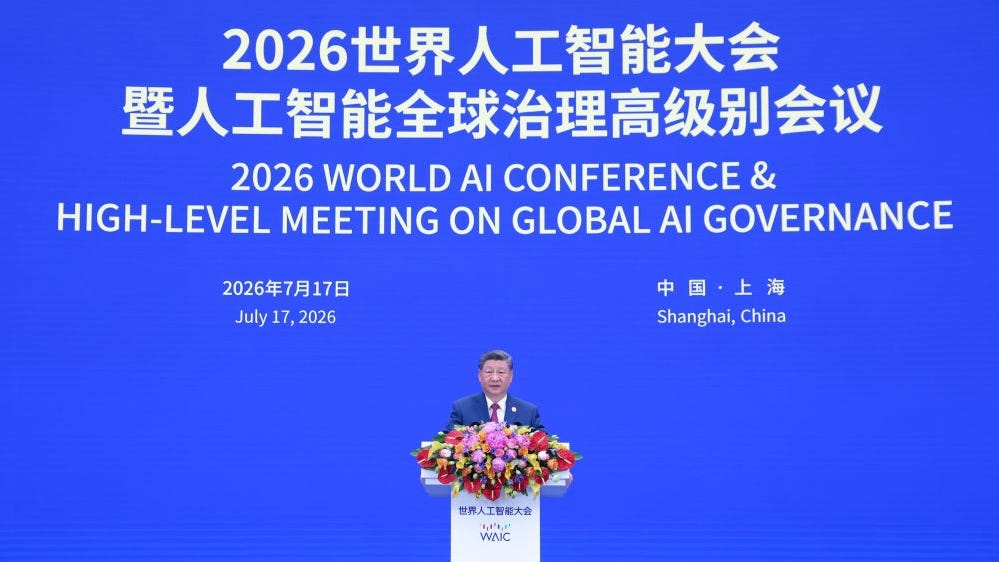
Kimi K3 dropped this week, and days later Xi Jinping gave his most substantive speech on AI yet at the World AI Conference in Shanghai. The full ChinaTalk squad convened for an emergency pod on what a Chinese Mythos-class model would mean, and whether Beijing has any mechanism to catch one before it ships open-weight.
Irene Zhang, Aqib Zakaria, and Lily Ottinger are ChinaTalk staff writers and co-authors of our recent scenario analysis on Chinese AI governance.
We discuss…
-
Whether Xi’s WAIC speech commitment to open source will hold, or if it’s just another Davos address
-
Why Xi shouted out the salt and iron debates of 81 BC for AI today
-
Three scenarios for Chinese AI governance — Let It Rip, China’s Glasswing, and full nationalization — and why the Chinese models themselves bet on the black box
-
Whether open weights kill the business model for everyone, and why compute ratios may matter more than the capability gap
Listen now on your favorite podcast app.
Jordan Schneider: A big week for China AI news. We had Kimi K3 drop, and Xi giving his biggest speech on AI yet. To discuss, we have the full ChinaTalk squad in attendance for this emergency podcast: Irene Zhang, Aqib Zakaria, as well as Lily Ottinger.
After much debate, we’ve decided to start with Kimi instead of Xi. Sorry, big man. Aqib, why was this model release a big deal?
Aqib Zakaria: It’s a big deal because now everyone in the US AI community is a little bit afraid. In the past months we were pulling farther and farther ahead from China in terms of model quality and model size. And first it was GLM 5.2, and now this week Kimi K3 just shattering that illusion. Kimi and China may be closer to a Mythos model than we think.
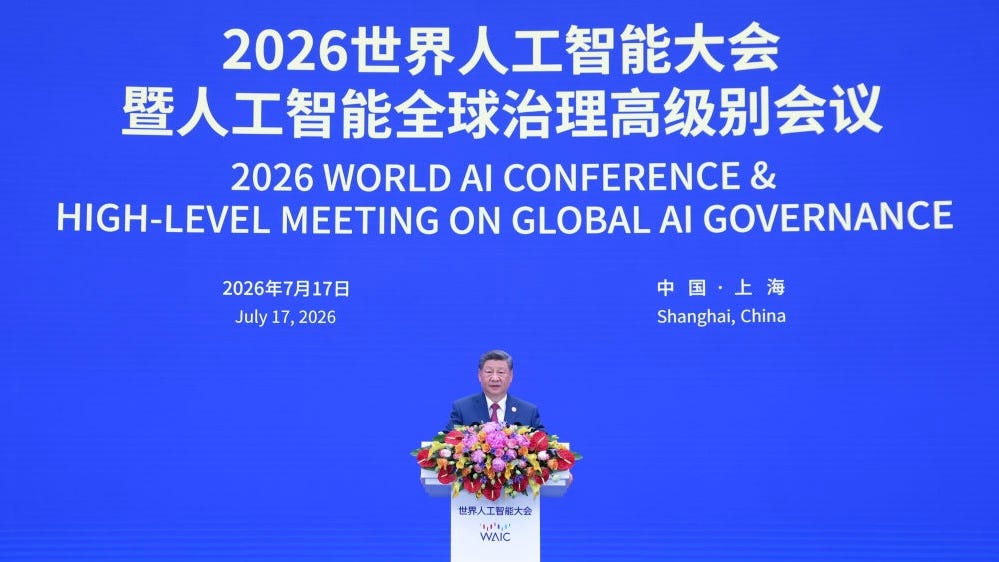
Jordan Schneider: So we have that release coming basically simultaneous to WAIC, the World AI Conference in Shanghai. Xi makes his first appearance, gives a thousand-character-ish speech, which took him 20 minutes to read. It was kind of brutal watching it. He seemed a little on the slow side, but he got a little juiced up for 开源 kaiyuan. He was excited to control and make the model stable.
It was a pretty strident laying of the flag in favor of keeping stuff open, is the first read. Maybe we can get to some Straussian ones later.
Lily Ottinger: I think it’s interesting the extent to which other countries are being talked about in the context of the expansion of the AI ecosystem, and the cooperation initiatives announced with Belt and Road countries, the Shanghai Cooperation Organization, ASEAN. When I was in China touring some of the Chinese AI labs, I found out that a Chinese company is helping Kazakhstan build their sovereign AI initiative.
Irene Zhang: And think about who he’s speaking to. Various people have noticed and analyzed by this point the fact that he opened with the Dartmouth workshop, which seems like a bit of an olive branch to the United States. But then in the middle section, he talks a lot about inclusiveness, about the uniqueness of world cultures, and solidarity, and that’s clearly meant for the Global South, for countries that China is trying to contest in terms of influence and ability to build partnerships in those ecosystems.
I’ll be very curious as to how that’s received in those capitals. Obviously we’re talking about the global majority, a very diverse group of countries here. But one part of it that links to Kimi is also that Kimi, whilst still cheaper than American frontier models, is more expensive than the previous class of Chinese open models we’ve been used to. And that incurs not insignificant costs for those very Global South countries. So it’ll be interesting to see how that tension plays out.
Jordan Schneider: Well, the cost — if they’re going to put it open weights in a week, it won’t matter, right? So hold on to your horses for that, July 27th, TBD.
I want to stay on Lily’s point that this feels like a speech for the world. It reminded me a lot of the Xi Davos 2017 one, the we’re-open-for-business speech that opened with a Charles Dickens quote. Within weeks there was THAAD in South Korea and a campaign of economic coercion against that country, and in the subsequent years, tiffs with Japan and Australia and India on down the list.
In terms of reception, I was at a conference with some American AI investors, and all of them were like, wow, this is remarkable. I wish my president could put out this vision to the world. I would just encourage folks, if this is the only Xi speech they’ve ever read in their life, to maybe take it with a bit of a grain of salt — these promises of global comity and an outstretched arm often have other layers and subtext to them.
Irene, reading that speech in the context of the AI Plus plan and the other official documents we’ve seen come out over the years, what struck you as similar or different?
Irene Zhang: I think thematically they’ve been really consistent. If you look at the big speeches and the big initiative documents and white papers coming out of the Chinese state since 2022 probably, they’ve been pretty remarkably consistent on their own set of buzzwords, like openness and inclusivity, and taking shots at the United States over what it calls the geopoliticization and securitization of AI.
You see probably more discourse in these documents, and a little bit in the Xi speech, over safety now, as that has become a lot more salient and less abstract. But I think it’s also a little hard to compare, because when Xi gives a once-in-a-few-years speech like this, he is hitting at some really abstract themes. He’s not expected to be delivering very specific policy initiatives or giving out the specs on how much China will govern AI. That probably is not his remit in real life either. Folks may disagree and I’m curious what y’all think, but I assume he’s not giving actual memos to the CAC on what to do. What he’s doing here is reinforcing the ideological layer and also signaling domestically that this is the general path forward.
Jordan Schneider: It’s almost like — this I think is the strain of almost all of the policy documents, really all the policy documents we’ve seen — they see this as a normal technology. And if it’s a normal technology, why shouldn’t it be as cheap as possible, and as many people in the world have access to it, and this can be a great export for China, just like all these other export businesses we’ve built over the past twenty years?
But at the same time, we have OpenAI 5.6 Soul Plus breaking out of a harness to access the internet by loading up seven other models. So this may be right, but it also may be three months away from being spectacularly wrong. I don’t doubt this government’s ability to change if and when they get confronted with something which is actually a lot more scary than it may seem today.
And it’s funny, Aqib, you started with this idea that the gap is narrowing, and it’s like, well, there still is pre-Mythos and post-Mythos. Kimi is still pre-Mythos. This is not something you can trivially hack stuff that hasn’t been Mythos-hardened yet. So it may be that this Xi speech is just a high point in open rhetoric, and once they get hit in the face with it, like the White House did, they change their tune. But maybe everyone’s just freaking out too much and they’re wrong, and CAC and Xi are right that we don’t actually have to be super worried about this thing.
Aqib Zakaria: I think the lens that AI is just normal technology actually explains a whole lot when you think about this speech. As an American audience member, you sometimes feel like there’s this weird tension between wanting AI to be open and inclusive, but also safe and secure. We think those things are inherently contradictory. But the Chinese position on this is like, look, it’s just like the internet. You want it to be as diffuse as possible, but just have good cybersecurity. What’s the problem? Why can’t you do both?
We’ll see how and if that changes in a post-Mythos world.
Jordan Schneider: And we don’t really want to buy American chips even if they’re offering them, because if your timelines are longer, then China’s done without for a while with lots of other things in the past, for the goal of import substitution. So sorry, ByteDance, sorry, Alibaba, just deal with it. Make your own chips. We’ll get there.
Lily Ottinger: I’d like to draw a little bit on what Irene said about the domestic signaling aspect of the speech, because the feeling that I get from Chinese developers is that they personally love openness. The AI researchers love open source because they learned a lot from open source software in the pre-AI era and they feel very strongly ideologically that they want to give back. I heard researchers say, this is in our blood. We just love openness because we really believe it’s the right thing to do. It’s a way to exert your will on the world and contribute to a community that you care about.
So I don’t know if the government necessarily cares so much about openness as an abstract value, but you have to remember that the people in the audience are all domestic Chinese AI researchers. And at some point there’s the question of, is the crackdown coming? The way that they came for Jack Ma, are we next? When Xi says openness is what we care about the most, maybe he’s just trying to say the government is on your side. Unclear how long that will last. He’s trying to hype up the domestic AI ecosystem and make them feel like they can innovate without being constrained too much.
We’ll see if a Mythos-level model changes that. I think it probably will.
Aqib Zakaria: I was thinking that statement was a lot more cynical. That a lot of these models maybe want to go closed source, and Xi is saying, we do not prefer that. Don’t do that.
Irene Zhang: I don’t know whether he’s necessarily saying that closedness is bad — I don’t think he said that explicitly. That’s probably just the realm of corporate strategy. But I agree with Lily, I think he’s offering a compliment to open source and being like, yes, we’re back, for now.
I also want to hit the point about AI as normal technology. Xi ends with this quote, 明者因时而变,知者随事而制, which is officially translated as “a man of wisdom adapts to changes, a man of knowledge acts by circumstances.” I wanted to look at where it was from. It’s from this record of policy debates from the Western Han dynasty, around 81 BC. And I thought it was actually really interesting because this document is called 盐铁论, Discourses on Salt and Iron. A lot of it was about how the Western Han was governing the salt and iron industries, which by that point were largely privatized, and they were trying to figure out how much should we extract from this private enterprise. If we have any listeners who are experts in the Western Han, please correct me on this, but it’s a cool parallel with AI today, which in China is also largely privatized, and the state is trying to figure out how much to extract from it.
Jordan Schneider: And other empires brought it in house, right? There was a salt monopoly for hundreds of years at some point.
Jordan Schneider: So speaking of nationalizing salt in 300 AD, maybe we should talk about our joint piece we put out a few days after Kimi launched, where we did a little scenario analysis of three potential paths for where Chinese governance of AI could go. Each of you guys wrote one of them. Let’s start with Let It Rip.
Aqib Zakaria: Yeah, I wrote that one. The Let It Rip scenario is just the status quo — the Chinese Mythos model will come out just as Kimi K3 did, just as GLM 5.2 did. It just drops. And maybe hopefully there’s a one-week delay saying we’ll release the weights later. But there doesn’t seem to be any system within the government for catching, this model’s different, this model actually has the capability to do some real damage. And then once it’s out, it’s out.
And maybe after that, this will be the wake-up call they need to scramble and have some policy to change how they review AI models. But an open-weight Kimi K4 or a GLM 6 can do some major damage out in the open.
Jordan Schneider: The question I have now is, what if it just doesn’t? What if it’s just another day in the life? We’ve had so much — can we call it hyperventilating? Can we call it alarm raising — from cybersecurity experts. There is a world in which they are wrong.
Let’s make the case. What was Kevin Xu saying? You need serious access to compute in data centers. Maybe at the cloud layer and the neoclouds, they just decide that they’re not going to do business with cyber hackers or Boko Haram or whoever else. Maybe things get patched fast enough that it’s just kind of a blip and we get to the other side, and instead of taking two or three years as some people are proposing, it takes a month. Then all of a sudden our models are great because there’s just a lot more money being put into these models to clean up systems than there is to attack systems. Other arguments folks have in favor of we just kind of move on?
Lily Ottinger: From the Chinese government perspective, they already live in a world of cyber exploit abundance. They’ve had a system for systematically acquiring zero-day vulnerabilities for a long time and have decided that the risks of using them outweigh the benefits in a lot of scenarios, but that’s because China’s a state actor with constraints placed on them by the multilateral system, the trade system. They don’t want the backlash.
And they feel like they have domestic insurgencies under control. So to them it’s not a threat domestically. I don’t think we are necessarily prepared for a world in which state actors — Claude Code made a lot of problems look software-shaped. I don’t think we’re prepared for a world in which a lot of problems look like they have solutions that are cyberattack-shaped. Unclear what steps are required to execute on any of those things. But the fact that the exploits exist, I feel like they’ll at least be sellable in a way that makes a lot of money for rogue actors in a way that we’re perhaps not prepared for. It’ll certainly be a nice way for the North Korean government to make money, but China’s not worried about them either.
You could be right that there’s no problem. I think the Chinese government for now certainly thinks it’s not a risk.
Aqib Zakaria: I think it could be such good PR for the Chinese government if it comes out without a major incident. Because people are upset over the safeguards on Fable 5 and all these lobotomized models, and now China’s the one giving it to us straight from the source. And then you have this scenario where the leading AI models are Chinese, and also the lower-cost ones are also Chinese, which could do major benefits for their adoption levels.
The Kevin Xu argument is that for Kimi, which is over two trillion parameters, you need like a dozen GPUs. You need a couple million on you, which is a lot, but certainly not insurmountable if you’re any organization or any evil rich guy, I suppose. It’s just a question of what actually gets done with it, and how much damage the CCP is willing to take. And if there is a major cyberattack with this Chinese Mythos model, how bad of PR is it for the government? And what can they even do after the fact to correct it?
Irene Zhang: It’s worth mentioning very quickly that the Chinese government does get hacked all the time. Their systems are not nearly as foolproof as they would like, as any government would like. And beyond state actors, beyond the United States and China’s various rivals around the world, there are also just the scammers in Myanmar who want Chinese PII. So there are lots of ways to make life annoying if bad actors get their hands on really strong cybersecurity tools, even without it challenging major geopolitical assumptions.
Jordan Schneider: PII is one thing, the NSA hacking you is also one thing, which is just — yes, governments hack each other, but they don’t put all the secrets online. We haven’t really had WikiLeaks for China. That I think would be a very interesting test of the case. Every government has awkward things that they don’t want the world to see, and I’m sure some of those are digitized in China. And there are definitely enough people with a few million dollars who feel some type of way about the Chinese government.
And then okay, so if you’re Xi, then what? That’s a really interesting thing because then you start to get into these state stability, global reputation type of questions. And that’s not sci-fi bioweapon stuff, that’s pretty run-of-the-mill. We’ve seen this happen in a lot of authoritarian societies around the world where awkward news comes out and folks freak out. You didn’t even need cyberattacks in 2012 with the New York Times reporting around elite politicians and money for that to really change how folks in the government thought about how they wanted to let a domestic population have access to global news. So that seems baked in almost at some point.
Lily Ottinger: I feel like the PR crisis comes when a Chinese-made nuclear reactor in a Belt and Road country gets shut down via cyberattack. That’s my prediction.
Irene Zhang: Where are the nuclear reactors?
Jordan Schneider: You heard it here first.
Lily Ottinger: Pakistan has some. There are plans to build them in several other countries in the Global South, but the Pakistan ones I think are the ones that have been subjected to the most fanfare. China makes a lot of nuclear reactors for countries that would not have them otherwise.
Irene Zhang: I’m reading this for another article that will hopefully come out soon — an October 2025 guiding document by the Cyberspace Administration of China. It’s basically a guiding document for various government agencies to adopt AI safely. There’s one section that’s actually pretty relevant to what we’re talking about, about how China deals with state secrets, where it emphasizes — and this is my own translation — to strengthen a bottom-line level of thinking and strictly make sure that anything that is a secret does not go on the internet, and when you go on the internet, there are no secrets.
And it doesn’t say that no state secrets or sensitive information should go into AI models. It says no state secrets, work secrets, or sensitive information should go into AI models that are not secrets-informed. Which implies the existence of secrets-informed AI models.
Jordan Schneider: All right, maybe we should jump from Let It Rip all the way to Black Box. Irene, what was your vision of the future?
Irene Zhang: My vision, which I think everyone ranked as the least possible, but which I will try to defend here, is a world where the Chinese state realizes that one of the leading labs in China develops a model that heavily surpasses previous models in cybersecurity capabilities and capabilities in general, and decides that rather than letting the company release it openly, they will get first dibs on it for government use and then only allow the company to release a lobotomized version, because it is too concerned about safety. And in that process partially nationalizes this lab and tries to coerce it into developing products that are more tailored towards government use and potentially offensive use.
The reason I think that’s a genuinely possible scenario — I know the biggest counterargument is that this is commercially bad for Chinese AI’s influence in the world, to have its top capability models not be available to any national audience to diffuse and compete with the US. But China’s advantage in some ways is that it has a lot of labs. Let’s say Kimi gets there first. Let’s say K4 is somehow extraordinary and the government takes that in house and forces Kimi to not release openly. Zhipu AI will get there someday, Qwen will get there, ByteDance — we don’t hear enough about ByteDance, but they will get there someday.
In a sense, the advantage that Beijing will get from a strategy like that maybe outweighs the short-term PR game and commercial game. My scenario makes sense in a world where the Chinese government is a lot more quote-unquote safety-pilled than people assume, and also sees genuinely useful things they can do with AI for national security and its strategic vision in the short term. Enough that it thinks making that sort of very explicit move to acquire top intelligence is really useful.
Jordan Schneider: Two points in your favor, Irene, from the Xi speech. Perhaps the most interesting paragraph was him saying we must attach great importance to the various endogenous and derivative risks brought about by AI and work to build systems of laws and regulations, technical monitoring, early risk warning, and emergency response. We must reinforce the safety baseline, prevent misuse and abuse, and ensure that AI always remains under human control. So clearly some safety emphasis there.
Plus, I gave the top three Chinese models and the top two American ones all three of our scenarios, and the Chinese models believed in the black box. Even though me, Lily, and Aqib all gave it a fifteen percent chance, DeepSeek was up to thirty percent, Kimi was up to forty-five percent. So the Chinese models think they’re going to get nationalized sooner rather than later.
Irene Zhang: Maybe they know something we don’t.
Aqib Zakaria: The only reason I find scenario three unlikely isn’t that I don’t think there’s this big mega-brain tradeoff happening. For scenario three to happen, the Chinese government has to know that this model is going to be really good. And the only way that happens, because I don’t think the model regulators check for cyber capabilities or bio capabilities, is Kimi has to be like, guys, K4 is different. And then the Chinese government has to believe them. And then they have to take that step of nationalization, which is a complete U-turn from the speech and the messaging they’re currently giving.
Irene Zhang: Well, Matt made that point when he came on ChinaTalk, about how there’s the version of the registry that’s on paper and then there’s what happens in real life. Which makes a lot of sense to me, given what I’ve heard as well. So on paper, they don’t test for bio, they don’t test for all of this before they can release a model, but in reality the CAC is probably in pretty close contact with these labs, and I really doubt that they have no idea of a model’s capabilities before they go out.
Lily Ottinger: I kind of feel like, from talking to AI researchers in China, their understanding is that they’re going to make the models exactly as safe as is required by law and they’re not going to think about it beyond that, because they’re compute constrained and they just want to do their national obligation. And that’s it. Maybe they talk a lot about safety, but it’s unclear how much that’s a thing that they personally really believe in, versus a thing that they’re aware the global community believes in, and thus want to be interested in safety in order to have their place in that global community. If it’s left up to the labs to flag cyber risks, we are in a bad spot. Let It Rip is probably pretty likely in that situation.
Jordan Schneider: Lily, let’s go to you then. How does China’s Glasswing happen?
Lily Ottinger: Project Glasswing would happen in a world where the capabilities are flagged in advance by somebody. Someone from the Chinese government gives a speech in advance that says we need to move the testing capabilities up, we need to evaluate first, release later, we need to fold in relevant stakeholders from private industry and government ministries before releasing a model with huge step-changing capabilities. And then the labs take that as a signal that now it’s their responsibility to figure out whether their model is going to be Mythos level before they release it. Perhaps the fact that Kimi is waiting to release the open weights of K3 is an indication that the labs are thinking about this more.
I think this is pretty likely because there’s a playbook for it already, in the form of Project Glasswing. It enables the model to eventually still go out in a way that is safe for everybody and has the cyber capabilities lobotomized, but enables Chinese developers to still work with the best tools, which is something the Chinese government seems to really care about because they believe AI is a huge unlock as far as productivity is concerned. So I think there are forces in the Chinese government that will work against having the models be totally black-boxed and government-only and never released.
I think it would cause a huge amount of infighting. The labs would not necessarily enjoy being the national champion of a Glasswing-style project, because it would mean handing over their proprietary technology to their competitors, all of which are building their own foundation models too. When Mythos was handed over to Microsoft, it wasn’t such a big deal, because Microsoft’s not a serious competitor in the AI race. But that’s not true in China, because everybody and their mother has their own foundation model, including delivery apps like Meituan. And they all hate each other and have longstanding rivalries and they all poach employees from each other. There’s so much drama.
Irene Zhang: I tried to think of examples previously of Chinese big tech cooperating with each other on stuff. And I really couldn’t think of any.
Lily Ottinger: And I think the government likes it better that way. They prefer that the companies don’t necessarily get along and do these big cooperation initiatives that stretch across conglomerates.
Irene Zhang: Yeah, that’s called price fixing.
Jordan Schneider: The funniest thing that’s happened in the Chinese AI race over the past few weeks is Qihoo 360, which is a security company, trying to convince everyone that their model or their harness is Mythos class and they’ve done their own Glasswing. Their CEO is like, we are only giving out our special sauce AI product to a handful of providers, and they took a photo or whatever. It’s like, okay, guys. Sure. Good luck with that.
There’s a piece of this, Lily, which you may be missing, where there’s some honor in being the one that has to kick off the Glasswing.
Irene Zhang: My question is, I don’t know the extent to which that kind of honor really buys them stuff in China right now. For example, Anthropic’s marketing makes sense even to average American society, because Anthropic and its peers have been messaging for so long to the general public in the US about AI’s risks, and everyone and their mother has heard that AI could kill us all and stuff. That doesn’t happen in China yet. The catastrophic risk narrative has not taken hold. People’s negative feelings about AI are mostly about job loss and the economic side.
So if some company were to come out with that heroic messaging around AI safety, taking that baton of honor, I don’t know how much that resonates with the actual public. The previous examples of Chinese big tech doing honor-based stuff that I can think of are like donating masks during COVID. Is that the kind of stuff that genuinely resonates with average people?
Lily Ottinger: Seems like a thing Alibaba would do.
Aqib Zakaria: One thing that’s interesting is that whatever path happens is really dependent on which lab gets there first. For this scenario, if Alibaba or Qwen was the one to reach there, they’re like, I am not sharing this with the other conglomerates. But maybe if it’s a smaller lab, they’re more willing to do it, because there’s not as much of that history of politics there.
Jordan Schneider: Yeah, but they’re all kind of tucked in, right? I don’t know if they’re fully subsumed and have vetoes, but if all your compute comes from one place, which is the case with Kimi and Ali, then that’ll get messy.
Irene Zhang: I guess we should not project our understanding of Silicon Valley’s internal dynamics onto the Chinese tech industry at all. There are obviously ways in which both systems learn from each other and mirror each other, but in terms of that relational thing, it’s really different.
Lily Ottinger: Everybody loves a good taboo though. The model secret, nobody can have it yet. And then when it finally comes out in a usable way, even if it’s lobotomized, people will be like, well, what is this whole thing about? Everybody loves something you’re not supposed to have. In that sense, maybe that’s more salient messaging than honor is.
Irene Zhang: But then you can’t do any more messaging beyond that, because so much of AI marketing now is about actually sharing your capabilities and getting people to use it, whether it’s consumer or enterprise or all of the above, and especially coding. This is actually a pretty word-of-mouth industry on the consumer side. People just be telling each other what models they like. So if you can’t use it, there’s a limit to how much you can sell the thing.
Lily Ottinger: Well, I just mean that the taboo is good marketing for Chinese Fable, not for Chinese Mythos.
Aqib Zakaria: The counterargument here is that all of these companies want to ship their model as fast as possible, so you can churn the money out of it before you have to ship the next model. So in this case, the Glasswing might actually be kind of problematic, because every week that you’re not shipping is a week of money you’re losing from an already presumably cash-constrained company.
Irene Zhang: Yeah, Lily sort of makes that point in the article, of the thing just getting bogged down by bureaucracy.
Lily Ottinger: The question of when do we actually release it after a Glasswing-style project is going to be really difficult, because nobody’s going to want to take responsibility for what happens after it gets released. So evaluate first, release later turns into endless evaluation. And it takes a long time to patch cyber capabilities. In the pre-Mythos era, there were bug finders that flagged serious bugs in Microsoft’s code that remained in the spreadsheet unpatched for eight years before they were exploited. So I think it’s hard to say.
Aqib Zakaria: How much do y’all think the path we go down depends on where America is at with model capabilities? If we’re already two, three generations after Mythos-level capabilities, do you think that will make China more likely to rush it, be like, we’re too far behind, we gotta let it rip? Or do you think they’re completely taking things at their own pace?
Lily Ottinger: I do think it makes Let It Rip more likely. Because they think, well, this isn’t us opening the floodgates, the floodgates are open. So if Fable came out and there was no problem, then this isn’t really all that different and we should just rush to catch up.
Irene Zhang: The question for my scenario is the extent to which the American frontier being much further ahead shapes what’s downstream of that. I can see a world in which the American frontier gets stronger in various other capabilities, in AI for science and all of that, but it doesn’t necessarily lead to the American economy taking off significantly more than it does now. It doesn’t lead to the US suddenly possessing much more incredible weapons and whatnot. In which case China might be less worried, because then the lesson it gets is, diffusion’s actually pretty hard, we have time to think of alternative pathways. But if that frontier means that the US economy or its position somehow genuinely gains significant leads, then probably Let It Rip is more likely.
Jordan Schneider: Let’s go one level up. What is the three-to-five-year national power impact of the world in which you can’t make a lot of money just developing models, because Chinese open-weight stuff keeps coming out and it’s pretty much as good? Versus the world in which you have this nine-to-twelve-month lag in capabilities, and the only way you can pay for intelligence is to buy tokens from OpenAI or Anthropic or maybe DeepMind if they get it together.
In the world where you can’t make this big surplus from developing models, development probably goes a little slower. But you still have the ratio of ten times more compute being outside of China as inside China. And the point of AI is not to make labs money. It’s to grow productivity. The world ex-China is still getting ten times more agents running around in data centers, inventing things, making your systems more productive than the PRC is, and you just aren’t paying this tax, which is maybe one third of it going back into R&D to make it better.
Aqib, why don’t you take the other side? The gap stays wide. You still have closed models that are a year ahead, or China starts closing off and the labs try to skim their own percentages from selling API access.
Aqib Zakaria: A lot of this is a function of how quickly model research becomes autonomous. In that sense, model development could be happening constantly, like every week, if the AI is just updating itself. And then all the money is being churned off of people wanting access to the newest model. But that also depends on how much the newest model really boosts productivity. How much can productivity really increase from Mythos 72 to Mythos 73?
Lily Ottinger: I agree with that. The capabilities are already there for a lot of tasks. People are happy to use Chinese open models for their open Claude bots and personal productivity management stuff. And enterprises are happy to pay.
Jordan Schneider: But we want science, right? We don’t have science yet, really. Maybe the first science we get is AI research, because that’s all software. Who knows when that unlocks.
Aqib Zakaria: One thing a lot of people have been talking about since K3 and GLM 5.2 is how much does compute matter? The entire theory about export controls and people talking about policy is these models should get worse and worse, or the gap should increase, because China has less compute. But now the gap isn’t really increasing that heavily, even if it’s still pre-Mythos, post-Mythos. Is this fully a problem of them remotely accessing compute in Malaysia? Or is it cope? What’s going on?
Jordan Schneider: It’s a business model thing as much as it is a training run thing. Okay, congratulations, Kimi, you dropped this really exciting model. Now you’re worth what, 75 billion dollars? That’s like series C for Anthropic. We’re up to a trillion at this point. And they’re worth a trillion dollars not just because they have the best models in the world, but also because they have enough compute to deploy them and make money off having the best models in the world. The problem about open sourcing your stuff is you can’t make money off of it.
So yes, maybe you can keep fast following, but at some point, unless the Chinese government steps in or there’s enough investor excitement, it will be difficult to compete with the most successful companies in the world. You can compete in fast following, potentially, if all you need is to be able to distill and you have some good researchers and you come up with creative stuff and you have enough compute to train models. But if you don’t have enough compute to actually do the deployment and make money on the front end and diffuse the technology into your economy, then you’re still at a pretty significant structural disadvantage when it comes to reaping the benefits of what this tech will deliver.
Irene Zhang: And just for context, Kimi has not been aggressive in doing anything commercial either. Zhipu is really the leader in on-prem deployments, some 2G stuff. Minimax and the various big tech models have their own commercialization 2C venues. Kimi’s kind of a purist. I’m sure they have a coding agent, I’m sure they have API revenue and whatnot, but they’ve not been interested in this stuff.
Jordan Schneider: Okay, so they’re worth thirty billion dollars. The question is how do you get to five hundred billion? You kind of need to sell something in order to keep growing, I think. Or is the Chinese government going to give one of these labs hundreds of billions of dollars? And even if you have hundreds of billions of dollars, can you buy compute with that? I guess if America keeps letting them, then the answer’s yes. But they’ll just be in Malaysia.
Aqib Zakaria: But don’t you think you get to a point where the difference between the American leading model and the second place Kimi or GLM is not enough for me to care? So I go with the cheaper open-weights one. In which case OpenAI and Anthropic can’t make money, and neither can the open source model. And you need to give life support to that layer, because otherwise everything downstream of it doesn’t exist.
Jordan Schneider: I think they’ll figure it out.
Lily Ottinger: It’s going to be good for us to figure this out.
Aqib Zakaria: Yeah, I don’t want to talk about giving welfare to the labs. That’s not very good political messaging.
Irene Zhang: Zhipu’s doing fine.
Jordan Schneider: They’re down forty-five percent on the month! Kimi was not good news for them.
Irene Zhang: I look forward to reading Kimi’s IPO documents sometime later this year.
Lily Ottinger: So I went to Kimi. I went and met all the people in Beijing. A lot of Carnegie Mellon people in their thirties who just seem really relaxed and excited to be there. All the conference rooms are named after American rock bands. The culture seemed very healthy and steady and sustainable compared to the culture I saw at Minimax, for example. So I think they’re in it for the long haul. I don’t think they’re that concerned about making money. They think it’s going to be fine.
Jordan Schneider: This is just OpenAI 2021, right? It’s all fun and games until you really need to have a business. And they may just not need to have a business. It might be enough utility for the state, and it’s an exciting thing to invest in. They can keep it going, they can keep up their compute access by having exciting, flashy, fast-following stuff. But I’m a little skeptical.
Jordan Schneider: I mean, DeepSeek decided they had to make money, right? Irene, why don’t you give us a DeepSeek update? Kimi and Moonshot have been getting all the headlines, but this whole other lab that kicked this all off still does exist.
Irene Zhang: The DeepSeek drama has just been that it has been raising funds. To jog everyone’s memory a bit, DeepSeek belongs to this hedge fund called High-Flyer, which is one of the most successful hedge funds in China, although recently it’s been going down a bit because there’s been a bit of a slump over AI. That means it’s basically had unlimited funding for a long time, unlike most of the other labs. It’s kind of cash rich, which is really strong. And Liang Wenfeng owns both DeepSeek and High-Flyer the hedge fund. So he basically takes the hedge fund money and puts it into AGI.
But over the past year or so there’s been a lot of rumors that DeepSeek is looking into raising external money. We got some confirmation of that over the past few months. That has been really interesting because DeepSeek has, according to some reports, turned down a bunch of investments from places like Alibaba, apparently because Liang Wenfeng didn’t want to dilute his control over the organization too much.
What we know now is that it has raised about fifty billion RMB, which is like seven and a half billion USD. Investors include Tencent and a few other organizations, and also CATL, the battery maker, and some state funds, including the National Artificial Intelligence Industry Investment Fund. But Liang Wenfeng has also put 20 billion RMB of his own money into this fundraising round, to lock in his own control even more.
Which makes me question the thesis of how much it has accepted its fate as a national champion. If it truly accepted that, there are tons of state funds in China excited to jump into this whole thing. They could have taken that money, but they didn’t. Not to the same extent.
Jordan Schneider: I guess the question in China is, once you’ve hit a certain threshold of billionaire, you’re not allowed to have fun. Really. In the way that you are in the West with yachts and everything. So maybe past three billion or so — what is he going to buy, Manchester United, or take the Brooklyn Nets off Joe Tsai?
Aqib Zakaria: It’s interesting how Anthropic is doing Claude for nonprofits and now OpenAI is trying to do ChatGPT for small businesses. I wonder if you’re going to see analogous programming by Chinese labs for diffusion.
Jordan Schneider: Look, I think that kind of program is actually a good idea. Yes, people are going to need human handholding to teach them how to learn this. If this is how diffusion’s going to happen, then great. It’s like the Ag Department of the 1910s telling people how to get rid of boll weevil. You gotta get boots on the ground to get people interested and excited about this stuff.
Irene Zhang: There’s a way in which this kind of stuff works better in China, where there’s real manufacturing. I can see it being really sexy marketing if Kimi starts being like, we’ll help all these textile manufacturers in Guangdong upgrade their stuff, make their processing more efficient so that they can treat their workers better. That kind of thing doesn’t exist in the US. Maybe agriculture.
Lily Ottinger: Seems like Zhipu will do that first if it happens.
Aqib Zakaria: I’ve been thinking about this a lot — going to the people, where it’s like, we have to teach the people who don’t know the revolutionary potential. And then they’re like, get out of here. It’s not going to work.
Irene Zhang: I find it funny that Aqib is pro 上山下乡, going up to the mountains and down to the countryside.
Aqib Zakaria: We gotta do it right. You can’t have a dude from San Francisco show up to Louisville.
Jordan Schneider: That’s the thing. If your AI isn’t good enough to teach a small business owner how to use it, and you need a human layer, I feel like you gotta put some more work into your model.
Aqib Zakaria: You have to convince them that they have to like the AI. It’s a people-shaped problem.
Lily Ottinger: This is a people-shaped problem for sure. Send Jasmine Sun. She’s the perfect person for the task. Send her to Louisville. Send her to the mines.

