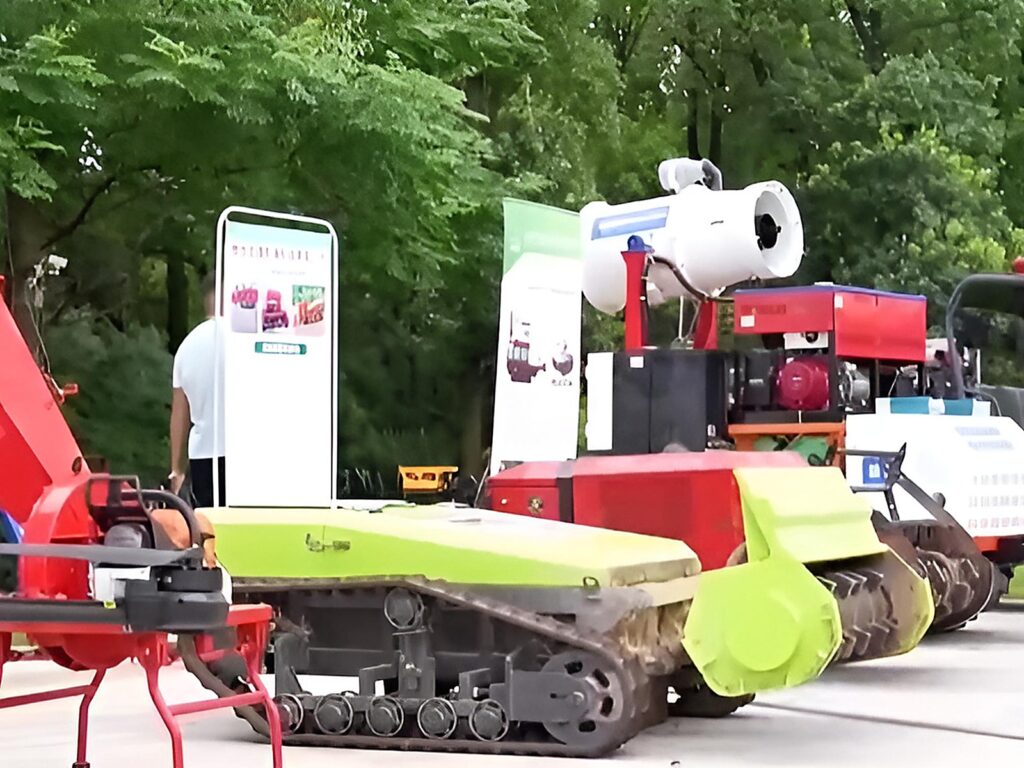
Tracked pest-control rigs, fire trucks that launch their own drones, and a robot dog are moving out of Chinese laboratories and into working forests, with Beijing claiming technology now delivers 62 per cent of the gains in the world’s largest forestry economy. That is according to the National Forestry and Grassland Administration, whose new machine fleet ran on state television on Wednesday, a week after the administration used its national science and technology work conference to set a 65 per cent target for 2030.
Held in Changsha last week, the meeting set six core research directions for the five years ahead, with patents across forestry and grassland science up 14.2 per cent and 15.8 per cent year on year. The 62 per cent figure aligns with the official contribution of scientific and technological progress during the 14th Five-Year Plan, the period from 2021 to 2025.
Crawler tracks carry most of the exhibition fleet, with pest-control rigs and new-energy site-preparation machines built for broken terrain lined up beside a robot dog developed for forestry and grassland work. Battery power reaches well beyond China, with New Zealand’s first electric wheel loader fitted with log forks passing 3,700 hours at the country’s largest maker of posts and poles.
“If machinery and technique can be integrated, development will come very fast,” Liao Kai, who directs the Hunan Forestry Equipment Engineering Technology Research Center at Central South University of Forestry and Technology, said, naming weeding, crown cutting, rotary tillage, trenching, and fertilising as the operations in play.
Fighting fire gives the unmanned push its sharpest test, with a vehicle from drone maker Jiutian Aviation carrying two water-based suppression bombs that fly to the flames on a roof-mounted drone. Algorithms make the targeting decisions, and a remote command centre issues the orders, with state broadcaster CCTV reporting that the sequence can run without a person on the ground.
“Fires are best put out within 30 minutes; they spread very fast,” Hu Feng, the head of Jiutian Aviation Technology, said of the response window the system is built to beat.
One machine at the showcase claimed a world first: the intelligent manufacturing centre for uniform-thickness bamboo mats, making its global debut and billed by its backers as the mother machine of the bamboo industry. The machine feeds a bamboo-instead-of-plastic campaign the state has pushed for years, targeting mats and single-use items, and Chinese researchers are separately developing bamboo into cross-laminated structural panels for construction.
“Bamboo’s utilisation rate is low because processing is too difficult,” He Lin, a bamboo industry representative at the conference, said of a fully automated line he expects to advance Beijing’s bamboo-instead-of-plastic campaign.
“Let technology move from the laboratory to the hillsides and the fields,” Cheng Qiang, Deputy Director of the administration’s Department of Science and Technology, said of a plan running seven coordinated measures, from projects and platforms to commercialisation, talent, and standards, through the five years to 2030.
Hunan takes the machines into the plantations, with more than 1.5 million hectares of camellia oil forest, making it China’s largest producer of the edible oil crop. Inside the Hunan Academy of Forestry’s demonstration site, water-and-fertiliser controllers, insect light traps, and sensor networks form a national testbed, while a portable harvester opens beneath the branches like an inverted umbrella, gathering fruit without bruising the blossom beside it.
A fresh-fruit processor strips shells that growers once removed by hand, and grafted improved varieties with integrated irrigation and fertilisation have increased yields from 7.5 tonnes of fresh fruit per hectare to 11.25 tonnes. That is half as much fruit again from the same ground, with the oil yield rate up 8 per cent.
It comes as the administration put China’s total forestry output at nearly RMB11 trillion in January, from an industry that supplied 43.8 per cent of Australia’s $3 billion wood products import bill last year. The target is now locked, with the rate that reached 62 per cent in the five years to 2025 required to hit 65 per cent by 2030, and the three-point climb resting on how fast the machines leave the laboratory.