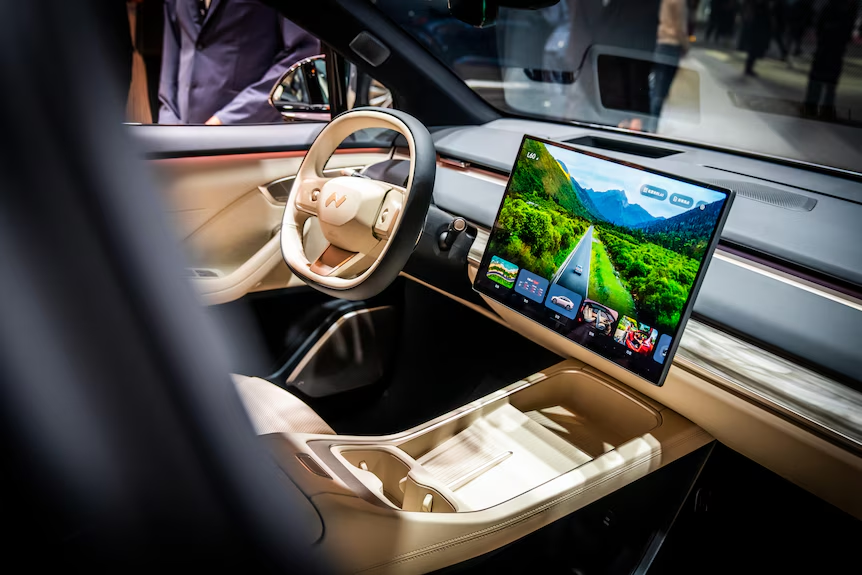
In some Chinese-made electric vehicles, you can swap your empty battery for a new one in under five minutes.
It sounds too good to be true, but the process is simple: drive your car into a special swapping station, take your hands off the steering wheel, then let robots take out the old battery and pop in a fresh one.
The tech is just one example of how Chinese EV companies have pushed the boundaries of automotive invention on their path to electric worldwide domination.
Loading…
Other Chinese companies have developed super-fast EV chargers that can replenish a car’s power to nearly 80 per cent in five minutes.
And finding a place to charge your car, a challenge in other parts of the world, is rarely a problem in China.
The country now boasts the largest EV charging network in the world with about one public charger for every 10 cars.
Australia, by comparison, has one public charger available for every 45 electric vehicles.
The extraordinary infrastructure and technology advancements have seen China largely overcome the problem of EV “range anxiety”, the fear of not having enough power to complete a trip, and helped put China at the forefront of the world’s electric vehicle revolution.
Chinese manufacturers are making cheap EVs with luxurious features. (Foreign Correspondent: Mitchell Woolnough)
China is now the undisputed global leader of the EV industry, producing almost 75 per cent of the world’s EVs.
And it is not just production where China dominates.
The country is widely considered superior in all stages of the EV process: from conception and development through to manufacturing and exporting to the rest of the world.
But China’s EV juggernaut did not happen by accident.
The grand EV plan
China’s government decided to prioritise EVs in 2001 and developed a long-term plan that would eventually catapult the country to the forefront of the future automotive industry.
The government focused on bankrolling new EV companies, giving loans to and partnering with existing companies, funding research and development programs, providing buyer rebates and tax exemptions, and building the infrastructure needed to support an electric revolution.
More than $US230 billion ($328 billion) of state capital was invested into the emerging sector over a 15-year period to establish China’s lead, and in the process transform China into an electric society.
EVs can be identified in China by their green numberplates. (Foreign Correspondent: Angus Llewellyn)
Global auto analyst Bill Russo, who has lived in China for more than 20 years, said China had won the EV race by achieving total self-reliance.
“[China wanted to] solve multiple problems at the same time: energy security, environmental pollution concerns and industrial competitiveness,” he said.
“In order to get that different path to take root, it invested in infrastructure, in tax incentives, put subsidies in early and then, over time, gradually removed them as the consumers started to accept the product.”
Bill Russo says China’s EV industry is “going global in a big way”. (Foreign Correspondent: Mitchell Woolnough)
Mr Russo said that instead of trying to replicate what other countries were doing in the automotive space, China decided to transform the sector.
China worked on breaking its dependency on the part of the energy supply chain it did not control, oil and gas, by developing new technology and new ways of manufacturing, Mr Russo said.
Then the country re-imagined what a car could be.
“The entrepreneurial part of China said … ‘We can be leaders — we don’t have to catch up,'” Mr Russo said.
“Now they’re introducing a whole new product configuration to the world which is the smart device on wheels.
“A moving living space with digital connectivity features. That’s the really transformative innovation coming from China.”
Luxury is the new standard — but cheap
Part of the success of China’s EV grand plan was making cheap cars with the luxury trimmings usually reserved for higher-end brands.
China-based car reviewer Ethan Robertson said a standard EV in China now included TVs, fridges, massage chairs with zero gravity (that is, seats that recline to near-flat), surround-sound audio, and above all else, digital connectivity.
An EV with those features could be available for about $30,000 in China.
One of the best-selling EVs in China is priced at under $15,000 and is made by the world’s biggest EV brand, Chinese-owned Build Your Dreams (BYD).
Close to 55 per cent of all new cars sold in China last year were electric.
Mr Robertson said China was now leading the pack when it came to the combination of technology, features and price — a mix he believed would leave many global competitors struggling to keep up.
Ethan Robertson is an American car reviewer who has been watching China’s EV industry rapidly develop. (Foreign Correspondent: Mitchell Woolnough)
“It’s a meme in China … if you don’t have a big screen, a refrigerator that also heats things, and individual seats with heating, cooling, massage, zero gravity and everything else, you are uncompetitive,” he said.
“These used to be stuff that you would have to pay thousands and thousands of dollars extra on cars from foreign manufacturers.
“But now that’s the standard here.”
Loading…
Mr Robertson said China could create the cheap but high-quality cars because it dominated the entire supply chain from conception through to the finished product.
“So long as these other manufacturers from other countries struggle to produce electric vehicles with the technology and the features and the price the consumers around the world want, I think they’re going to lag behind the Chinese,” he said.
One car every minute
The rapid advancement of automation and robotic development in China has redefined the speed at which cars can be produced.
Inside the manufacturing workshop of one of China’s best-known EV brands, Nio, there is barely a person in sight.
Instead, robots on wheels carry car frames between stations, where other robots piece the rest of the vehicle together.
Yang Yi says the manufacturing of EVs in China has become “more and more smart”. (Foreign Correspondent: Mitchell Woolnough)
Nio’s promotional director Yang Yi said production technology had become so advanced in China that his company was able to produce a car every minute.
That pace of development is known across the globe as “China speed”.
“So in this factory there’s over 1,200 robots [including] 300 to 400 AGV [automated guided vehicles] to transport the components,” he said.
“In China, that’s pretty much the standard now.
“This factory, it’s amazing. It’s becoming more and more smart.”
Electric vehicles being built in the Nio manufacturing plant in Hefei, China. (Foreign Correspondent: Mitchell Woolnough)
At the Nio factory in Hefei an electric vehicle is manufactured every minute. (Foreign Correspondent: Mitchell Woolnough)
As a result of China’s supply chain dominance, foreign car companies have flocked to the country to learn, develop and build cars there.
Even European brand Renault, which does not sell cars in China, has set up a top-level research and development lab in Shanghai to get the China advantage.
Renault’s director of innovation technology Xiao Xing said the Chinese know-how was helping them develop cars three times quicker than ever before.
Xiao Xing works at Renault’s research lab in Shanghai. (Foreign Correspondent: Angus Llewellyn)
Part of that, he said, was that China now had “the most mature” supply chain for EVs in the world, meaning that if a company wanted to design or build a car they did not need to leave China.
“China is the most competitive market in the world,” he said.
“So you cannot run away, you cannot hide, you need to embrace it. Because if you don’t embrace it, but your competitor embraces it, you will lose.”
Security and trade collision
China’s EV success and the wave of cheap cars flooding overseas markets have put the country on a collision course with other major manufacturers.
In recent years, Chinese brands have increasingly looked to overseas markets to help sustain their profits and offset a slowdown in domestic spending.
In 2025, China exported about 2.5 million EVs to the rest of the world, double the previous year’s figure.
Nearly 1 million of them were sold into the European Union (EU), the world’s second-largest electric-car producing region and the home of major legacy car brands competing for survival against newer, cheaper Chinese alternatives.
European leaders fear the low-cost Chinese EVs, which can match European quality at a lower price, will hollow out local industries.
But despite additional EU tariffs of up to 35 per cent being imposed on Chinese EVs in 2024, Europeans’ demand for Chinese cars continued to grow.
EU leaders are now threatening additional measures and signalling a possible trade war with Beijing unless China can rein in its export dominance.
China is edging ahead in the race for global electric vehicle dominance. (ABC News: Mitch Woolnough)
One of the only markets in the world China has not penetrated is the United States.
In 2024, America introduced a 100 per cent tariff on all electric vehicles imported from China, and in 2025 banned all internet-connected vehicles from China.
At the time, the US government said it was safeguarding the future of its manufacturing industry and responding to security concerns that people’s data could be accessed by China.
Mr Russo said concerns about security were an ongoing issue that China would have to address through diplomacy.
“It’s certainly got some data security risks associated with where and how information’s being used,” he said.
Last year China exported about 2.5 million EVs, double the previous year’s figure. (Foreign Correspondent: Mitchell Woolnough)
But, he added, the world’s view that China was “collecting data and targeting people with it” was “overblown”.
“We shouldn’t say lay down and let China control everything. We should compete with it,” Mr Russo said.
“The global auto industry shouldn’t block China. They should race at the speed of China.”
The future is flying
Even though China’s EV industry is dominating the world, the country is still innovating to keep its position at the top of the pack.
Car company Nio, which proudly boasts thousands of battery swap stations where EV drivers can swap over their battery in under five minutes, has started rolling out the technology internationally.
It is also in discussions to expand its operations to Australia, but the timeline remains unclear.
BYD, which claims its Megawatt Flash Charging System can charge an EV from 10 to 70 per cent in just five minutes, is reportedly rolling out an “even more powerful” generation of chargers.
The company has also revealed plans to become the world’s number one car manufacturer and overtake Japanese company Toyota within the next five years.
Loading…
Multiple companies are also developing autonomous flying cars that will go on sale at the end of this year.
Mr Robertson said every year Chinese car brands were pushing the boundaries further and further.
He said they were backed by both the government and the public.
“Chinese brands have gone from something that frankly was an embarrassment for Chinese consumers … to a source of pride,” he said.
“If you want to know what the pulse of the global car industry is, you’ve got to be in Beijing.”