As Spain’s World Cup-winning heroes assembled on the podium, opponents Argentina, bedraggled and beaten, turned their backs.
It marked the culmination of a tetchy, petulant and distasteful performance by the now deposed world champions, which left them a man short on the field for the 30 minutes of extra time, and starting bar-room-type brawls on the pitch after the final whistle.
In the heat of battle, scuffles and skirmishes can happen. Their shunning of the Spanish coronation, however, felt uniquely unappealing, a show of disrespect to the winners of the most high-profile sporting event in the world.
It was, however, entirely in keeping with a charmless Argentine showing which offered little by way of substance or style over the 120 minutes.
President Donald Trump booed at World Cup final | World Cup Daily Briefing
Megan Feringa and Laura Williamson
Before Sunday’s final, many had felt that Argentina would need to disrupt a refined Spanish team which has grown in confidence and authority as this World Cup progressed.
Spain are, in many ways, the counter-culture to Argentina. They are a system team; organised, logical and surgical in its play. If Spain keep cool, then Argentina run hot; a warm-blooded, emotional, often chaotic side where performances swing wildly within games, never mind from one match to the next. Never has a team appeared so beatable while so rarely being beaten.
The pre-game framing was clear, even if a little simplistic: Spain would play with their heads and Argentina with their hearts. That, however, does a disservice to the steel and desire shown by Spain, who are now both European and world champions, and also to the Argentine ability to lock in under pressure and produce when that gets turns up.
Was that the stupidest red card in World Cup final history?
Argentina sought to drag the Spanish into their game, as they tried to do with England in their semi-final victory on Wednesday. On that occasion, Argentina sought to prod, poke and provoke; Enzo Fernandez left one on the head of Elliot Anderson early on, Leandro Paredes caught the ankle of Jude Bellingham.
The team’s recital of the pre-match national anthem almost acted like a referendum on each player’s patriotism. Neck veins bulging and voices belting, it was an intimidating sight, akin to the New Zealand rugby union team’s pre-match Haka. The irony, however, is that Argentina finally outmanoeuvred England not when leaving a sly elbow here or a nasty nibble there, but when they concentrated on the football, comprehensively outplaying their opponents in the game’s final 25 minutes.
If Argentina sought to destabilise the English, the beginning to the final against Spain was more tentative. If anything, Argentina were peculiarly passive, both in how they sought to attack but also in the dark arts. Their descent into anarchy was a slow burn, rather than instant ignition.
Spain’s shrewdness came in their refusal to engage with off-the-ball trivialities. They settled the game down, placing the Argentines on their carousel and rotating the ball at their leisure. It was the equivalent of a sedative to numb their provocations. Spain won this game not by rising to the bait, but by simply playing better football.
Spain center back Aymeric Laporte made clear prior to the game that they knew what was in store. “In the last few matches we’ve seen things that really surprised us, incidents that were ignored,” he told reporters. “Especially with Argentina, who are a team that leave a lot of little messages with their challenges.”
Laporte’s diagnosis was correct. Referees have exhibited leniency towards Argentina players in this tournament, and it happened again today. Referee Slavko Vincic was perhaps hoping that he could keep 22 players on the field by applying a soft touch. Yet the impact was simply to let Argentina players off the hook.
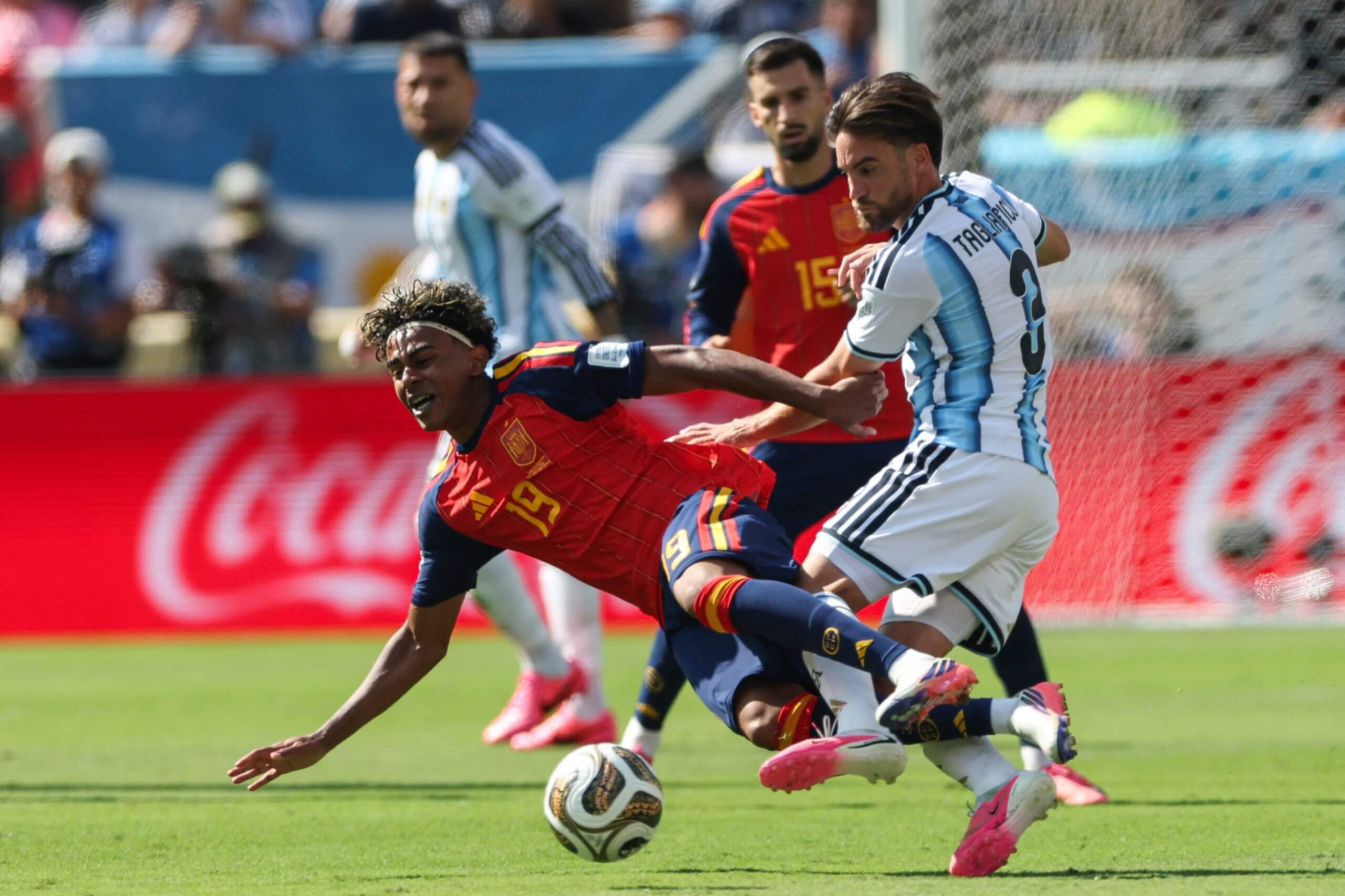
Nicolas Tagliafico brings down Lamine Yamal (Patricia De Melo Moreira/AFP via Getty Images)
Alexis Mac Allister’s early foul on Dani Olmo was badly timed and nasty. Then Nicolas Tagliafico, a poor defender up against a great attacker in Lamine Yamal, took to attempting to foul the winger in four different ways at once, but most unpleasantly grazed his studs down Yamal’s calf. Both walked away without punishment.
Leandro Paredes, when he arrived from the bench in the second half, embraced the role of a sneaky villain, shoving Dani Olmo to the floor, barracking the referee and appearing both incredulous and offended on any occasion the whistle was blown against his team.
For much of the second half, Argentina played with plenty of perspiration, but little by way of inspiration. Even Lionel Messi, so often the divine saviour, was a peripheral passenger.
As the South American and world champions tired, their self-control slipped. Enzo Fernandez’s first yellow card was for dissent, although he was fortunate to not be immediately dismissed, as he sarcastically applauded Vincic. His eventual dismissal in second-half stoppage time was an exercise in rash stupidity, crashing through Spain’s teenage center back Pau Cubarsi.
Spain’s technical staff and substitutes rushed off the bench to protest. They also recognised the magnitude of the moment, handing the initiative inexorably to their team.
From there, the Argentines became even more desperate.
Messi had an exchange of words with Marc Cucurella, and the Spaniard briefly appeared to cover his mouth. That is a red card offence if used to conceal insults during a confrontation, but Messi’s reaction, turning to raise his hand and request an intervention from the referee, brought to mind how a child might behave when seeking to tell tales to a teacher.


After the final whistle, some Argentina players shook Spanish hands. Messi collapsed to the ground and later stood alone. He eventually broke down in tears. But others disgraced themselves.
They had exhibited some unappealing traits in victory over England, particularly Cristian Romero, who goaded England players after Argentina’s goals, and the unused substitute Valentin Barco, who ran across the pitch in front of his opponents — a lack of sportsmanship which provoked a post-match slap across the head from Bellingham.
This time, things were more heated.
As Spain’s players rejoiced, defender Nahuel Molina appeared to try to catch Rodri with his arm. Rodri confronted Molina, who squared up to the Manchester City midfielder.
Spain’s Eric Garcia then leapt to his team-mate’s defence. Paredes was quickly on the scene, grabbing Garcia briefly by the throat and shoving him to the floor. Paredes also went for Gavi. Nicolas Otamendi, the Argentina defender, was caught by DAZN footage in Spain appearing to tell Rodri that he and Laporte had been “crying all week” and should talk less.

Leandro Paredes clashes wth Eric Garcia (Al Bello/Getty Images)
Lionel Scaloni, the Argentina head coach, attempted to intervene. In his immediate post-match interview, he said: “We’ve been great in victory, and we need to be great in defeat. We have shown today that we know how to lose, too. We lost the game, and we accept that.”
Others were less impressed.
Ex-Germany midfielder Toni Kroos wrote that Spain had ensured that “football won”, while his former international teammate Thomas Hitzlsperger wrote on Twitter that “Paredes, Fernandez, Otamendi, the lot” are “disgusting sportsmen… Messi is a genius on the ball, most of his teammates are thugs with no sense for the beautiful game — viva Espana.”
At this point, we should recognise that the unity of this Argentina team, and the profound sense of allegiance stirred by their national flag, has often been its point of difference, turbocharged by the genius of Messi.
That camaraderie among the players, who often vacation with one another, has carried this team to win a World Cup in 2022 and the Copa America in 2021 and 2024. It helped reverse knockout-phase deficits against Egypt and England in this tournament. These Argentines turn out with an almost frantic patriotic intensity; they play for the flag, but also are bonded in an almost religious subservience to their greatest player, Messi.
Their fans have provided the electricity of this tournament, travelling in huge numbers, turning Kansas City, Atlanta, Miami and Dallas into oceans of blue and white. The connection with the fans is obvious.
“One of the things people used to complain about with past national teams was a style of play that didn’t connect with Argentines,” the former Argentina striker Gabriel Batistuta told Telemundo. “This one did exactly what any fan would ask for — playing with heart.”
Argentina were not here to win friends. They were here to win matches. Yet on this occasion, they tripped over the tightrope, channelling aggression to their detriment. “We couldn’t compete head to head today when it comes to football,” Scaloni acknowledged.
Ahead of the trophy celebrations, the Spanish extended an olive branch, providing a guard of honour to their opponents. Yet when it was time for the victors to be recognised, Argentina turned inwards. They congregated at one end of the field, concentrating on their own fans, who physically bowed to Messi.
When Rodri collected his Golden Ball award, having been voted player of the tournament, the Argentina supporters drowned it out with chants for Messi.
In doing so, they diminished themselves in front of the world.