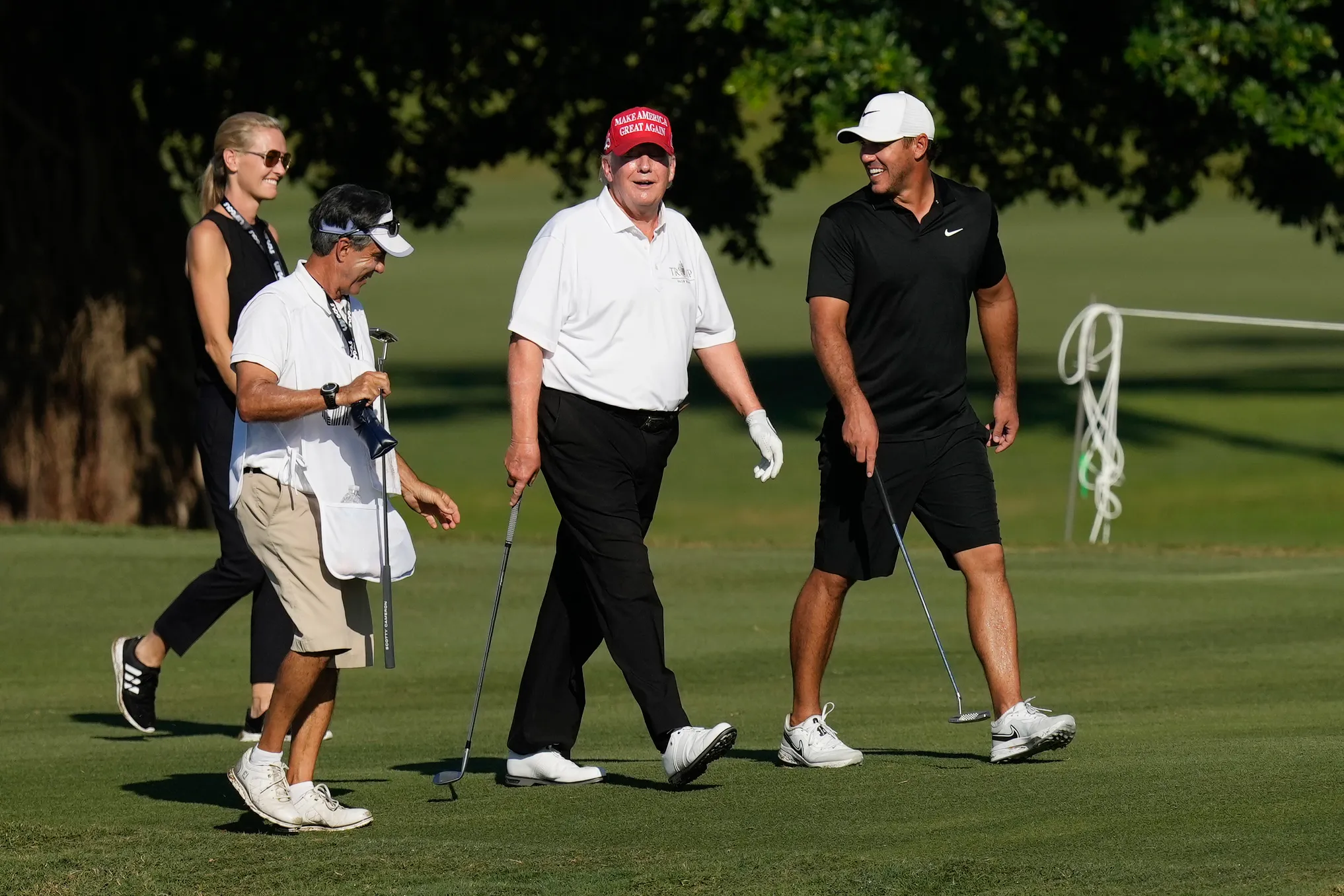
An attorney friend, a sharp legal mind and a lifelong Democrat, asked me recently, mid-round, whether I would play golf with Donald Trump if he invited me. I said yes, enthusiastically. He looked startled. “Why?” I said it would give me a chance to talk with one of the most consequential political figures of our time.
That small exchange captures a large American problem. We have started to treat conversation as a moral hazard. A republic that cannot talk to itself is inadequately positioned to talk to a world that is fracturing before our eyes. I’m not making a case for sleeping with the enemy. I want to give the skeptics their due. They aren’t wrong about everything. Sitting down with an adversary looks like giving them legitimacy, whether or not that’s the intent.
When Trump met Kim Jong Un in Singapore in June 2018, the first-ever meeting between a sitting American president and a North Korean leader, the joint statement committed both sides to work toward denuclearization and a new relationship, but it contained no verification mechanism and no timeline. The Council on Foreign Relations argued that the summit normalized Kim as a legitimate actor on the world stage even as Pyongyang’s weapons programs, human rights record and missile development went largely unaddressed in the communique.
Harvard’s William Alford made a similar argument about Nixon’s 1972 trip to China. The “Nixon goes to China” mythology, he contends, obscures the fact that Nixon spent years stoking the very anti-communist hysteria that made rapprochement so difficult in the first place. In international relations, engagement can be theater, but pictures of handshakes are not policy.
Nonetheless, the historical record also shows what happens when the alternative — silence — is tried instead. For more than two decades, Washington and Beijing exchanged almost no direct communication. When Nixon and Mao Zedong finally sat down in February 1972, the encounter did not resolve the ideological chasm between the two systems. It did something more modest and more useful. It replaced imagined enemies with observed ones. The trip produced the Shanghai Communiqué, opened liaison offices in each capital and lifted the dark cloud the two nations had lived under for a generation.
Reagan and Gorbachev offer an even stranger case, because their most consequential meeting was seemingly a failure. At Reykjavík, Iceland, in October 1986, the two men came close to an agreement to eliminate their entire nuclear arsenals before the talks collapsed over the Strategic Defense Initiative. No treaty was signed. And yet historians now treat Reykjavík as a turning point of the Cold War, the moment two leaders discovered that abolition was more than rhetoric. The breakthrough treaty on intermediate-range missiles followed a year later, built on what the failed summit had revealed about both men’s actual red lines. Two years later, Reagan stood in Berlin and challenged Gorbachev to “tear down this wall.” The wall fell in 1989; the Soviet Union followed it into history two years after that.
Jimmy Carter’s 13 days at Camp David with Anwar Sadat and Menachem Begin make the same point in a different key. The two leaders disliked each other so intensely that Carter had to separate them after three days and shuttle between their cabins for the rest of the negotiation. Proximity did not build affection. It created a treaty, the Camp David Accords, that has held, unbroken, about five decades.
And then there is the case that has nothing to do with political summits. Nelson Mandela spent twenty-seven years in prison, much of it under the watch of a young Afrikaner prison guard, Christo Brand. He was told that he’d be guarding the country’s most notorious man. Instead, the two built a friendship that outlasted apartheid itself, continuing until Mandela’s death in 2013. Reconciliation, in Mandela’s hands, started as a daily contact with a jailer before it became a national policy.
If I found myself walking a fairway with Donald Trump, I would ask about his strong short game and his unconventional swing and putting stroke, not out of courtesy but genuine curiosity and admiration. Pivoting to geopolitics would test the diplomatic skills I taught for more than three decades. I would ask what he believes China wants over the next 20 years. Respect, disruption or dominance? What he thinks Iran is actually hunting for. How he defines American strength in a world where no single country sets the terms. These are not partisan questions. They bypass the red-blue ideology. They are about the emerging global geopolitical architecture, not party allegiance.
My attorney friend’s reluctance on the golf course reflected something real. A widespread diffused anxiety that talking to people we oppose is itself a kind of betrayal. But if conversation threatens a person’s convictions, it means that the convictions were never as strong as they felt. Strengthening them requires contact with the alternative, not distance from it.
So yes, if Donald Trump invited me to play golf, I would say yes. Not because I agree with him. Not because I admire him. But because in a plural, dangerous world, the ability to sit across from someone and ask a real question is not a weakness. It is reconnaissance.
And if my attorney friend is reading this, I say: relax. I’m not defecting. I’m just teeing off. You’re still buying the beers after. As you always do.
Narain Batra is a study leader at the Osher Institute at Dartmouth College. He lives in the Upper Valley.