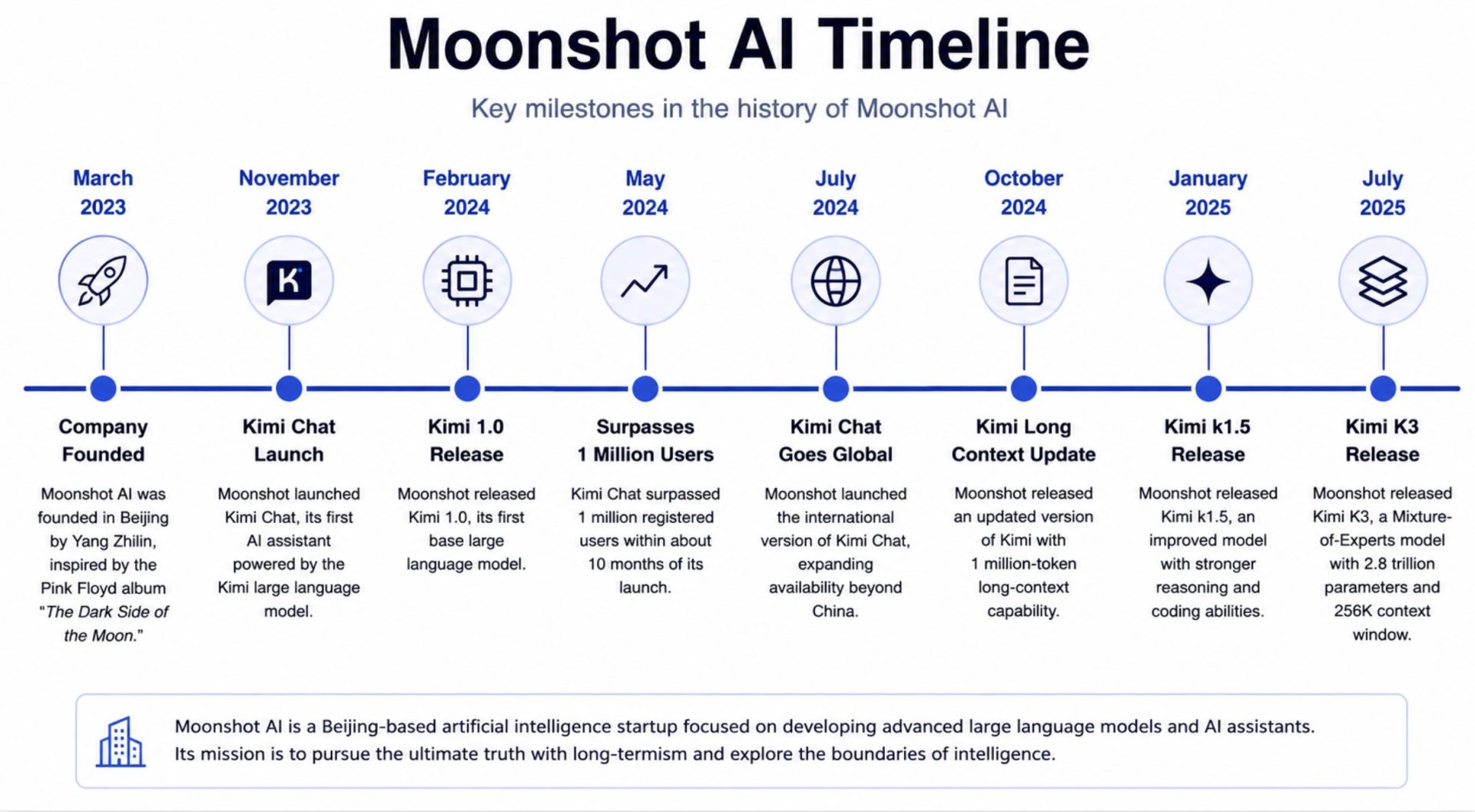

A new artificial intelligence model from Beijing-based startup Moonshot AI is fueling fresh concerns about the outlook for U.S. technology stocks, underscoring China’s growing influence in the global AI race.
U.S. markets declined Friday after Moonshot unveiled Kimi K3, an open-source large language model the company says contains 2.8 trillion parameters, making it one of the largest open-source AI models released to date. Semiconductor stocks led the selloff, with companies including Nvidia and Micron Technology falling as investors questioned whether demand for high-end AI chips could slow if lower-cost Chinese models gain traction.
The latest market reaction echoes the volatility triggered by Chinese startup DeepSeek in early 2025, when its efficient AI model sparked a temporary selloff before U.S. AI investment accelerated and technology stocks rebounded.
Unlike many U.S. models, Chinese AI systems have been designed to operate with fewer computing resources, partly in response to U.S. export restrictions limiting China’s access to advanced semiconductor technology. Their lower infrastructure costs have raised questions about whether companies will need as much expensive AI hardware as previously anticipated.
While Kimi K3 still trails leading U.S. models from Anthropic and OpenAI in overall capability, independent benchmarking services rank it among the world’s top-performing AI systems. Many businesses are already using Chinese models for less demanding workloads while relying on premium U.S. models for more advanced applications, helping reduce computing costs.
The development also highlights intensifying competition between American and Chinese AI companies as both countries race to establish leadership in generative AI.
Among China’s leading AI developers are startups Moonshot AI, DeepSeek, and Z.AI, along with established technology giants Alibaba, whose Qwen family of models has gained broad adoption, and ByteDance, which has developed its Seed language model and the Seedance AI video-generation platform.
The rapid advancement of Chinese AI has also intensified geopolitical debate. U.S. lawmakers have expressed concerns that widespread adoption of Chinese AI models could pose national security risks, while Chinese President Xi Jinping recently promoted greater international openness in AI development and warned against expanding national security restrictions in the sector.
For investors, the key question is whether increasingly capable, lower-cost Chinese AI models will reduce the massive infrastructure spending that has fueled the recent rally in U.S. semiconductor and technology stocks—or simply accelerate AI adoption worldwide.