Key Points
-
The Schwab U.S. Dividend Equity ETF has returned about 20% in 2026, ahead of both the S&P 500 and the Nasdaq-100.
-
The fund’s index only admits companies with at least 10 consecutive years of dividend payments.
-
Healthcare and consumer staples are the fund’s two biggest sector weights, at about 21% each.
- 10 stocks we like better than Schwab U.S. Dividend Equity ETF ›
The Schwab U.S. Dividend Equity ETF (NYSEMKT: SCHD) is having an exceptional year, despite being considered a more conservative fund compared to growth-focused funds. The fund has returned about 20% in 2026 as of this writing, ahead of the roughly 11% gain in the S&P 500. And it’s ahead of the tech-heavy Nasdaq-100‘s roughly 17% return, too.
That is not how this usually goes.
Where to invest $1,000 right now? Our analyst team just revealed what they believe are the 10 best stocks to buy right now, when you join Stock Advisor. See the stocks »
The growth indexes have set the market’s pace for most of the artificial intelligence (AI) boom, and income funds have been the thing investors held for stability. Yet here is a $95 billion portfolio of dividend payers trading at a 52-week high, yielding about 3.2%, and charging just 0.06% in annual expenses.
Here’s a closer look at how the fund pulled it off.
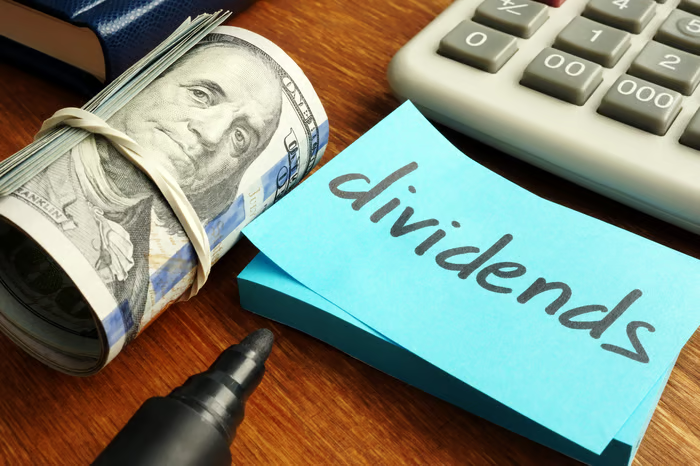
Image source: Getty Images.
How the fund picks its 100 stocks
The exchange-traded fund (ETF) tracks the Dow Jones U.S. Dividend 100 Index, and the index’s admission rules do most of the work. To be eligible, a company must have paid dividends for at least 10 consecutive years. Real estate investment trusts and master limited partnerships are excluded entirely.
From that pool, the index evaluates the highest-yielding stocks on four fundamentals: free cash flow relative to total debt, return on equity, dividend yield, and five-year dividend growth. The top 100 make the cut, with buffer rules that favor current constituents. No single stock can exceed 4% of the index at rebalance, and no sector can exceed 25%. The whole thing is reviewed annually and rebalanced quarterly.
Those quality screens matter. Ranking on free cash flow relative to total debt and on return on equity helps the index avoid yield traps (companies whose fat dividends are a warning sign of a deteriorating business). The fund wants payers that can keep paying — which is exactly what I want from a dividend holding, too.
The result is a portfolio that looks nothing like the growth indexes. The biggest holdings are UnitedHealth Group, Home Depot, and Abbott Laboratories, each at about 4.3% to 4.5% of assets, alongside names like Coca-Cola, Procter & Gamble, and Chevron. Healthcare makes up about 21% of the portfolio, and consumer staples another 21%.
And what the rules screen out matters just as much. The market’s dominant AI names, with their tiny yields or short dividend histories, don’t come close to qualifying. Scan the fund’s top 25 holdings and you won’t find Nvidia, Microsoft, or Alphabet.
Why the formula is working this year
That exclusion has been a drag on relative performance for most of the AI rally. In 2026, it has been the advantage.
Many of the market’s most expensive software and AI names have struggled this year, and investors have rotated toward steadier earners. The rotation went to drugmakers, household staples, and energy. This fund was already concentrated in all three.
To be fair, the growth benchmark hasn’t surrendered the longer race. Over the past 12 months, the Nasdaq-100 has returned about 30%, still ahead of this fund’s 27%. What 2026 has done is flip the order. That, I think, says more about how expensive the growth trade had become than about dividend stocks suddenly getting exciting.
Meanwhile, the income keeps arriving. The fund has distributed $1.05 per share over the past 12 months, and at the current price, it yields about 3.2%.
The portfolio also trades at about 17 times its holdings’ earnings, versus the mid-20s for an S&P 500 index fund. Investors are getting the cheaper collection of businesses and getting paid more to hold it.
In that sense, the fund behaves more like one giant value stock than anything in the growth indexes.
So, should investors buy a dividend ETF after a 20% run? I would set expectations first. A dividend screen probably won’t outrun the Nasdaq-100 in most years — that isn’t its job. Its job is to deliver a growing income stream from durable businesses, with less drama along the way. The fund has done that job well, compounding at about 13% a year since its launch more than a decade ago. Of course, if AI stocks reassert themselves in the second half of the year, the order could flip right back.
But for investors who want income and an anchor that doesn’t depend on the AI trade staying hot, I think this fund remains a solid buy, even near its high. The rules that built it haven’t changed. And after a year like this one, it’s harder to call them boring.
Should you buy stock in Schwab U.S. Dividend Equity ETF right now?
Before you buy stock in Schwab U.S. Dividend Equity ETF, consider this:
The Motley Fool Stock Advisor analyst team just identified what they believe are the 10 best stocks for investors to buy now… and Schwab U.S. Dividend Equity ETF wasn’t one of them. The 10 stocks that made the cut could produce monster returns in the coming years.
Consider when Netflix made this list on December 17, 2004… if you invested $1,000 at the time of our recommendation, you’d have $400,964!* Or when Nvidia made this list on April 15, 2005… if you invested $1,000 at the time of our recommendation, you’d have $1,272,955!*
Now, it’s worth noting Stock Advisor’s total average return is 930% — a market-crushing outperformance compared to 210% for the S&P 500. Don’t miss the latest top 10 list, available with Stock Advisor, and join an investing community built by individual investors for individual investors.
*Stock Advisor returns as of July 18, 2026.
Daniel Sparks and his clients do not have positions in any of the stocks mentioned. The Motley Fool has positions in and recommends Abbott Laboratories, Alphabet, Chevron, Home Depot, Microsoft, and Nvidia. The Motley Fool recommends UnitedHealth Group. The Motley Fool has a disclosure policy.
The views and opinions expressed herein are the views and opinions of the author and do not necessarily reflect those of Nasdaq, Inc.