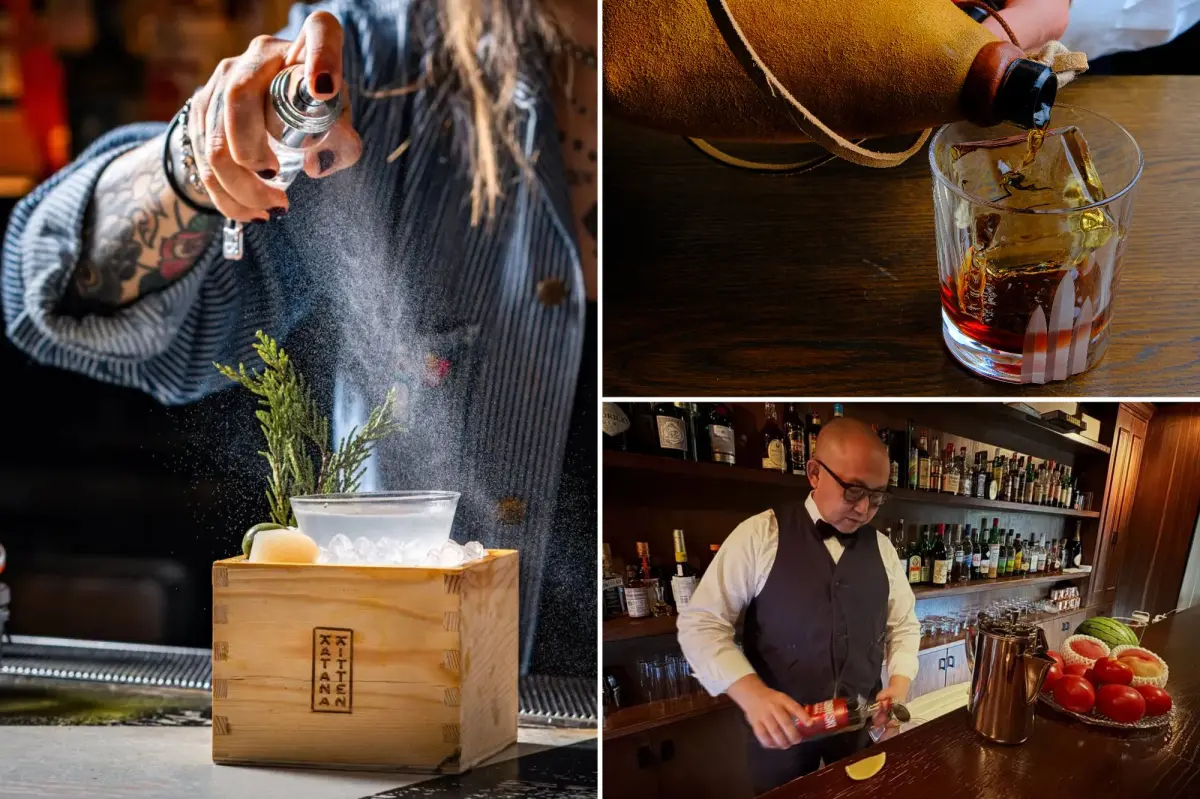
You could easily walk past one of the best cocktail bars in Tokyo without even knowing it was there — Daisuke Ito’s nine-seater speakeasy-style joint, Land Bar Artisan, is hidden behind a heavy door inside a nondescript Shimbashi shopping complex.
Shaven-headed and dapper, with chunky black glasses, a gap-toothed smile and a bow tie, Ito could be found quietly holding court inside the bar recently, talking about his last trip to New York – the one where he was drink-slinging at a private party that Jeff Bezos had flown him in to work. The tech tycoon is one of Ito’s regulars.
“I don’t promote myself — everything comes only through personal introductions,” he patiently explained to The Post, via a translator.
At the Bezos bash there was a small crowd, maybe fifty people max, but the story goes that they all raved about Ito’s cocktail jockey skills.
Soon, his newfound fans were encouraging the preprandial pro to consider something he’d never dreamed of doing — if they built a permanent spot stateside for him to his Olympic-level martini-making and more, would he come?
“I took a moment to think — and I’m turning 50 this year, so I’m just going with the flow,” he said. “I want to show them how grateful I am, repay my friends like that and take those opportunities.”
A little bit of wheeling and dealing later, and the result is Land Bar New York, which will open this fall on Greenwich Street in Tribeca. It’s bigger than the original — a 40-seater joint, tucked away upstairs from a Tokyo-style Wagyu spot, Nikuya Tanaka.
The arrival of the Bezos-anointed bar in the Big Apple is part of a tsunami of Japanese gin-slinging going on around town, offering an alternative to conventional cocktail culture in the city.
There’s Nomad’s Stone & Soil, for example, and Kintsugi in Flatiron, as well as the award-hogging Katana Kitten in the West Village — co-owner Masahiro Urushido has another bar in the works, Winter’s Coming, due in Chelsea before year’s end.
Sitting in Tokyo and watching Daisuke work, it’s easy to see the appeal of the Japanese approach to drinks. He makes fresh peach juice with a hand blender, silently somehow, spiking the liquid with a glug of fresh lime juice as a flavor booster.
“The first taste is the most important,” he said.
Fans know when coming to Land Bar not to fret over what to order — it’s far better just to put yourself in the master’s hands.
“I do not make requests, I only listen to them,” he says of his drink-making mindset.
Ito’s planning to come to New York for a month or so when Land Bar opens, to train staff and also source the farm-fresh ingredients he relies on in Tokyo. So far stateside, he’s a big fan of the Union Square Greenmarket.
Drinks at spots like Land Bar can offer better value than most Manhattan spots, he promises — because Japanese bartenders don’t adhere to the typical formula which makes cocktail bars so profitable. Drinks will start at $20.
“In New York bars, they often use only about 10 percent of the selling price on the actual ingredients and sell it for ten times that,” he said. “If you organize everything around cost and optimization, there will be no surprise. That only happens when you go above and beyond cost for the customer — then customers support a place because they want it to survive.”
New Yorker Greg Boehm is in agreement. He just opened NYC’s Cocktail Omakase and Bar 7, both in partnership with another legendary Tokyo spot, Bar Libre.
At the former, you get four cocktails and four bites over an hour — for just $59 per person.
“I look at margin less on this,” said the longtime bar owner (he’s also a driving force behind Katana Kitten with Masahiro Urushido). Boehm’s long been obsessed with Japanese bars — he says he’s been to 200 or more in Tokyo — and wanted to partner with Bar Libre to bring that singular approach stateside.
“The style of hospitality is incomparable: very calming, buttoned up and with an attention to detail so every drink is perfect,” he explained of his experiences.
Boehm says it’s the perfect time for Japanese joints to take over New York.
“15 years ago, people wanted bigger is better, but now it’s about being more refined, and very experiential,” he said, of the pleasure he wants drinkers to take in watching their cocktails made. “We’re more open minded to a bit of a show.”
Japanese bars are as adroit at making booze-free drinks as a stiff martini, too — which syncs up with the shift in mindset so evident now.
Bar Omakase has three set menus, ranging from standard to alcohol-free via low ABV. The latter’s been his surprise breakout.
“We thought it would be about 10% of our business and it’s about a quarter,” Boehm said. “We give you a one-hour experience … you can go on after to do something else.”
The Japanese approach to drinking isn’t as new to New York as some might assume.
Take the late, great Sasha Petraske’s legendary Milk & Honey bar, which opened on the Lower East Side on New Year’s Eve 1999 and kickstarted the early aughts cocktail movement here.
Most folks assume its inconspicuous, insiderish approach was riffing on speakeasy culture. Instead, Boehm explained, Petraske was directly inspired by a pioneering Japanese bar in Manhattan, Angel’s Share, which opened in 1993, in the East Village, hidden above a Japanese grocery store on stubby Stuyvesant Street. (After a high-profile 2022 eviction, Angel’s Share reopened on Grove Street, in the West Village.)
Takuma Watanabe moved from Tokyo to work there in the last two decades of its East Village run, bringing his expertise with him — he’s now the multi-award-winning owner of three cocktail bars in New York, Martiny’s, L’Americana and jazz club Midnight Blue.
Watanabe is always in pursuit of shokunin, the Japanese term for an artisan who masters their profession — that obsessive quality-chasing is another reason serious drinkers flock to Japanese bars like these.
“We need a why,” he said of his thoughtful, painstaking approach — a stark contrast to the production-line efficiency that’s New York’s default drink method.
Order a drink in a Japanese bar, he explained, and you won’t risk the sniffy judgement so commonplace at high-end cocktail dens here. “We’re trying to make you happy — like your mom is cooking something for you,” he said.
The yen for such spots comes, in part, from visitors to Tokyo — like Jeff Bezos — wanting to import the vibes they’ve enjoyed. So many more people are visiting Japan now — with 42.7 million tourists in 2025, up an astonishing 116% over a decade earlier.
Marielle Lee helps run IntoJapan, specializing in organizing fancy trips to the country — she’s seen business boom as a result.
“We get tons of requests to dip into cocktail culture there, and people constantly say they wish there was a cocktail bar like that in their home town — if they could take it home with them in whatever shape or form they could, they would,” she said.
Lee said that because most Japanese bars are phone-free and focus more on conversation than loud music, they wind up feeling a bit like Cheers — but with better drinks, surely, and bartenders that could teach Sam Malone a thing or two about humility.
The rise of Japan isn’t going unnoticed in the wider drinks world. The annual Tales of the Cocktail event in New Orleans, considered to be something like the Olympics of bartending, is offering an omakase program this year, and is helping multiple Japanese liquor brands try to break into America.
Charlotte Voisey, the event’s executive director, said: “Often, in a London or a New York bar, it’s about the stage and the bartender is performing. In the Japanese bartending culture, it’s all about the perfection of the cocktail. The drink is the most important thing, And there’s a seductiveness to their service.”
What’s more, that so-called hard shake, considered by high-end bars to be superior to the standard, reducing ice crystals and frothing a mixture far more smoothly? Yep, that was invented in Japan, too, Voisey explained.
Just don’t expect Daisuke to make any more of a fuss about his soon-to-open New York spot than he has at the OG bar.
“If I really just wanted money, it would be easy to do Instagram promotion and all of that,” he said, wiping down the counter of his Tokyo bar carefully, “But I thought that would be boring. I have no desire to promote to people I have never met.”