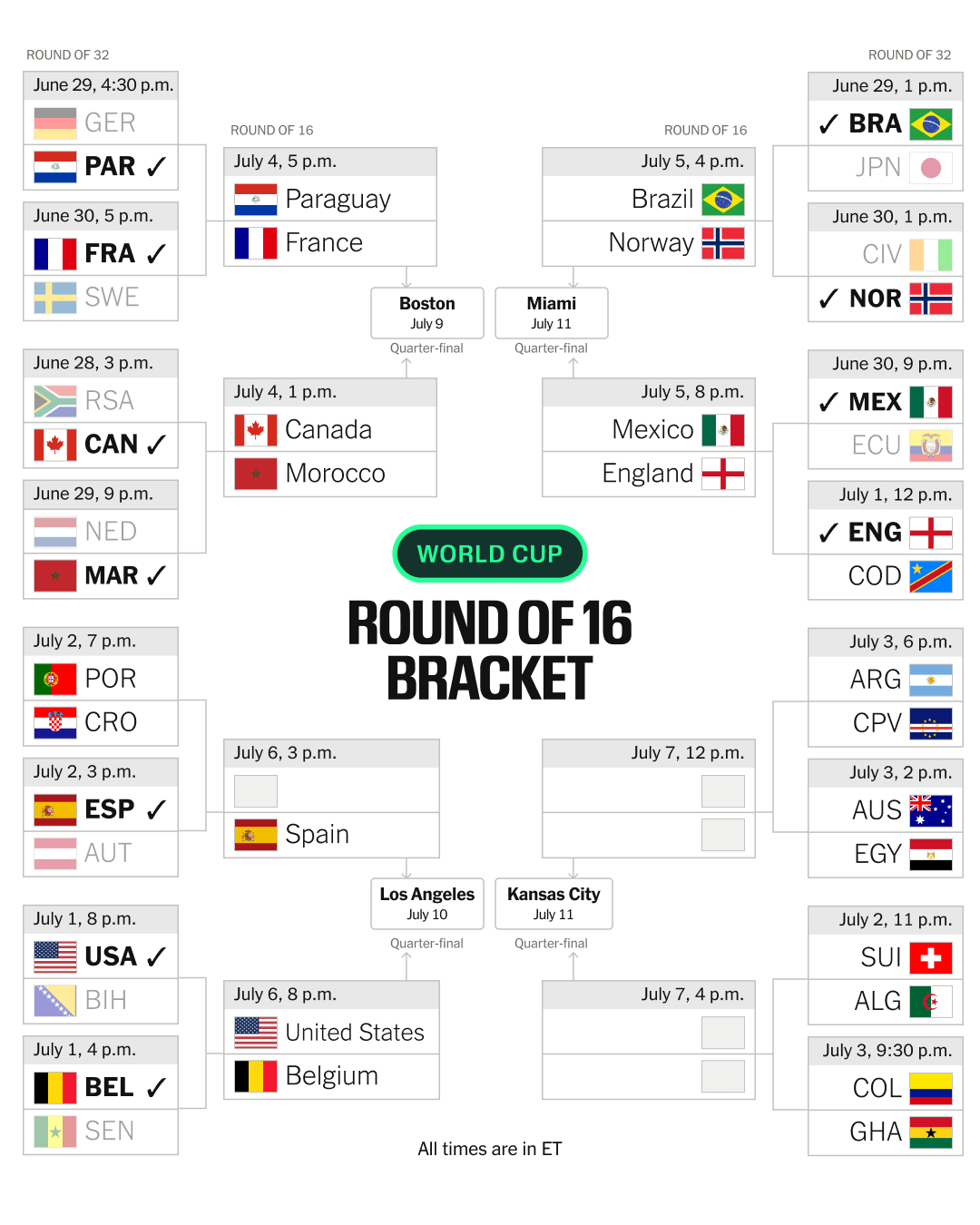
Spain dominated Austria in Los Angeles to reach the last-16 with a 3-0 victory and looked every bit one of the teams to beat in the World Cup.
Among the favourites for the tournament, Spain were in complete control and with Lamine Yamal again pulling tricks and striking fear into defenders, Luis de la Fuente’s side look the biggest challengers to France for the title. They could face the 2022 finalists in the semi-finals in Dallas on July 14.
Mikel Oyarzabal calmly slotted home after a cross from the left in the first half before Pedro Porro made it 2-0 in the second half after great work from Marc Cucurella. Another Cucurella cross was then finished by Oyarzabal for his fourth goal of the tournament.
The result means Spain go through to the last 16, where they will face either Portugal or Croatia at AT&T Stadium on July 6.
Laurie Whitwell, Dermot Corrigan, Mark Carey, Phil Hay and Graham Scott break down the action.
No-look passes and nutmegs — how good was Yamal?
Yamal arrived at SoFi Stadium wearing a chunky diamond-encrusted gold chain, which had Batman’s face etched onto a skyline of Gotham City. From an Austrian perspective, he spread a sense of foreboding like the Dark Knight does his adversaries.
Yamal may not have scored — he went closest when seeing his shot cleared off the line by David Alaba five minutes from time — but he was a constant menace, displaying much of his arsenal to ensure those in white were straining repeatedly to keep up, softening their resistance for others to take advantage.
Austria coach Ralf Rangnick shifted Konrad Laimer, the reliable Bayern Munich player, to left-back in an attempt to best handle Yamal — giving him the chance to tackle on his stronger foot when the 18-year-old cut inside — and the pair engaged in an entertaining tussle.
Yamal twice nutmegged Laimer and although on neither occasion was he able to retrieve the ball on the other side, it was a sign of the danger he posed.
Laimer made two strong early tackles to set the mood, and even shimmied past Yamal down the touchline in another moment — drawing a pained look up to the sky from Yamal. But the Barcelona forward was a joy to watch, always looking to inflict damage.

At one point he did a sharp no-look pass to Porro and he tested goalkeeper Alexander Schlager with a well-struck shot.

He constantly got possession wide right and drove towards goal, the ball stuck to his foot.
After recovering from a hamstring tear in April, this was a performance that indicated he is getting into his groove.
Laurie Whitwell
Have the real Spain arrived?
Spain came into this game having won Group H easily, picking up seven points from nine against Cape Verde, Saudi Arabia and Uruguay. Arguably they only really impressed when scoring three times inside 24 minutes in their second game against the Saudis.
This was a much more rounded performance which showed why they were viewed among the pre-tournament favourites. De la Fuente’s side started the game at a really high tempo, dominating possession and pinning Austria back into their own half.
The first goal showcased Spain’s quality, with centre-forward Oyarzabal sweeping in first time from Cucurella’s clever cross to give the impressive Schlager no chance.
Oyarzabal is not as high-profile as some of the attackers at this World Cup, but his second of the night (from another Cucurella cross) means he has now scored four times in this tournament. He also now has 18 goals in his last 21 international appearances — a run which started with yet another Cucurella cross setting up his winning goal in the Euro 2024 final over England two years ago.
Spain’s second goal was much deserved for their dominance throughout, and also spoke well to their squad depth — Alex Baena and Porro started this tournament as backups, but have earned their spots in the XI.
Goalkeeper Unai Simon had little to do for much of the game, but midway through the second half he set a new record of 461 minutes without conceding at World Cups (including two games from Qatar 2022) — passing the mark set by Iker Casillas during 2010 and 2014 tournaments.
Near full-time, Simon also set a new all-time World Cup finals record by passing the previous mark of 517 minutes set by ex-Italy keeper Walter Zenga during Italia ’90.
It remains to be seen whether Simon can follow Casillas in being the second Spain goalkeeper to win a World Cup. But this dominant performance suggests they have a real chance.
Dermot Corrigan
Are referees being more strict on grappling at corners?
Cucurella thought he’d drawn first blood midway through the first half. Lamine Yamal’s corner fell to him after some jostling on the Austria goal line, and Cucurella lashed in the loose ball from close range.
Referee Glenn Nyberg blew up instantly, however, calling a foul on ‘keeper Schlager.


While the feeling at this World Cup is that match officials have been very lenient as a rule, we’re seeing them look after goalkeepers — in circumstances where keepers don’t necessarily deserve the protection they’re getting.
Germany paid the price for Jonathan Tah falling foul of ‘screening’ — a scenario where attacking players try to block a keeper off as a set-piece arrives in the box — and Schlager had Spanish bodies around him as the corner dropped, with Rodri, Aymeric Laporte and Pau Cubarsi jumping for the ball.
Former Premier League referee Graham Scott says: “I was not surprised that Cucurella’s headed goal was disallowed, even though I did not like the decision and would have much preferred it to stand.
“Despite most pundits and commentators disagreeing with the Tah decision in the Germany game, FIFA chief refereeing officer Pierluigi Collina doubled down and defended the call, pointing out that coaches had been warned that any blocks on goalkeepers were highly likely to be penalised.
“In the Spain game, there is no foul that I can see. But referees have been instructed to protect goalkeepers at this World Cup, and once Nyberg awarded a defensive free kick, there was no way the VAR would intervene.
“The way goalkeepers are treated seems to swing from one extreme to the other. For years, they were over-protected, more recently they have become fair game, especially in the Premier League.
“We need the pendulum to stop swinging so violently and find a happy medium.”
Phil Hay and Graham Scott
How do Spain dominate teams?
Even the most casual football fan will know that a possession-dominant style is synonymous with the Spain national team.
It has been a style that has brought them success on multiple occasions across the past two decades, with an evolved approach that has provided a greater counter-attacking threat since Nico Williams and Lamine Yamal have been immersed into the squad — helping them to win Euro 2024.
De la Fuente should also be credited for how hard his team work off the ball. On the few occasions that they do cede possession, each of Spain’s attacking players are quick to swarm around the ball to snatch it back like a bully in the playground, before quickly bearing down on goal once more.
While Austria did make it easy for Spain at times, it was a sight that was repeatedly on show.
On the one hand, credit must go to Spain’s defensive awareness to be so sharp in the seconds that follow a possession loss. On the other, that possession-dominant style is intrinsically linked to their defensive work-rate — slowly wearing the opposition down in submission until their energy is sapped and they struggle to get out of their own half.
Spain’s technical quality allows them to gain territorial dominance going forward, but it is their relentless desire to win possession back that allows them to sustain those attacks.
Mark Carey