“Since we Catalans don’t have a national side, we’re going to choose the team that will represent us in this World Cup.”
Thus began a recent episode of the popular Catalan podcast La Sotana, a humorous football show whose name translates as Nutmeg — the trick of playing the ball through an opponent’s legs.
It is one of the most-listened to shows in this region of Spain, and the episode title’s was ‘After Vozinha’ — referencing the 40-year-old Cape Verde goalkeeper who had heroically kept out the Spanish in a 0-0 draw in their opening World Cup game, on June 15.
Manel Vidal, one of the podcast’s four regulars, introduced a segment in which, in a humorous tone, he held a “casting call” for the teams Catalans should support at the tournament — with Cape Verde featuring high in that list, precisely because of their exploits against Spain.
It was all in good fun — but at the same time, it reflects a widespread current of opinion within Barcelona and Catalonia.
Not everyone feels this way — and it is difficult to speak in general terms about the cosmopolitan Barcelona urban area especially, as it is home to around six million people — but a sizeable portion of the region is not supporting Spain at this World Cup.
To outsiders, this might seem contradictory. Of the 26 players Spain has taken to the tournament, nine were born in Catalonia, and Barcelona’s team is represented by eight players in the squad.
Even so, a portion of the Catalan football fanbase would rather follow others at the tournament — with Argentina, because of Lionel Messi’s links with Barca, a popular choice.
Why would some supporters celebrate their team’s players every weekend — but then hope they lose on the game’s biggest stage?
You need to turn back a few centuries to begin to get a hold on it.
September 11 is a public holiday, the national day of Catalonia. It commemorates the fall of Barcelona in a final stand at the end of the War of the Spanish Succession in 1714. A Catalan army was raised in an attempt to preserve the region’s autonomy under the Habsburg Spanish monarchy, but defeat ushered in a tough centralised order imposed by new Bourbon rulers, and a period of political and cultural suppression followed.
Blazing further onwards in our fast-forward history session, Catalonia, and other Spanish regions such as the Basque Country, were heavily repressed during the dictatorship of General Francisco Franco, who ruled Spain from the end of the civil war in 1939 until his death in 1975.
Moving closer to the present day, the modern peak of a Catalan pro-independence movement came in 2017, when a referendum on the issue, organised by local authorities without the permission of the Spanish government, brought huge crowds into Barcelona’s streets and was met with a heavy police crackdown.
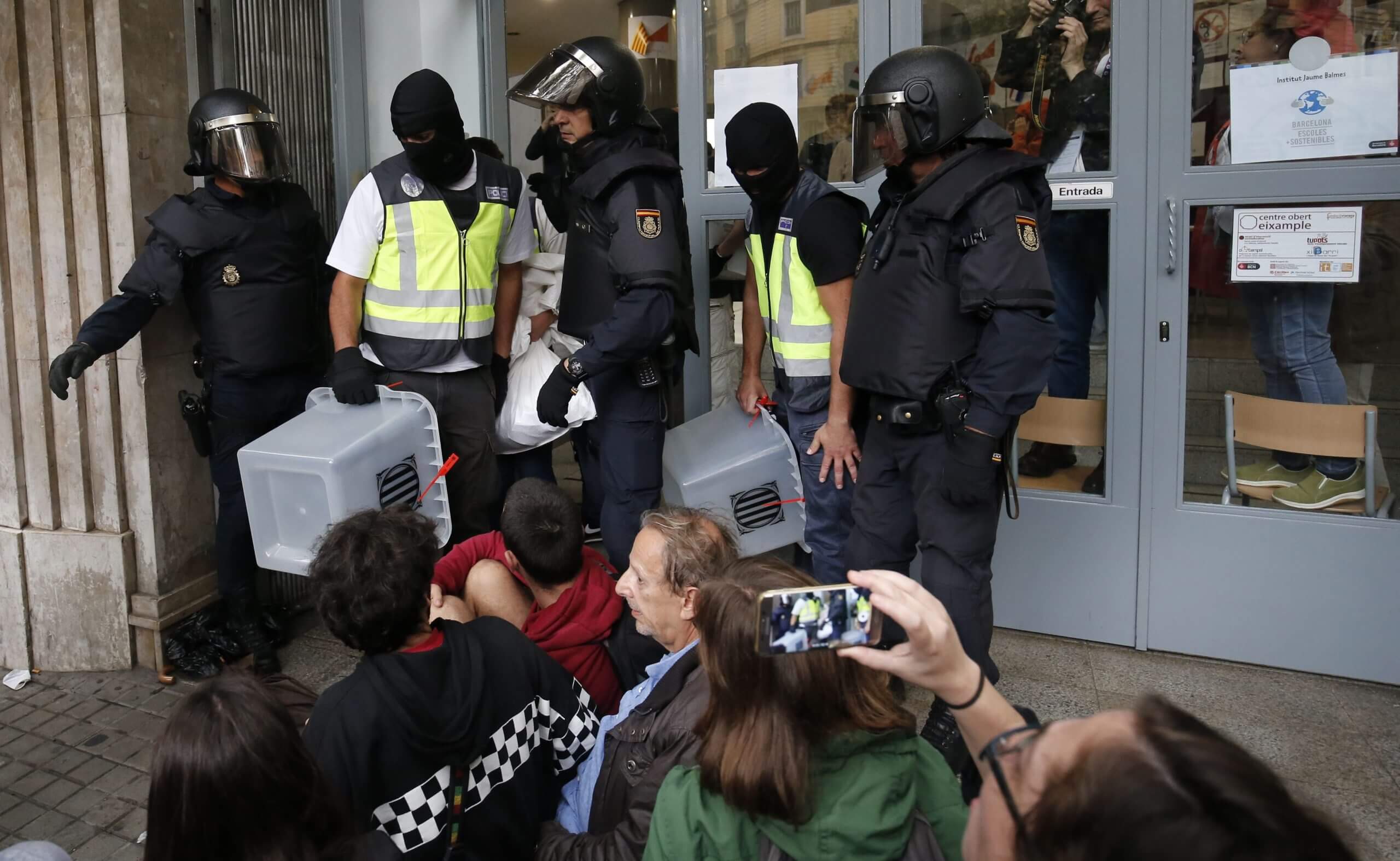
Police officers seizing ballot boxes at a polling station in Barcelona on October 1, 2017 (Pau Barrena/AFP via Getty Images)
Popular support for that cause has waned in the years since — as reflected in the results of recent regional and municipal elections in Barcelona and Catalonia. In 2024, parties that had campaigned for the independence movement lost a decade-long majority in the regional parliament.
But when it comes to football, the politics of whether you are pro-independence or not doesn’t have to be the defining factor behind why you might not support Spain. Not all people who would identify as Catalan rather than Spanish would necessarily support breaking away.
Vidal, from the podcast La Sotana, is an outspoken supporter of Catalan independence. So how does he see it?
“The very existence of the Spanish national team means that a Catalan one cannot exist,” he says. “Therefore, we don’t have a team at the World Cup. This means that this global and general exploitation of Catalonia by the Spanish state is also expressed in the sporting arena, an area where we are a world power, which causes frustration.”
In Vidal’s view, Barcelona’s importance to Spain’s golden age from 2008-2012 (when they won the World Cup and two European Championships), and their recent success at Euro 2024, is less a reason to get on board, more a reason to rail against injustice.
“I didn’t celebrate the World Cup in 2010 when Spain won,” he says. “Because we have existed for many years, but we have a very fragile balance with our constant struggle to exist, to make people aware that we exist, and in this obsession with being seen, any triumph of the Spanish national team works against us as Catalan nationalists.”

Then-Manchester City manager Pep Guardiola spoke in support of the referendum in 2017 (Lluis Gene/AFP via Getty Images)
Catalonia actually does have its own national team. Sort of.
A Catalonia ‘national’ side is run by the regional football aspsociation, and has played unofficial matches for years. The team enjoyed something of a own golden age itself — at least in terms of regularity and prominence — in the 2000s, when they would often play two matches a year, drawing decent crowds, and sometimes playing at Barcelona’s Camp Nou.
They twice faced Brazil (in 2002 and 2004) and Argentina (in 2004 and 2009) — while Barca and Netherlands legend Johan Cruyff served as ‘manager’ between 2009 and 2012.
Recently, these matches have been reduced to one a year — or none at all — against teams that are less appealing to the public, or have become vehicles for political protest, such as November’s match against Palestine.

Catalonia’s most recent game was against Palestine in November, at the Estadi Olimpic Lluis Companys (David Ramos/Getty Images)
For many fans, Barcelona fill the gap. To some, they are seen almost like a cross between a club and a national team — which helps explain the unique pressures of that environment.
This is where Barca’s famous mes que un club (more than a club) motto comes in, coined by former club president Narcis de Carreras during his 1968 inauguration speech.
“Joan Gamper wanted to turn Barca into the sporting ambassador of Catalan identity,” says Frederic Porta, a postdoctoral researcher at the University of Barcelona — referring to Swiss-born Hans Kamper, the man who founded the club in 1899 and would later change his name to sound more Catalan.
“During the Civil War, with the loss of freedoms that it entailed and under Franco’s dictatorship, people found in Barca a refuge where they could hold on to their Catalan identity,” Porta adds.
“The writer Manuel Vazquez Montalban (who died in 2003) said that Barca was the unarmed army of Catalonia.”
There is only one known case of a pro-Catalan-independence footballer refusing to play for Spain: Oleguer Presas.
Known more commonly just by his first name, Oleguer was a centre-back who shone under Frank Rijkaard at Barca, winning two consecutive La Liga titles between 2004 and 2006, as well as the Champions League in 2006.
That same year, he received a call-up from then-Spain coach Luis Aragones.
“I didn’t feel I had the commitment to join a national team that doesn’t represent me in any way,” Oleguer told Panenka magazine in 2018. “On the contrary, it made me feel repelled and averse to what it stands for.”
Oleguer also told La Sotana that he was “forced to go” and join the national camp, but then explained in a conversation with Aragones that he “didn’t want to be there”. He did not play for Spain — but did appear six times for Catalonia before retiring in 2011, then an Ajax player.

The Spanish flag is displayed before kick-off in Spain’s final group game against Uruguay (Alfredo Estrella/AFP via Getty Images)
For Porta, Catalonia not having its own official national team comes down to a “decision by Spain”.
“While Great Britain tolerates and allows, without any problem, the existence of England, Northern Ireland, Wales and Scotland, Spain is very inflexible democratically and does not tolerate this,” he adds.
“Spain thinks that allowing the nations of Spain to have their own teams would be the beginning of the end of Spain. But it is a completely mistaken idea.”
Not everyone would necessarily agree on that point. Indeed, after Spain’s opening World Cup 0-0 draw with Cape Verde, Mariano Rajoy, who was Spain’s prime minister at the height of those 2017 clashes over the Catalan independence movement, wrote a newspaper column in El Debate calling on fans to “support the national team” as “it is one of the few things we have today that unites Spaniards”.
That was in contrast to the reaction among many Barcelona fans on social media following that result.
“Beating Cape Verde isn’t within everyone’s reach,” one user wrote on X.
Their post was accompanied by a screenshot of the score from a 2013 friendly match between Catalonia and Cape Verde — which the Catalans won 4-1.