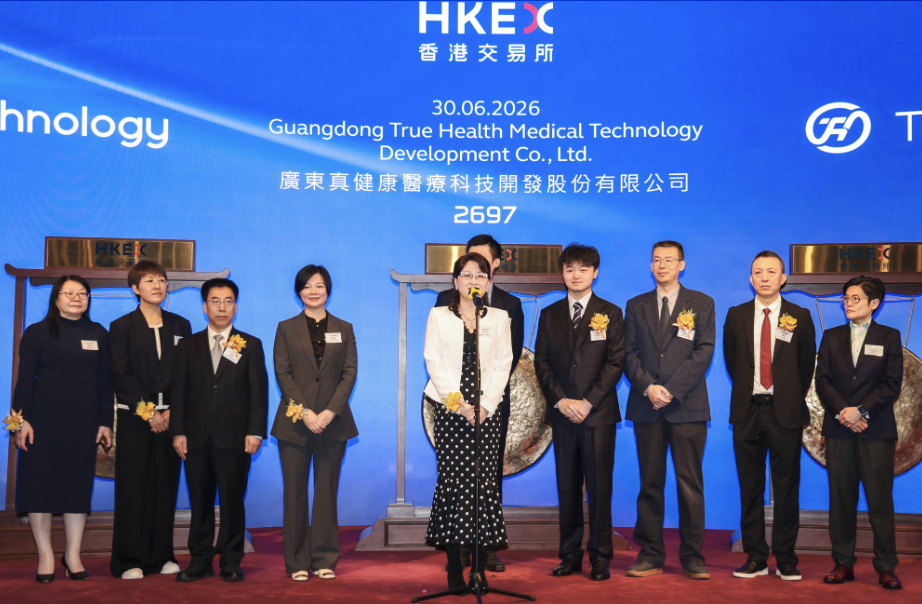
Guangdong True Health became the first Macau-linked biopharma company to list publicly, debuting on the Hong Kong Stock Exchange
The surgical robotics firm raised HK$384 million (USD49.23 million), marking the first public exit for a company cultivated by the Macau-Hengqin integrated development zone
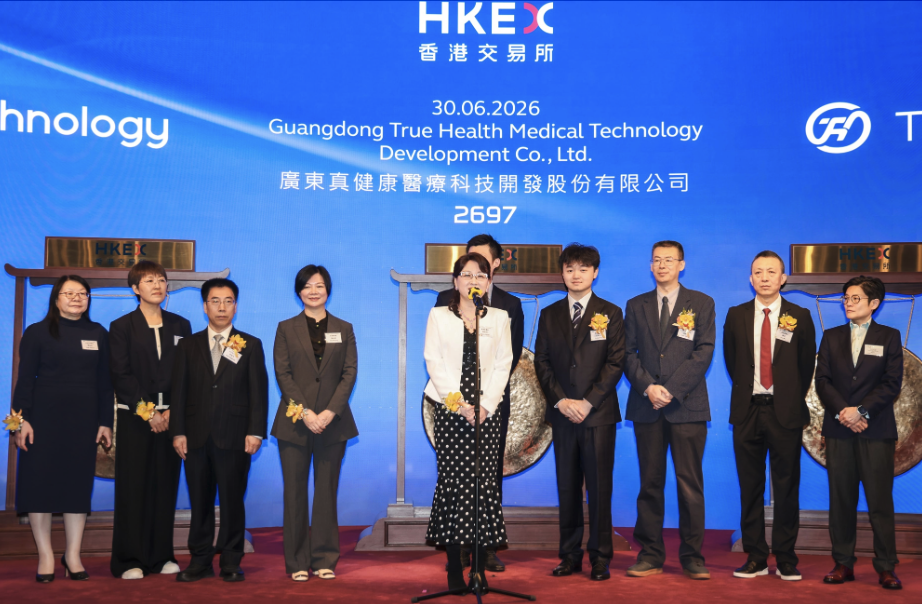
Guangdong True Health Medical Technology Development Co., Ltd. began trading on Hong Kong’s main board on Tuesday, becoming the first Macau biopharmaceutical company to list on a major stock exchange.
The debut is also a milestone for the Guangdong-Macau In-Depth Cooperation Zone in Hengqin, where the company is headquartered and which is jointly steered by authorities from both sides, as True Health is the first company cultivated by the zone to reach the public market.
True Health’s initial public offering (IPO) comprised about 3.56 million shares priced at HK126.20(MOP129.90/USD16.10)each,raisingnetproceedsofroughlyHK384 million (USD49.23 million).
Founded in 2018 by Macau businesswoman Cheong Hou Iam, a former employee of the Macau Health Bureau, the company develops and commercialises surgical robots used in percutaneous puncture and ablation procedures in China, according to its listing prospectus. Ablation involves destroying or removing tissue often using heat or cold, while percutaneous puncture refers to minimally invasive access through the skin using a needle.
True Health moved its headquarters to Hengqin in 2023 and later received a RMB100 million (MOP118.80 million/USD14.72 million) equity investment from the zone’s industrial investment fund.
Example of “Macau+Hengqin” development
At a listing ceremony on Tuesday, Cheong Chok Man, director of Macau’s Policy Research and Regional Development Bureau, said the company benefited from Hengqin’s policy support and coordination among government departments, as well as access to the mainland’s large market, Macau Daily News reported.
He called True Health a practical example of the “Macau + Hengqin” integrated development model, under which Macau companies and entrepreneurs can tap support and opportunities in the cooperation zone. He said he expects the listing to encourage more young people from Macau to start businesses and build careers in Hengqin, the newspaper reported.
The cooperation zone’s authorities said that, following True Health’s listing, more than 40 Hengqin-headquartered companies have been identified as potential IPO candidates. Two have already submitted IPO filings to Hong Kong, while more than a dozen others have set out clear plans to list.
Financially, the prospectus shows True Health is still in an early commercial phase. Since first recording sales of its surgical robots in 2023, True Health reported revenue of RMB1.79 million (USD263,000) in 2024 and RMB12.18 million (USD1.79 million) in 2025. It posted losses of RMB92.2 million (USD13.57 million) and RMB90.1 million (USD13.26 million) in 2024 and 2025, respectively, which it attributed mainly to research and development spending, as well as selling, distribution and administrative costs tied to product development and initial commercialisation.
The company said it expects to remain loss-making in the near term, while forecasting that revenue will expand as commercialisation of its core product progresses, laying the groundwork for “a steady approach towards profitability.”
Leverage Macau’s platform role
True Health’s strategy leans on broader momentum in surgical robotics, as hospitals increase uptake amid the growing prevalence of minimally invasive procedures and ongoing technological advances. Citing figures from authorities and consultancies, the prospectus estimates mainland China’s surgical robot market grew from RMB2.3 billion (USD338.7 million) in 2020 to RMB9.4 billion (USD1.38 billion) in 2025 and is projected to reach RMB52.4 billion (USD7.72 billion) by 2031.
International expansion is also on the agenda. True Health said in its prospectus that it submitted an application for CE marking in January 2026, which indicates conformity with European health, safety and environmental requirements. The approval would support entry into Europe and other markets that recognise the European Union (EU) standards, including parts of Southeast Asia, the Middle East and Australia, it noted.
The company also said it plans to use Macau’s role as a bridge between China and Portuguese-speaking countries to support regulatory alignment and market access in overseas markets. “We plan to establish Macau as our centre for technology showcases and clinical training, paving the way for entry into Lusophone markets, including Brazil,” it added.