Charlie Munger once said there are 3 ways for a smart person to go broke: liquor, ladies and leverage.
It would seem many investors are taking the leverage theory for a test run.
The South Korean stock market is on fire, up nearly 200% in the past 12 months alone.
Investors there have taken notice and levered up:
According to the Korea Financial Investment Association on Wednesday, the outstanding balance of margin loans stood at 36.3967 trillion won as of the previous day. The figure represents a jump of 8.976 trillion won, or about 33%, from 27.4207 trillion won at the start of the year. The balance of loans secured by deposited securities, which investors who have already maxed out their credit limits take out using stocks and bonds as collateral, also swelled by nearly 2 trillion won this year to 25.9297 trillion won. Investors are pursuing additional purchases through dollar-cost averaging despite the burden of collateral requirements.
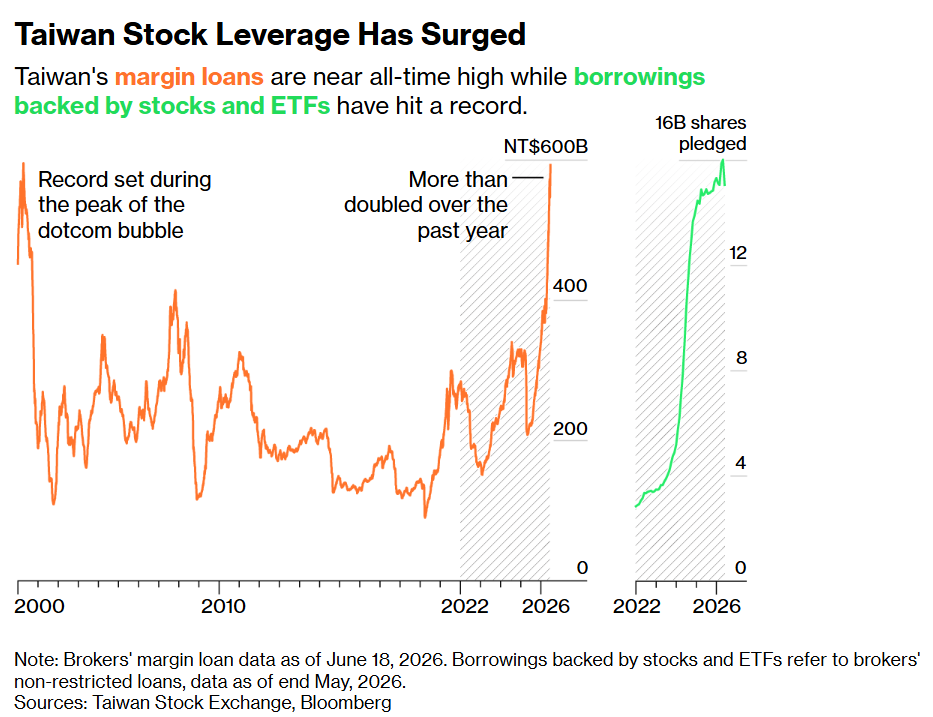
Taiwan’s market has also caught AI fever. The market has doubled in the past year.
Investors are borrowing money like drunken sailors there too:
Andy Cheng is 26, unemployed and, with the help of a little borrowed money, the proud owner of $60,000 worth of Taiwanese tech stocks. And in many ways, he speaks for the entire island of 23 million people when he doles out the following advice: “Buy any stock and you will make money.”
Up, up and away:
Americans never like to be left out of a boom so stock market borrowing is happening here too. This is from The Wall Street Journal:
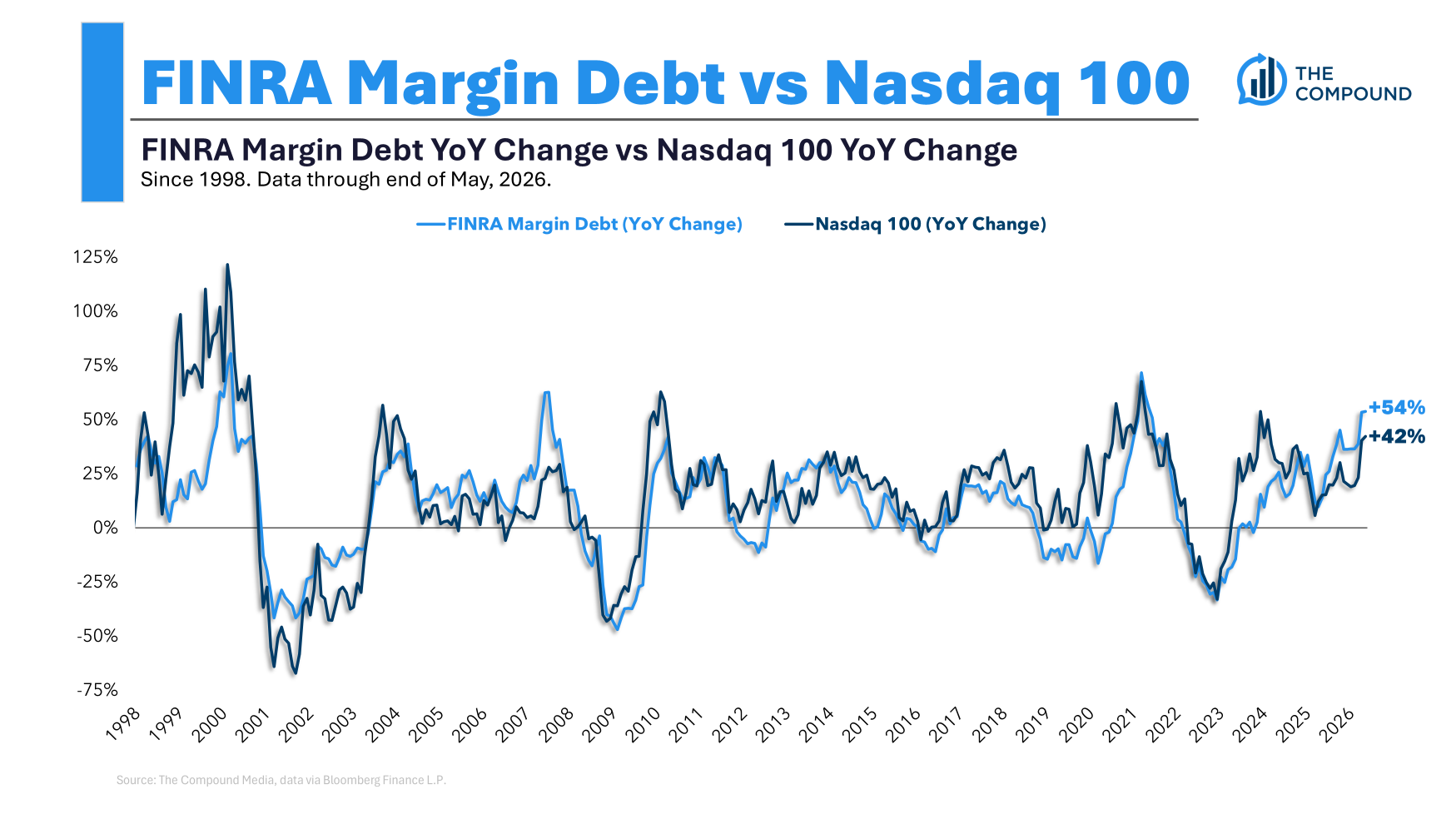
U.S. margin debt, or what investors borrow from their brokerages to buy securities, rose 54% to a record $1.4 trillion in May from a year earlier, according to Finra data. Meanwhile, high-risk leveraged exchange-traded funds that produce double or triple the daily move of underlying stocks are growing rapidly, as is trading in options tied to them.
This number doesn’t include things like leveraged ETFs, box spread loans or the embedded leverage in instruments like futures and options.
So it’s probably much higher than this.1
My take on leverage in the stock market is that I’m more concerned about it on a micro rather than macro level. I don’t think leverage is going to bring down the entire stock market but it could certainly blow up some of the biggest momentum names and traders.
Margin debt being at all-time highs makes sense because the stock market is at all-time highs. It’s a concurrent indicator:
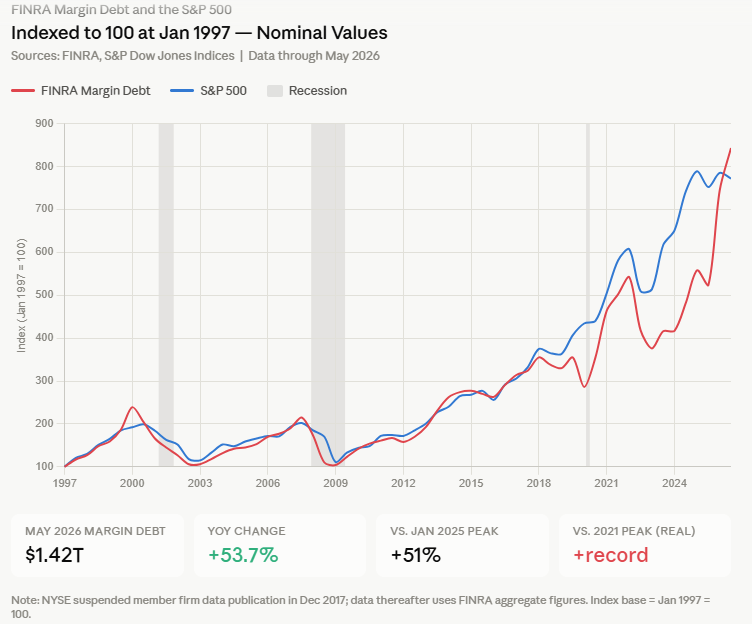
Growth in margin debt follows growth in the stock market:
Now look at margin debt as a percentage of the S&P 500 market cap:
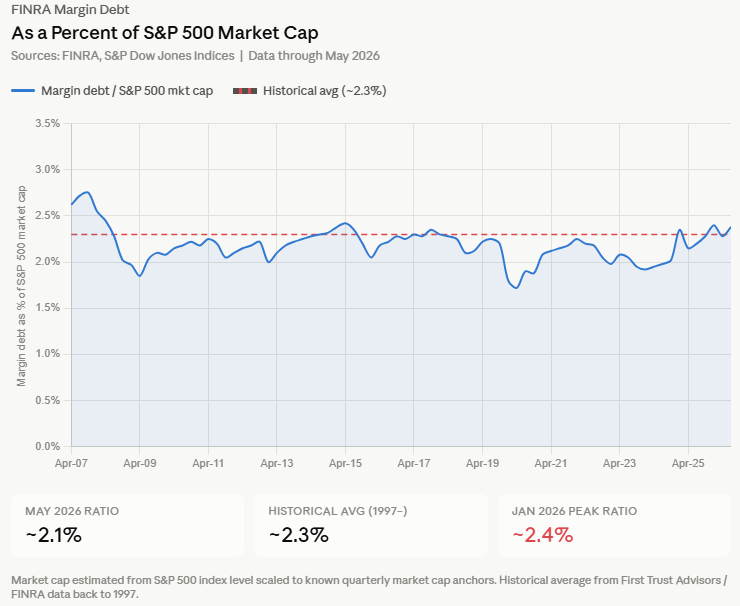
Margin debt is not going to help you call a top in the stock market. When the market falls, margin debt will too. If the market keeps moving higher, margin debt will keep hitting new highs too.
I do, however, think leverage in the high flying names — SK Hynix, Samsung, Taiwan Semi, Micron, SanDisk, etc. — will lead to some air pockets in these names.
These stocks are up anywhere from 150% to 700% this year alone. Anytime you have gains that big compressed into such a short period of time, there are bound to be big down days interspersed with the huge up days.
Sprinkle in some leverage and there are sure to be some huge losses even if these stocks keep moving higher.
This is essentially what happened in the 1987 crash. The stock market was up 40% or so on the year heading into the fall before Black Monday hit.
Of course, I’m not saying that’s going to happen to the overall market.
It’s certainly possible these stocks could cause some damage if they sell off. We’ll see.
All-time high margin debt levels do sound scary in the midst of a technology boom. But all that tells you is that the market is at all-time highs too.
Debt can ruin individual investors who overextend themselves.
It would need to be much higher to take down the market.
Further Reading:
Two Things I’m Not Worried About
1Although it’s worth noting that not all borrowing against stock portfolios goes back into the stock market. Sometimes it’s used for other things.