SANTA CLARA, Calif. — In advance of the 2026 World Cup, where dramatic penalty shootouts have already eliminated multiple contenders, the U.S. men’s national soccer team has used brainwave technology to help players practice penalty kicks.
The shootouts are intense, packed with pressure and jeopardy. They end in either heartbreak or ecstasy. They can break even the most experienced stars and send teams like Germany and the Netherlands packing.
So, beginning in January of 2025 and at every training camp since, the U.S. team’s staff worked with a German company, Neuro11, and equipped players with high-tech devices, then monitored their brain activity as they took penalties against a goalkeeper.
The technology was part of a broader effort by a working group of coaches and analysts to find minor advantages that could yield major benefits at the World Cup, both in shootouts and on set pieces, including free kicks and corner kicks.
The brainwave readings allowed staff to measure a player’s focus or concentration, and assess their optimal approach to a penalty, five players and head coach Mauricio Pochettino told The Athletic.
“Everybody talks about being ‘in the zone,’ and having things slow down,” U.S. captain and defender Tim Ream said. The U.S. staff explained to players that they “can actually track these brainwaves and help you get into that zone, to be ready to take the penalties,” Ream added.
Multiple players admitted that the technology “feels weird” or is “funny-looking.” The players would sit in chairs on the side of a training pitch while staffers outfitted them with a pack around their abdomen and patches on their head.
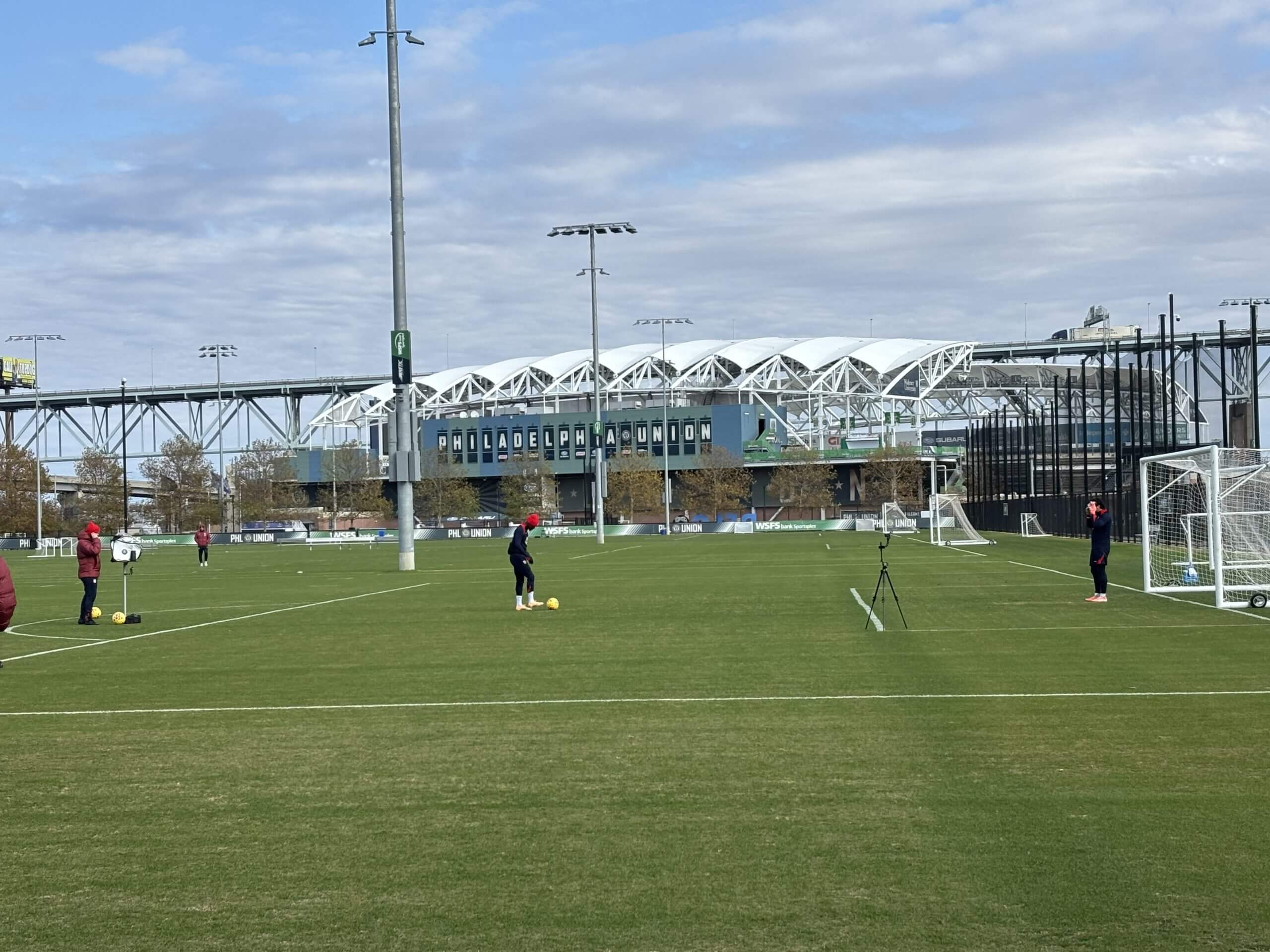
Folarin Balogun tests out the USMNT’s penalty kick brainwave technology during training in Chester, Pa., in November 2025 (Henry Bushnell / The Athletic)
“It just feels like they’re putting stuff where stuff shouldn’t be put,” midfielder Tanner Tessmann said in May.
“You’ve got to stick things to your head and put this helmet on, and wires, and wear this kind of fanny pack thing,” midfielder Diego Luna said. “It was crazy.”
But Luna — who, like Tessmann, was left off the World Cup roster after being with the USMNT for much of 2025 — said it “definitely” helped. “I’ve done it three times,” he noted back in May, “and each time I’ve finished more PKs.”
So, how does it work?
Players, equipped with the high-tech gear, step up to the penalty spot during or after training. Some sort of machine, monitored by a staffer, stands behind them. They hear a beeping sound, and sometimes there’s “a speaker with the sound (of a crowd), to kind of recreate the sensation that you have in the stadium,” wingback Sergiño Dest said.
Ream also mentioned that staffers “use different things and try to throw you off.”
Pochettino acknowledged Tuesday that “it’s impossible to replicate the emotional stress, and pressure, expectations” of an actual World Cup penalty shootout — which the U.S. men could experience for the first time on Wednesday in the round of 32 against Bosnia and Herzegovina. But the idea was to mimic it, then test the players.
“You’ve got to be locked in at that moment to finish,” Luna said. “When things are going crazy, and when there’s people, when there’s noise, when there’s chants, when there’s a goalie, it’s about staying focused in a moment like that and finding that kind of safe space, safe place for you when you’re in such a nerve-wracking moment.”
Why everyone will (finally) be watching the U.S. knockout game
Henry Bushnell
How can the focus be quantified?
Some of the scientific specifics aren’t clear. U.S. coaches, via a team spokesman, declined requests from The Athletic to elaborate on the technology during and prior to the World Cup.
Pochettino said Tuesday only that he and his staff have worked with a “few companies” and “people that are with us” to help the team prepare for penalties.
A study by researchers at the University of Twente in the Netherlands, however, can perhaps give clues to how the tech works. The researchers used what appears to be a similar technique to “explore the brain activity related to missing penalty kicks,” as they wrote in their 2021 paper. They equipped participants with headgear and “used functional near-infrared spectroscopy (fNIRS) to investigate the influence of the brain on this process.”
In the study, they found that “the task-relevant brain region, the motor cortex” — which controls muscle movements — “was more activated when players were not experiencing performance anxiety.” But when they were anxious or distracted, the prefrontal cortex — which helps humans plan ahead or think into the future — was more active. The researchers hypothesized that this activity “can be caused by players’ worries about the consequences of scoring or missing the penalty kicks.” And it was associated with more misses.
The U.S. national team’s staff could presumably get similar readings, relay them to players, and help them develop techniques to improve concentration.
“They basically tell you, based on your brainwaves, how focused you are in a specific moment of taking the penalty — or depending on what side you go to, where your brain feels better,” wingback Max Arfsten said.
That latter point is the other piece of the utility.
“They’ve studied where the easiest saves are, (where) the most goals go in,” Tessmann said of the coaching staff. They therefore coach players to hit the ideal portion of the goal, but they know that not every player will be comfortable hitting it again and again, and again.
If they aren’t confident, according to Tessmann, the coaches might say: “OK, well can you hit (this other spot)? Because this is the next best place.”
If they can’t hit any of the optimal spots, then they likely won’t be chosen to take a penalty in a shootout. Pochettino said Tuesday that selecting the five takers would be “our decision.”

U.S. defender Alex Freeman takes and converts a penalty kick against Costa Rica in the 2025 Concacaf Gold Cup quarterfinals (Carlos Gonzalez / ISI Photos / USSF / Getty Images)
The brainwaves, in theory, can help quantify confidence and concentration, and help a player figure out “where your best shot is,” as Arfsten said.
Players used the devices throughout 2025 and 2026, often after grueling training sessions. They felt it was worth the extra effort and time because, as Dest said, “it can be necessary. You never know, especially now that we continue in the (World Cup knockout) round.”
The Americans’ opponent on Wednesday, Bosnia, qualified for the World Cup by winning consecutive penalty shootouts against Wales and Italy. Its goalkeeper, Nikola Vasilj, has saved 16 of the 43 penalties he’s faced in his career. The 37.2 percent save rate makes him one of the top penalty stoppers at the tournament. So, extra preparation could prove invaluable.
The U.S. has won its only penalty shootout under Pochettino, in last summer’s Concacaf Gold Cup quarterfinals against Costa Rica.
The technology was occasionally visible at training sessions last year, and Pochettino told The Athletic in October it was “nice technology, it’s very good to help.” But it has not been visible during the team’s World Cup camp, and Pochettino said Tuesday, when asked about penalties in general, “I don’t want to talk too much,” presumably to preserve any competitive advantages.
Ream, when asked Monday about the team’s prep for a penalty shootout, said: “We’ve been doing a lot of work on penalties. I won’t go into (details). That’s something that we’ve been working on throughout the weeks together, even before the tournament started. That’s taken care of, really.”