It was the soundtrack to Argentina’s 2022 World Cup win — and you’ve probably heard it at this tournament, too.
‘Muchachos’ is the song about heartbreak, the late Diego Maradona, Lionel Messi and the country’s successful quest for a third World Cup star. It references the Falklands War, Maradona’s parents and the multiple finals La Albiceleste lost before lifting football’s most prestigious honour again in Qatar, 36 years on from their previous victory in Mexico.
Its infectious rhythm has been sung in the stands and in the dressing room. Messi picked it as his favourite chant from Argentina’s triumphant campaign four years ago. It is, as supporter Cristian Raña tells The Athletic, “the war cry of the Argentine fanbase”.
The original is a song by the Argentine band La Mosca Tse-Tse, which has nothing to do with football, called ‘Muchachos, Esta Noche Me Emborracho’ (‘Lads, Tonight I’m Getting Drunk’). It was adapted by schoolteacher Fernando Romero after Maradona’s death at 60 in November 2020 and Argentina’s Copa America final win against Brazil in Rio de Janeiro eight months later — Messi’s first major international trophy after years of near-misses.
“I felt anguish at first at losing an idol and someone who is very loved in this country,” Romero, 34, tells The Athletic of Maradona’s passing. “That Copa America didn’t erase my sadness at his absence, but in sporting terms, it gave us back our smile. It made us feel there was also some justice for Leo.
“I said to myself it was a good moment to remember that we all belong to this land and to those two — not one or the other, we belong to both of them.”
Romero says he came up with the lyrics in 10 minutes. The music came naturally enough — the 2003 original Muchachos was well-known in Argentina, had been adapted for the terraces at Buenos Aires side Racing Club and was easy to sing.
“Fans choosing a melody to support their team is so magical that you can’t do it in a premeditated way,” says Guillermo Novellis, the lead singer of La Mosca Tse-Tse, who played at Maradona’s 40th birthday party and Messi’s 20th. “It’s very mysterious. If only we could know what that mystery is to create a hit every day.”
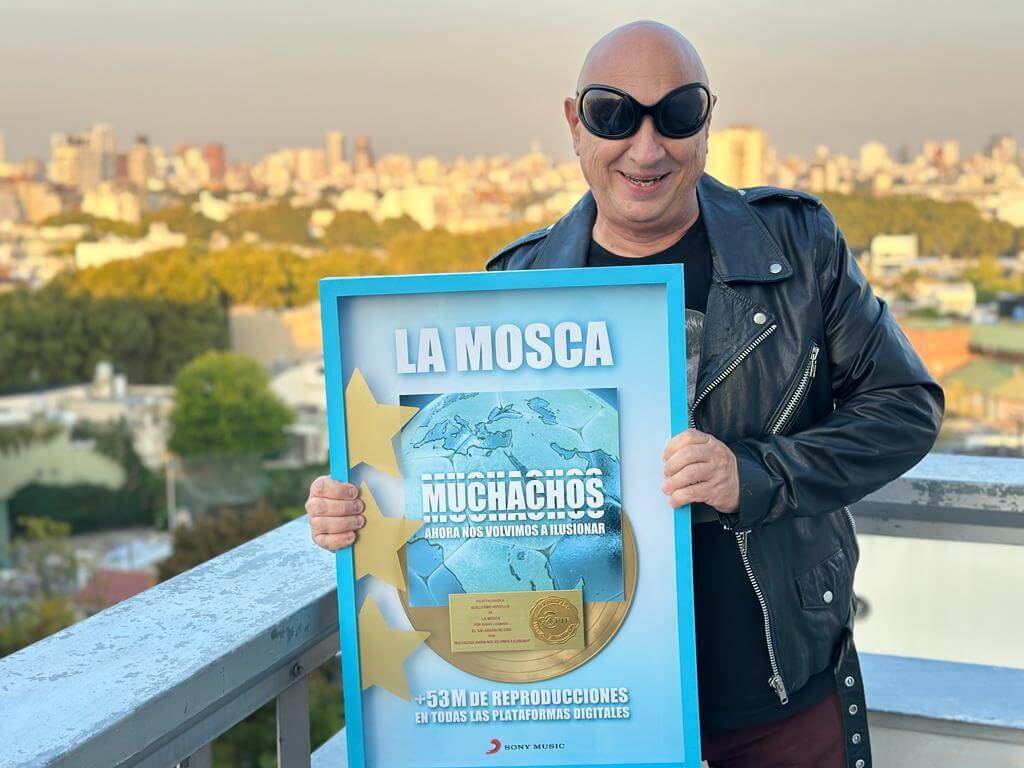
Guillermo Novellis is presented with an award from Sony for more than 53 million plays of Muchachos on all digital platforms (La Mosca)
Romero and Novellis are still unable to explain that mystery. After a World Cup qualifier in Brazil in 2021 in which health officials stormed the pitch to try to escort Argentina players away under Covid quarantine rules, journalist Matias Pelliccioni called on his followers to come up with a song about the incident. Romero couldn’t help with that, but he offered the lyrics to his version of Muchachos free of charge in the replies.
The reporter must have known he was onto something: he invited Romero and his friends to sing the chant live on air before Argentina’s following game against Bolivia in Buenos Aires. The clip went viral, and the players sang it after their Finalissima win against European champions Italy at Wembley in June 2022.
La Mosca Tse-Tse invited Romero to collaborate on a new release of the song before the World Cup — “He doesn’t sing very well; he played the drum,” says Novellis — and it became the team’s anthem as they made their way to glory in Qatar.
When Messi was hoisted onto his close friend Sergio Aguero’s shoulders on the pitch following the final against France, he held the trophy in one hand and waved the other while singing Muchachos with the fans.
“On the day football does him justice and gives him that World Cup, the player who has been the best in the world throughout his career sings a song which came from my heart,” says Romero. “That’s totally unthinkable and unfathomable. It’s inexplicable.”
It wasn’t all plain sailing. After Argentina lost their opening World Cup game to Saudi Arabia, Romero had to walk the gauntlet with his pupils at school. “They told me ‘Your song brought them bad luck’,” he says. Novellis and his band, meanwhile, watched the quarter-final against the Netherlands from a hotel room before playing a gig that night.
“We were winning 2-0, they bring it back to 2-2 and we go to penalties. We were saying: ‘If we lose, what do we do? Do we go out to play? Will people stay to watch the show? Or will they go home bitter and sad?’,” he says. “There were a lot of moments like that.
“My digestive system suffered a lot.”
The melody is catchy, but the lyrics make Muchachos. “They have a lot of tango about them,” says Novellis, referring to the distinctive Argentine music and dance genre which centres on love, loss and longing.
It opens with the line “En Argentina nací, tierra del Diego y Lionel” — “I was born in Argentina, the land of El Diego and Lionel”. For so long, Messi lived in Maradona’s shadow for the national team, despite his record-breaking exploits in Europe with Barcelona.
What differences did Novellis notice between them when he played at their respective parties?
“Diego got up on stage with us to play the drum — he was the master of the party,” says the 66-year-old. “With Leo, I invited him to come up and he didn’t want to. His mother had to push him to do it. He got up for a minute, then he ran away. That speaks to his shyness and extremely low profile.
“There’s a great difference in their personalities; each of them is how they are.”
That first verse references “the boys from Malvinas who I’ll never forget”. Las Malvinas is the Argentine term for the Falkland Islands, where hundreds of their soldiers — mostly young and poorly-equipped — died in 1982 after being sent by the country’s military junta to try and reclaim that territory from the United Kingdom. Many more veterans survived but have felt the effects of a lack of support in the years since.
Argentina’s government still claims “las Malvinas son argentinas” and fans at football stadiums sing “whoever doesn’t jump is an Englishman”. Maradona famously dedicated his Hand of God goal against England in the 1986 World Cup to the Argentinians who died in the conflict. There is emotion in Romero’s voice as he describes meeting a woman whose husband had served in Malvinas, struggled with depression and got out of bed “because the people were singing a song of love towards them”.
The song then bemoans “how many years we cried over the finals that we lost” — at the 2007 Copa America, the 2014 World Cup and the 2015 and 2016 Copas America for Messi, the latter leading him to briefly quit international football. “But that’s finished now,” the lyrics continue, as the rhythm builds to its most hopeful point, “because at the Maracana, in the final against the Brazilians, ‘dad’ won again”.
And then, the defining chorus:
Muchachos, ahora nos volvimos a ilusionar
Quiero ganar la tercera, quiero ser campeón mundial
Y al Diego en el cielo lo podemos ver
Con Don Diego y con la Tota, alentándolo a Lionel
Lads, now our hopes have been raised again
I want to win the third one, I want to be a world champion
And in the sky we can see Diego
With Don Diego and La Tota, supporting Lionel
The 2022 World Cup was Argentina’s first since the death of Maradona, hence his watching on from the skies. Don Diego and La Tota were his father and mother — who became celebrities in their own right in Argentina thanks to their son’s fame and success.

Fernando Romero singing to 80,000 people at Estadio Monumental (Fabian De Ciria)
“They appear because in one of the final interviews Diego gave, the journalist asked if he was happy and he said yes, but that he missed his parents and he started crying,” says Romero. “So the only thing that consoled me on the day he died was thinking he was back in his mother’s and father’s arms.”
For fans, even the word ‘muchachos’ — what you might say when inviting your friends for a drink — symbolises a unity and sense of closeness to the national team they hadn’t felt for many years before their multiple trophy wins over the past five years.
Romero has never properly met Messi and Co. The closest he came was attending an event with South America’s governing football body, CONMEBOL, where he presented four of the players with an award.
“But I’m going to be the creator of that song for all my life, and they’re going to be world champions from that year for all their lives,” he says. “So at some point God will bring us together.”
Other renditions of Muchachos have been sung since 2022 — including by the players, who changed the lyrics on the flight home from Qatar to sing “now we’ve won the third one, now we’re world champions”. But Novellis and Romero didn’t release a version for this tournament as they consider it so closely tied to the events leading up to last time.
Could Romero see himself writing another song if Argentina make it back-to-back World Cup wins with a 39-year-old Messi this summer?
“In all this process, nothing was forced,” the schoolteacher says. “Everything was from a real feeling, finding a necessity — and I wrote about that. If there’s something I want to express, I express it and if it comes out well, it comes out well.
“And if it stays on my phone forever, it doesn’t matter.”