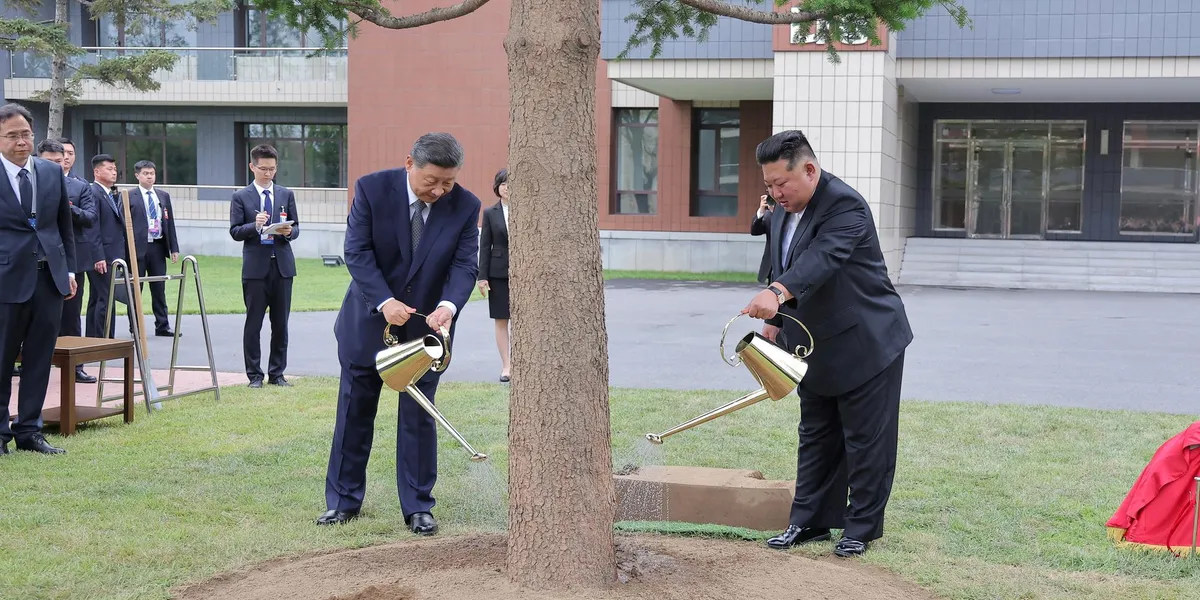
Chinese President Xi Jinping’s summit with North Korean leader Kim Jong Un in Pyongyang earlier this month celebrated their decades-long alliance, with both sides vowing to elevate their ties to “new heights.” However, the summit reflected a marriage of convenience with clear limitations.
The Xi-Kim summit was a meaningful indication that China-North Korea bilateral ties have returned to pre-COVID-19 levels. At the working level, China and North Korea have gradually expanded practical cooperation in areas such as trade, tourism, construction, and civilian exchanges, but leader-level meetings were put on pause. Xi’s trip to Pyongyang, alongside
Kim’s trip to Beijing last September, fully restores the structure of bilateral diplomacy between Beijing and Pyongyang.
Against the backdrop of reinvigorated China-North Korea ties, both sides aim to rebalance their respective positions with regard to Russia.
In recent years, North Korea has tilted toward Russia and drifted away from China. Pyongyang formed a military alliance with Moscow and aided its war against Ukraine as an arms supplier and a co-belligerent on the battlefield. In the process, Pyongyang reduced its strategic dependence on Beijing and also gained greater Russian support for its nuclear and missile programs. Moscow now openly helps Pyongyang evade international sanctions and defends North Korea’s nuclear buildup. Russia might also be sharing advanced military technologies with the regime.
These developments have greatly emboldened North Korea, and China cannot be comfortable with the situation. Beijing has long prioritized stability and predictability on China’s periphery. In that sense, North Korea’s aggressive nuclear buildup and military posture, backed by Russia, have been worrisome. Improved bilateral ties and strategic communications with Pyongyang would put Beijing in a better position to manage the risk.
Pyongyang also has an interest in strengthening its ties with Beijing as part of a broader effort to dual-hedge vis-à-vis Russia and China. Pyongyang wants to avoid overdependence on either Moscow or Beijing, while leveraging both sides to extract strategic benefits. Ultimately, China offers North Korea incentives that Russia cannot. The financial gains North Korea has enjoyed from its wartime transactions with Russia are unlikely to last after hostilities in Ukraine end at some point, and broader North Korea-Russia economic cooperation is limited by international sanctions on both countries. For boosting North Korea’s economy, Chinese support is essential.
Despite the overall positive spirit, the Xi-Kim summit still raised more questions than it answered regarding the future of strategic relations between China and North Korea.
The summit readouts on regional security lacked clarity and substance compared to the language on economic cooperation and civilian engagement. Beijing and Pyongyang broadly agreed to “strengthen strategic coordination, firmly safeguard their respective sovereignty, security, and development interests, and jointly uphold regional peace and development,” but there was no mention of specific regional issues. Another potentially noteworthy point was that, while the North Korean readout stated that both sides “reached a satisfactory consensus of views” on regional issues, that phrase was excluded from the Chinese readout.
The overall weak language and substance on regional security make sense. Beijing and Pyongyang have divergent geopolitical and security interests. Some analysts might suspect that the two countries are consolidating their alliance for military confrontation with the United States and its regional allies. Pyongyang may want to move in that direction, but Beijing has good reasons to be reluctant.
China and North Korea have quite different grand strategic outlooks. North Korea has openly characterized the regional security landscape in Northeast Asia as a “new Cold War,” stressing the need to prepare for bloc confrontation. In contrast, China has consistently rejected such a notion. The optics of the September 2025 Tiananmen military parade — where Xi stood next to Putin and Kim — left an impression of an emerging “authoritarian axis.” In reality, such an arrangement can conflict with China’s interests, and Beijing has therefore maintained some distance from Moscow and Pyongyang.
China’s growth remains dependent on global and regional integration, and forming a rigid security bloc with North Korea and Russia to wage a “new Cold War” will have the opposite effect, encouraging more regional actors to decouple from Beijing and align with Washington. Continued integration and interdependence with the West are also valuable deterrent tools for China. For instance, Washington and countries in Asia and Europe have had to worry about how Beijing could weaponize its rare-earth dominance and other supply-chain advantages if they escalate against China in security and economic disputes.
Moreover, a China-Russia-North Korea security bloc could further undermine China’s regional deterrence posture. Over the years, North Korea’s escalatory behavior has created pretexts for U.S. military buildup in Northeast Asia, as seen in the U.S. deployment of the THAAD system in South Korea and the institutionalization of U.S.-Japan-South Korea military cooperation. North Korea’s participation in the Ukraine war has also invited more European military engagement in Northeast Asia. European naval vessels now routinely travel to Northeast Asian waters in support of missions to monitor and contain North Korea’s illicit economic activities at sea. Given this track record, the consequences will predictably be counterproductive if China expands its cooperation with North Korea to the military realm.
Overall, North Korea is strategically valuable enough for China to maintain its alliance, as a buffer between China’s border and Washington’s forward presence in Northeast Asia and as a regional distraction that diverts U.S. strategic resources and attention. However, it is also a strategic burden that requires avoiding overcommitment and overalignment. The Xi-Kim summit’s relative lack of substance on regional security can be understood in this context.
One development at the Xi-Kim summit that raised concerns in Washington, Seoul, and Tokyo was Beijing’s silence on the North Korean nuclear issue. Some observers view Beijing’s silence as an unspoken acceptance of Pyongyang’s nuclear status. While the suspicion is valid, China’s stance may remain that of passive opposition rather than acceptance.
In recent years, as Pyongyang has shifted toward a non-negotiable position on its nuclear arsenal, Beijing has also reduced rhetorical support for North Korean denuclearization, while upholding it as a security interest in principle. This passivity was observed at Xi’s summit with President Donald Trump last month, where both sides “confirmed their shared goal to denuclearize North Korea,” according to the U.S. readout. The phrase was omitted from the Chinese readout, but Beijing did not deny the U.S. statement.
China’s ambiguous stance is disappointing to the United States, South Korea, and Japan, but it is also not ideal for North Korea. Pyongyang appeared clearly disturbed by Xi and Trump’s reported discussion of denuclearization, accusing Washington of lying. Days before Xi’s arrival, Kim inspected a new nuclear plant and pledged an “exponential” nuclear expansion. Pyongyang ideally wants to see a Russia-China-North Korea coalition in support of recognition of its nuclear status. Russian officials now publicly endorse North Korea’s nuclear status, calling denuclearization “a closed issue” and nuclear weapons “the key to North Korea’s prosperity.” Beijing, for its part, has yet to show any willingness to follow Moscow’s path.
Ultimately, the Xi-Kim summit portended continued strategic gaps in the China-North Korea alliance. The United States, South Korea, and Japan can exploit these gaps by pursuing more proactive diplomacy with China. To prevent the militarization of the China-North Korea alliance, or, more precisely, to avoid driving Beijing toward that path, Washington, Seoul, and Tokyo can collectively work to reassure Beijing that they do not aim to undermine China’s core security interests. Simultaneously, they can seek Beijing’s reassurance that it will not pursue military cooperation with Pyongyang.
Improving China-North Korea ties also presents an opportunity for the United States, South Korea, and Japan to increase regional communication in dealing with North Korea. Beijing will not pressure Pyongyang to denuclearize; that era is over. Nonetheless, Beijing, Washington, Seoul, and Tokyo all share an interest in reducing instability on the Korean Peninsula and preventing an emboldened Pyongyang from creating a crisis. Beijing could play a positive role here, and Washington, Seoul, and Tokyo could benefit from stepping up engagement with Beijing.
From Your Site Articles
Related Articles Around the Web