
Listen to this article
Estimated 5 minutes
The audio version of this article is generated by AI-based technology. Mispronunciations can occur. We are working with our partners to continually review and improve the results.
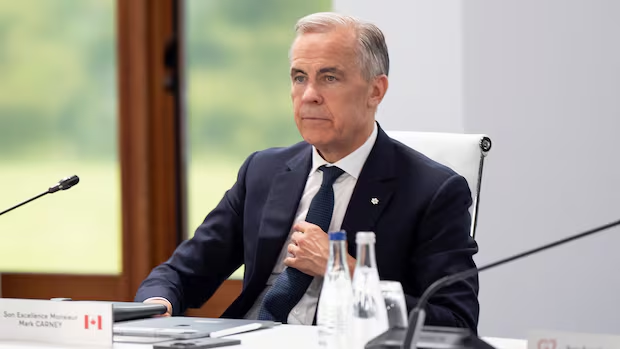
Prime Minister Mark Carney is again praising the new U.S.-Iran peace deal after calling the war “worth it” — if it ensures Iran does not acquire a nuclear weapon.
Speaking to reporters on Thursday, Carney said keeping a nuclear weapon out of Iran’s hands was “why this all started.”
“That is at the heart of this agreement, it’s all anchored in and around that,” he said.
Carney called the war in Iran “worth it” for that same reason earlier this week.
In an interview with CNN’s Kaitlan Collins on the sidelines of the G7 summit in France, he called Iran the “biggest exporter of terror,” saying the country was “hell bent” on getting a nuclear weapon.
“Moving to this position where that’s been taken off the table, yes that’s worth it,” Carney told CNN.
Asked by CBC News whether he believed military action was necessary to achieve the peace deal, Carney did not directly answer. But he said he welcomes the deal which “creates a foundation to achieve peace.”

Prime Minister Mark Carney reiterated that he welcomes the U.S. and Iran’s deal to negotiate an end to the war. ‘What’s important now is to make this work because what it does is it creates more than a framework, it creates a foundation to achieve peace,’ Carney said.
When the U.S. and Israel first struck Iran on Feb. 28, Canada was quick to announce its support.
A statement from the prime minister said “Canada supports the United States acting to prevent Iran from obtaining a nuclear weapon and to prevent its regime from further threatening international peace and security.”
Four days later, Carney said the support came “with regret.”
“We were not informed in advance, we were not asked to participate,” Carney told reporters at the time. “Prima facie, it appears that these actions are inconsistent with international law.”

Under the United Nations Charter, military force is strictly prohibited unless authorized by the UN Security Council or used in self-defence against an actual or imminent armed attack.
The U.S. and Israel did not consult the international body before carrying out the strikes that began the war with Iran.
Experts have also expressed concern about violations of international humanitarian law over the course of the war, such as strikes on civilian infrastructure and the bombing of a girls’ school in Iran.

U.S. media, including the New York Times and Reuters, are reporting that preliminary findings of an internal military investigation suggest that a deadly missile attack on a girls’ school in Minab, Iran, may have been the result of U.S. use of outdated targeting data.
On Wednesday, U.S. President Donald Trump was asked whether he would hold anyone in his administration accountable for the airstrike that killed at least 175 people, mostly children, at an Iranian school on the first day of the war.
While the strike is still under investigation, Trump told reporters “nobody did that on purpose.”
“Mistakes are made, war is nasty,” he said.
Thousands killed
Iran’s Ministry of Health says at least 3,468 people have been killed and over 26,500 wounded in U.S.-Israeli strikes since the beginning of the war.
In Lebanon, at least 3,783 people were killed and 11,699 wounded, according to the country’s Health Ministry.
The figures do not distinguish between civilians and combatants.
At least 28 Israeli soldiers and four civilians have been killed according to that country.
Hundreds of others have been confirmed by other countries in the region to have been killed or injured through the course of the war.
Global Affairs Canada says it is aware of the deaths of two Canadians in the region since the war began.
In April, Canadian Mohammad Hassan Haidar was killed in southern Lebanon during ongoing strikes in the region by Israel.
Israel has not claimed responsibility for the death. But, at Canada’s request, Israel agreed to conduct an investigation.
There are 113,199 Canadians currently registered in the Middle East, according to Global Affairs.
Economic impact
The economic impact of the war is also felt around the globe, with the closure of the Strait of Hormuz, a key corridor for the world’s oil supply.
Before the war, about 20 per cent of the world’s crude oil was shipped from states in the Persian Gulf through the Strait of Hormuz.
Iranian attacks on ships carrying energy through the strait blocked the supply route and sent fuel prices skyrocketing.
The new deal signed with the U.S. will see the strait reopened, and global oil prices have already started to respond, falling more than four per cent on Monday, hitting the lowest levels since early March.
But the war highlights the risks of overreliance on the Strait of Hormuz in the face of geopolitical ruptures.
At the G7 summit this week, world leaders backed Canada as a key and reliable supplier of energy to global markets moving forward.
“We welcome the potential for Canada to deliver significant additional capacity to global markets in coming years,” said a joint statement by the G7 leaders on Wednesday.