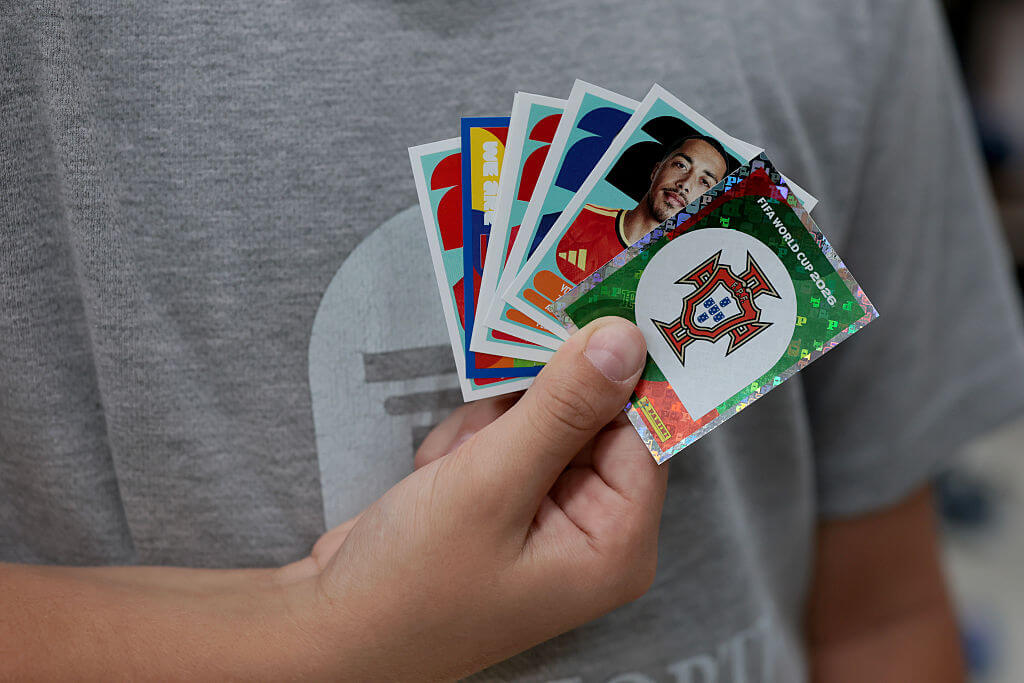
Part of the challenge Panini faced when producing their globally beloved World Cup sticker album for this year’s tournament hosted throughout North America was figuring out how to alter, even just temporarily, American collecting culture, which is far more focused on trading cards than stickers.
Sports card collectors in the United States typically place their treasured collectibles in a variety of plastic cases to preserve peak condition and value. The thought of peeling off part of a baseball card and sticking it onto the page of a book forever is enough to cause heart palpitations.
Going back to its debut with the 1970 World Cup, Panini’s sticker album has become a beloved tradition all over the world. Collectors buy packs of stickers and swap duplicates with friends and strangers to fill out the album, which includes players from every team in the tournament. It’s a communal and tangible expression of World Cup excitement, but, as with the sport itself, it’s one that has never fully taken hold in the U.S. to the same extent as many other parts of the world.
This time around has been different, though. It turns out the only challenge for Panini in 2026 has been keeping up with the demand.
“We’ve had some significant retailers surpass what they did in 2022 a week before the tournament even started,” said Jason Howarth, Panini America’s senior vice president of marketing and athlete relations.
One major effort to introduce Panini’s World Cup sticker album to the American public was simply to give some away. And by “some,” Panini meant giving away 10 million albums at fan events across the country on top of selling stickers and albums through a variety of major retailers, including Amazon and Dick’s Sporting Goods. Panini has also extended its partnership with Coca-Cola to the U.S. for the first time, with 375 million stickers hiding inside the labels of 20 oz bottles.
Howarth said Panini has printed “way more” stickers than ever before in the history of the U.S. market because this type of collectible is a more consumable product than trading cards. It’s also the result of there being more teams in the World Cup than ever before (48, up from 32) and more players to collect than ever, resulting in a whopping 980-sticker collection (up from 670 for the 2022 World Cup).
Where overprinting is always a concern from trading card collectors preoccupied with long-term value, that’s generally not the case for sticker collectors.
“Everything’s printed for the majority and of equal value so that everyone can complete their albums,” Howarth said. “You know that stuff is happening in that cadence and that expectation. So you want to make sure that you’re getting that product out into the market as fast as you can. And then it’s just the replenishment game.
“The people that are faster on replenishment win. You’ve got retailers like Walgreens that are replenishing super fast and others along those lines — Walgreens, CVS, Walmart, Target, the Amazons of the world. We didn’t really have a massive Amazon presence in 2022. We launched a TikTok shop this year just to make sure that we were ready for this World Cup to capitalize on the user-generated content that just explodes all over the place when people are getting stickers.”
But while Panini hoped the American sports card enthusiasts could adapt to stickers, the company is also meeting them halfway with a proven sports card concept to help further American collectors’ desire for stickers: parallels.
Modern sports cards have thrived by including different versions of the same card, with a base version being the most common (and least desirable) and others each utilizing a different color and carrying a different print run that can vary from several thousand all the way down to just one.
The U.S. version of the Panini World Cup stickers utilize the parallel system through different colored borders. This creates a danger for unsuspecting collectors of the stickers sold in the U.S. And some collectors have already fallen victim to affixing rare stickers to their album pages, ruining their value.
So before mindlessly peeling every sticker off its back paper, make sure not to damage a one-of-one, highly valuable sticker of the likes of Lionel Messi or Lamine Yamal. Messi’s 2022 World Cup one-of-one black bordered sticker sold in 2023 for $139,200, a record for a World Cup sticker.
Unfortunately, there have been posts on social media where some rarer parallels, including the one-of-one for Argentina’s Julian Alvarez, have already been placed in albums.
2026 World Cup sticker variations (U.S. edition):
- White (Base)
- Orange (Amazon exclusive)
- Blue (one in every two packs, on average)
- Red (1:25 packs)
- Purple (1:200)
- Green (1:1,400)
- Black (only one in existence per sticker)
The U.S. edition of Panini’s 2026 World Cup stickers
“As far back as five years ago, we were thinking about 2026 and how we integrate the collecting culture that resonated in the U.S. market, which has always historically been trading cards,” Howarth said. “I think as it relates to the category and the hobby, I think the one thing that we did really well, and really smart in 2022 is, even though the goal is to complete the entire album, we decided based on our success on the trading card side to infuse these parallels into the sticker product.”
It can’t be overstated, though, how important the 2026 and 2030 World Cup years are and will be for the vitality of Panini as a company.
According to a sales pitch document compiled for possible buyers of Panini obtained by The Athletic, Panini claims it made nearly $720 million in net sales (613 million euros) from its 2022 World Cup products, setting a company record for a single Panini event collection. Panini also estimates net sales of $1.48 billion in 2026 (1.26 billion euros) and $1.5 billion in 2030 (1.3 billion euros) off World Cup licensed products. Panini’s net sales projections for the entire company are listed with estimates of around $2.47 billion (2.1 billion euros) in 2026 and $2.78 billion (2.37 billion euros) in 2030.
That soccer cash cow could be diminished for Panini in 2031.
FIFA and Fanatics inked a long-term, exclusive licensing deal that will allow Topps, which is owned by Fanatics, to produce soccer cards, stickers and trading card games for the World Cup and other FIFA events starting in 2031. This will end FIFA and Panini’s long-standing partnership in the trading card and sticker space that will have lasted nearly 60 years at that point.
In Panini’s first public response since the news broke in early May, Howarth said, “I think we’ve got a long way to go before we get there. We’ve got this year and we’re super focused on ‘26. We’ve got 2027 to think about next year with the Women’s World Cup, and then 2030. It’s going to be crazy to think about what 2030 looks like when you have a massive market like (host nations) Portugal and Spain and Morocco on that side of it. Great markets for us, and I’m sure that those guys in Portugal and Spain on the Panini side are already thinking about what I was thinking about in 2022. ‘Can we just get through ‘26 and get there already?’
“You think of something (losing the license) that’s five or six years away and so much can happen between now and then. We’ve just been so focused on ‘let’s do what we do’ and make sure that we’re not distracted and execute against what we’re supposed to deliver and execute.”
All of this is occurring with Panini in an ongoing court battle with Fanatics, which it has accused of anticompetitive behavior and monopolization of the sports card industry after Fanatics acquired exclusive, long-term licensing rights from the NBA and NFL previously held by Panini to pair with its exclusive licenses for MLB, the Premier League, F1, Bundesliga, WWE and others.
The FIFA license won’t be added into this lawsuit, according to lawyer Stuart Singer, who’s representing Panini in the litigation against Fanatics. But Singer told The Athletic, “Panini is moving full speed ahead with the litigation, which is now entering the important period of depositions. The court has earlier said that we have legibly alleged facts which support monopolization and unlawful restraint of trade as well as tortious interference with contract. We are confident the depositions will support these allegations.”
The Athletic maintains full editorial independence in all our coverage. When you click or make purchases through our links, we may earn a commission.