Completing the through-train vision
ESF, Hong Kong’s largest provider of English-medium international education, first introduced its through-train concept in 2019, when it aligned primary schools with associated secondary campuses. That reform aimed to provide greater certainty and smoother transitions between Year 6 and Year 7.
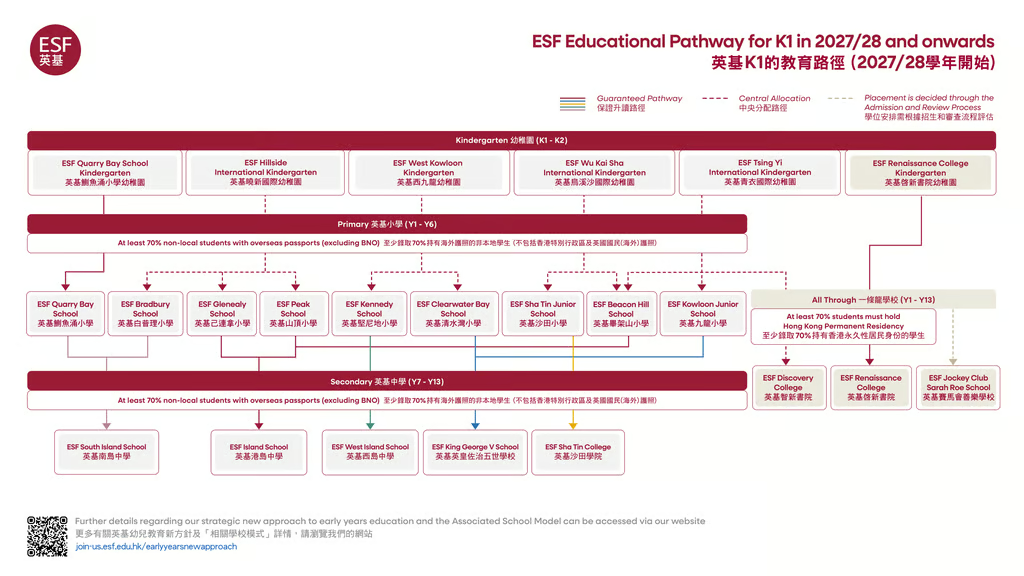
The latest announcement extends the model downward to the earliest stage of formal education. Under the Associated School Model, each kindergarten links to designated primary schools, giving K1 families early certainty about their child’s pathway and removing the need for separate primary applications later.
Belinda Greer, Chief Executive Officer (CEO) of ESF, described the development as a defining moment for the organisation.
“This is a significant moment in the history of ESF, one that will bring immense benefits to our students and their families,” she said. “After we make this change, when a child joins the ESF family at age three, they are securing a continuous learning pathway – one built on absolute continuity and progression, all the way until they graduate.”
Certainty in a competitive city
Hong Kong’s international school sector is characterised by high demand and limited supply. Many families apply to multiple institutions at every stage, often years in advance, mindful of waiting lists and assessment requirements.
Transitions between kindergarten and primary, and later to secondary, can be particularly stressful. Even within established school groups, separate admissions processes have historically required parents to prepare portfolios, attend interviews and face uncertain outcomes.

According to Greer, the benefits go beyond admissions security. The alignment will allow for closer collaboration between early years and primary educators, enabling a more integrated understanding of each child’s development.
“The move will allow our world-class early years educators to work together more closely than ever to truly get to know each child,” she said.
“Teachers in our kindergartens and their linked primary schools will collaborate deeply to understand each child’s unique learning style, ensuring the transition to primary school is a progression, not a new start.”
The distinction is central to ESF’s strategy. Rather than treating kindergarten and primary as separate educational silos, the organisation intends to build stronger curricular continuity and shared support systems across phases.
Building a unified system
Historically, ESF operates a network of kindergartens, primary and secondary schools across Hong Kong. While long associated with academic continuity, the formal linking of all three phases signals a structural shift toward a more unified system.
“By completing our through-train model, ESF is evolving from a network of associated, individual schools, into a truly unified education system,” Greer said.
“This means greater coherence and a seamless progression in their child’s learning. From the moment they first walk through our gates until they graduate from secondary school, each child will experience a single, connected ESF community.”
Education observers note that such alignment can facilitate the sharing of specialist resources and expertise. Learning support services, language development strategies and pastoral care frameworks can be coordinated more effectively when schools operate within a clearly defined pathway.
For students, the practical impact may be felt most strongly during transitional years. Moving from kindergarten to primary and then to secondary often involves adapting to new expectations, environments and peer groups. A linked model allows schools to manage those changes more deliberately, reducing disruption and reinforcing a sense of continuity.
Strategic focus on early years
The announcement also reflects a broader emphasis on early childhood education. By positioning kindergarten as the formal entry point, ESF underscores the importance of the early years in shaping long-term educational outcomes.
Research consistently highlights the role of high-quality early education in supporting cognitive, social and emotional development. A more integrated approach between kindergarten and primary may strengthen curriculum alignment, ensuring foundational skills are built upon rather than revisited or re-taught.
A shift in the admissions narrative
For many Hong Kong parents, school planning can feel like a sequence of gates, each one demanding preparation and contingency plans. ESF’s move reframes that narrative.
While competition for places at international schools is unlikely to diminish, the promise of a guaranteed pathway within one of Hong Kong’s largest English-medium providers may reshape how families approach long-term planning.
Greer characterised the development as “the next exciting chapter” for ESF. For parents seeking stability in a fast-moving city, it may also represent something equally valuable: clarity.
From first steps in kindergarten to graduation in Year 13, the journey, ESF says, can now be mapped from the very beginning.
“This is the next exciting chapter of our story.”

