As part of our Language of Soccer World Cup series, The Athletic is speaking to supporters of all 48 nations competing at the 2026 edition to capture their unique football culture, distilled into a single phrase. You can read the articles in one place here.
Totaalvoetbal – Total Football
When the Netherlands appeared at their first World Cup in 36 years, Bert Stummel was there.
It was 1974, and he was 18 years old. After spotting an advert with tickets for sale in his local newspaper, he was on his way to neighbouring West Germany to watch his country’s second game in the first of two group stages, against Sweden in Dortmund.
The tournament was a big deal for the Netherlands for reasons that stretched beyond sport.
German soldiers had marched across the Dutch border in 1939, overrunning Doetinchem, the town where Stummel was born 16 years later.
The Second World War left deep scars across the Netherlands, and Stummel can remember the conversations he heard as a child about those six years of Nazi occupation.
“There was animosity with people who lived through the war,” he recalls. “But there was a kind of friendship between younger people. The border was not far away. I learned German in school and grew up watching German football. They always seemed superior. Every time you had the opportunity to beat them, you wanted to do it for reasons that were not just about football.”
Stummel travelled by bus, with a sandwich and an apple in his backpack. He had enough money to pay for two beers. On arrival in Dortmund, he was overwhelmed by the size of the city, the huge crowds and the noise — Doetinchem is a quiet town surrounded by flat countryside.
The match against Sweden finished goalless, yet it holds a cherished place in football history.
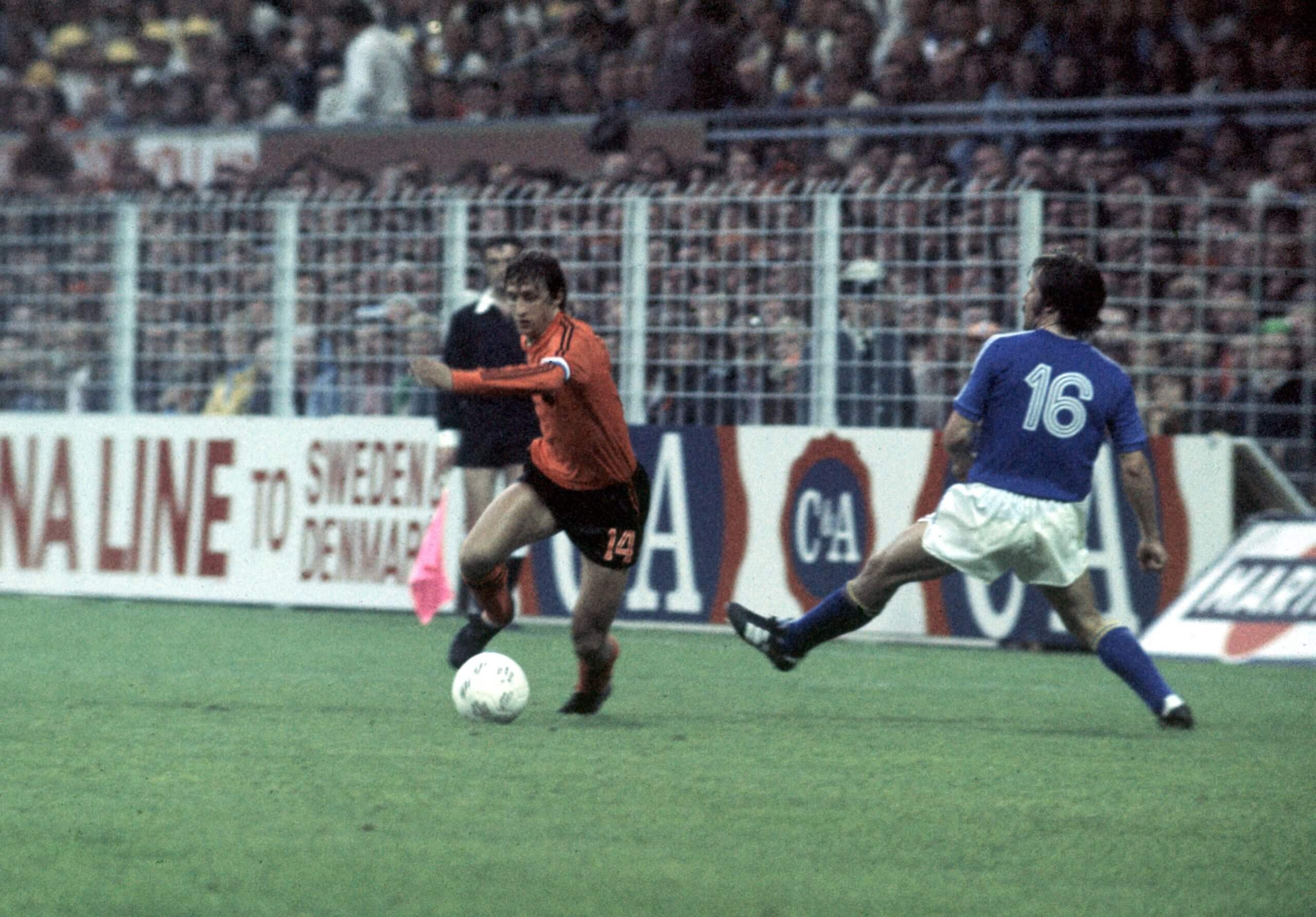
Stummel was yards away when Dutch forward Johan Cruyff twisted his way past Swedish defender Jan Olsson by feigning a pass before dragging the ball behind his standing leg, pivoting 180 degrees, allowing him to accelerate into space.
“The Cruyff move,” Stummel calls it, though in other parts of the world it is referred to as a “turn”.
“I can see it very clearly. There was a short gasp in the crowd but Cruyff moved so quickly it was difficult to know exactly what had happened. It was only later when I saw the news that I realised it was a special moment.”
Johan Cruyff in action for the Netherlands that night against Sweden in 1974 (J Varley/Mirror Syndication International/Mirrorpix via Getty Images)
Stummel would meet Cruyff at an exhibition in Amsterdam 39 years later. “I told him I was there (at that match). He smiled. I asked him what prompted him to make the move. He could not really answer — it was improvisation.”
Cruyff is not just the Netherlands’ greatest footballer but one of the country’s most famous figures, on the same level as artists Van Gogh and Rembrandt.
He never won the World Cup, though.
In 1974, the Netherlands got to the final but lost 3-2 to West Germany in Munich. Four years later, they were beaten again in the final by the host nation, this time Argentina. The Cruyff team broke up after that but by the late 1980s, another terrific Dutch side was coming together, rebuilt by Rinus Michels, the former Ajax coach who’d had a profound effect on Cruyff as a player.
In 1988, the Netherlands faced West Germany again in a tournament the latter was staging, this time in the semi-finals of the European Championship in Hamburg.
Stummel refers to what followed as “the greatest match ever”. On this occasion, he was not there. Instead, he was working at a farm in the north-east of his homeland. He watched the match on television, his closest neighbour miles away. A 2-1 Dutch victory broke the silence of the countryside.
“Fireworks went up,” he says. “The celebrations went on all night. Even in a remote part of the Netherlands, everyone felt like they were together.”
Judith van Heems was 13 years old and living just outside Breda, a city in the south of the country, at the time. “The Netherlands has never felt more united,” she concludes.
Back in Munich for another final, 14 years on, Michels’ team swept past the Soviet Union, winning 2-0 with Marco van Basten scoring one of the greatest goals of any final in the history of the sport.
With the rest of her family, Van Heems hung an orange banner over a bridge, looking out at a gridlocked highway, where all of the cars were beeping their horns. When the victorious squad returned to Amsterdam, they boarded a canalboat and sailed around the city with the trophy.
A teenage Emile Albert de la Bruheze watched all of this from France, where he was on holiday. He can remember the parents of families from other countries suddenly becoming very interested in the Netherlands: “For the Dutch, it felt like liberation. Back in Amsterdam, people were jumping in the (canal) water.”
That team of Van Basten, Ruud Gullit and Frank Rijkaard had such a profound effect on Van Heems that she started following her country’s football team around the world.
A decade later, like Stummel in 1974, she got hold of tickets for the 1998 World Cup by calling a hotline and waiting on hold. She and her father then drove to Marseille in the south of France, where they saw the Netherlands beat South Korea 5-0 in the group stage: “At every gas station, there were people dressed in orange. I had tulips on my head. It was magical.”
Van Heems has since been to six other tournaments. She believes Dutch fan culture is “not just about what is happening on the pitch — if the Netherlands lose, other nations go home but (we) stay in the nightclub”.
She feels comfortable following the national team because there are more women and children than is the case with other countries’ sides: “It is a family event, and I think this helps other countries form a more rounded impression of Dutch people.”

Netherlands fans create a sea of orange before their team’s Euro 2024 semi-final against England in Dortmund, Germany (Hesham Elsherif/Getty Images)
Jeroen Heijink has also followed the team far and wide. He thinks the football landscape in the Netherlands is separated into two distinct supporter identities, with many who follow their club sides home and away not showing the same interest in what happens at international level.
“I like tournament football because you see the best players, you have a trip to a country you have never been to, and you have the opportunity to become a champion,” he says.
“But a lot of people around me when I watch (mid-table top-flight side) Go Ahead Eagles do not understand why I follow the national team. They think it is not as serious, because you see people (Dutch supporters) walking around with a windmill or a piece of cheese on their head. When the Netherlands played Romania (once), there was a banner that said, “You are clowns, not football fans’.”
Heijink says the dynamic shifted at some point in the mid-1990s, when the Dutch authorities clamped down on hooligan groups from the country’s biggest clubs attending international fixtures. There was also a perception at the time that the national team was too heavily influenced by players from Ajax, even though for a period around that time the Amsterdam side were among the best in Europe.
“Fans of other clubs did not have a connection with those players. The fans of the other clubs wanted Ajax to lose,” Heijink says.
The Netherlands have played in three World Cup finals and lost them all. According to Heijink, this inconvenient fact plays a huge part in a national debate about what Dutch supporters really want to see from their team.
“Other nations think everyone in the Netherlands demands Total Football (or totaalvoetbal, a term that will forever be associated with Cruyff, both as a player and a manager). Nobody remembers the 2010 team (beaten in that year’s World Cup final by Spain), because it was pragmatic. There was not much to fall in love with.
“But the truth is, a lot of people just want to win. A whole generation has not experienced this feeling. If we don’t have the quality, then start with five defenders, I don’t care!”
The Language of Soccer series is sponsored by Google.
The Athletic maintains full editorial independence. Sponsors have no control over or input into the reporting or editing process and do not review stories before publication.