Written by Brian Hioe.
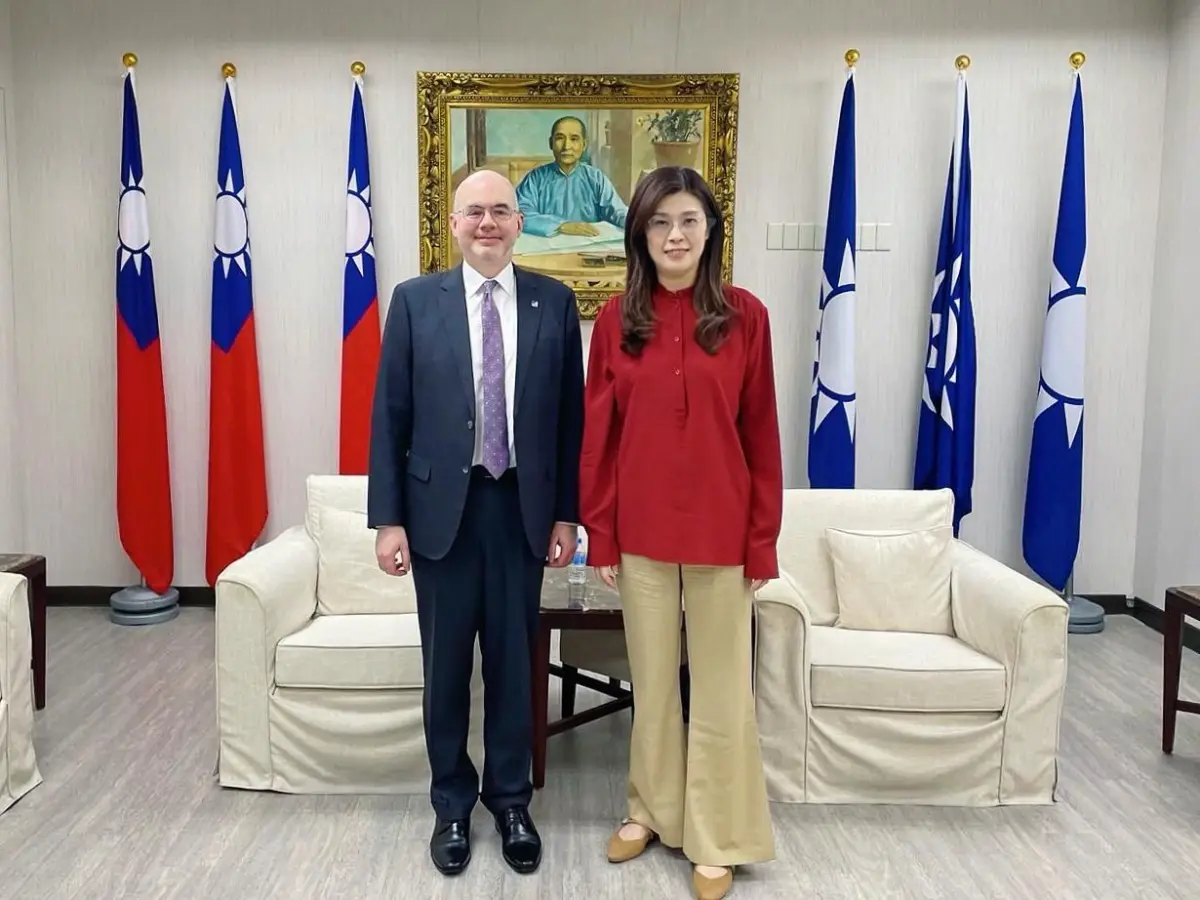
Image credit: 鄭麗文/ Facebook.
Despite having only been KMT chair for a relatively short time, the tenure of Cheng Li-wun has already had a notable impact on cross-strait relations. Most remarkably for a previously obscure politician, Cheng was not only able to secure a meeting with Chinese President Xi Jinping but indirectly caused US President Donald Trump to echo her language on cross-strait relations through Xi.
Specifically, during her meeting with Xi in Beijing in April, Cheng emphasised the 1992 Consensus and opposition toward Taiwanese independence. Some analysts have understood this as suggesting that the CCP and KMT pursue a united front against the DPP, depicted as a political force bent on achieving Taiwanese independence.
Notably, Xi responded to Cheng’s remarks by also emphasising the need to combat Taiwanese independence. One notes that subsequent cross-strait meetings, such as the annual Cross-Strait Media Summit, also involved Chinese government officials emphasising to Taiwanese counterparts the need to combat independence. At the Seventh Cross-Strait Media Summit earlier this month, deputy Taiwan Affairs Office director Wu Xi called on Taiwanese media workers to “expose” Taiwanese independence.
Indeed, Cheng’s rise to chair has been nothing short of meteoric; though not a new figure in Taiwanese politics, she had been quiescent in past years before her recent rise. Cheng stated that she hoped to meet with Xi while campaigning for chair, and her rise to power was largely built on this promise. Cheng may be seeking to follow the example of past KMT leaders who maintained power in the party because of their ability to dominate the party’s relationship with China, such as Lien Chan or Ma Ying-jeou.
The May meeting between Trump and Xi was hotly watched, then, as to whether there would similarly be an emphasis on combatting Taiwanese independence. This did not happen during the meeting itself, which was largely a non-event in which no major deals were announced. Whether Taiwan came up at all is, in fact, a question, with the Chinese readout claiming that Taiwan was discussed between the two leaders, but the US readout not referring to Taiwan. Trump ignored questions from reporters as to whether he and Xi discussed Taiwan.
This proved very different after the summit, following an interview with Fox News where Trump seemed to indicate a view of Lai as pro-independence and stated that the US did not support independence. In the same interview, Trump indicated that he was still weighing whether to sell arms to Taiwan or not and that this was a negotiating tactic with China, indicating a view of Taiwan as a bargaining chip vis-à-vis China. Though the US’s Reagan-era Six Assurances state that the US would continue to sell arms to Taiwan and would not consult with China about such arms sales, clearly, longstanding diplomatic precedent does not matter to Trump.
Cheng Li-wun has stated that she plans to visit the US in June, during which she hopes to meet with Trump. It is unclear as to whether this would take place, but Cheng would have several aims through a prospective Trump meeting. For one, Cheng could upstage the DPP in claiming to have carried out a diplomatic achievement that Lai has not been able to do, as well as moderate her pro-China image. But Cheng could also, in this way, influence the US’s stance on Taiwan.
Indeed, Cheng’s rising political star makes it hotly speculated at present as to whether she may seek the KMT’s 2028 presidential nomination. Cheng could perhaps be seeking to appeal to isolationist quarters of the Trump administration that wish to see Taiwan go away as a stumbling block in negotiations with China and may hope for a KMT victory to remove Taiwan as an obstacle.
In the wake of Trump’s comments opposing independence, President Lai Ching-te stated that Taiwan would not be “sacrificed or traded away”. In particular, Trump’s comments put his administration in a tough political position when the DPP has otherwise sought to convey that the US is a dependable ally in wartime in a political environment in which the KMT has increasingly leaned into US-sceptic discourse.
To this extent, the DPP has made the KMT’s refusal to pass the defence budget into a battleground issue. The KMT currently claims, however, that the party will reevaluate defence spending if the US sends a letter of acceptance notifying of further arms sales. With Trump holding up defence spending himself, this undercuts the DPP and strengthens the KMT’s hand.
After Trump’s comments, the Lai administration has reaffirmed its view that Taiwan is, by the name of the ROC, already a sovereign and independent state that is already independent and does not need to declare independence. But it proves noteworthy that the Lai administration is now wedged between pressure from apparently both the US and China regarding Taiwanese independence.
The state of play for cross-strait relations has taken an unexpected turn in the past months. In this light, with the spectre of Taiwanese independence taking on new significance, it is probable that, taking advantage of Trump’s statements, the KMT and CCP will place new emphasis on efforts to frame the DPP as ideologically committed to independence in a way that harms the party. It is to be seen whether the Lai administration attempts to strengthen efforts to remind that the present DPP adheres to a pro-status quo position and not a pro-independence one.
Yet in this light, it is likely that the KMT will continue with efforts to attack the DPP over its refusal to accept the 1992 Consensus, as happened in past election cycles. One notes that Cheng was highly emphatic on the 1992 Consensus during her meeting with Xi. However, it remains unclear as to whether the public at large will accept this, when the 1992 Consensus has increasingly become a toxic brand to the extent that KMT presidential candidates have been reluctant to embrace it. Nevertheless, it, too, is possible that the KMT will try to redefine the 1992 Consensus so as to appeal to the public. This is to be seen.
In the meantime, it is also still unclear as to whether the Trump-Xi meeting ultimately boosts the narratives of the KMT or the public will continue to have faith in the DPP’s ability to manage not only cross-strait relations, but also relations with the US. The KMT has historically campaigned on the basis of the claim that it is the only party able to manage cross-strait relations, while the DPP has also in past years emphasised its ability to maintain strong ties with the US. Both parties, then, will be betting in the coming elections as to perceptions of what relationship with the US keeps Taiwan safe, as thrown into sharp relief by not only this month’s Trump-Xi meeting but upcoming possible meetings, with Trump having invited Xi to another meeting in September.
Brian Hioe is one of the founding editors of New Bloom. He is a freelance journalist, as well as a translator. A New York native and Taiwanese-American, he has an MA in East Asian Languages and Cultures from Columbia University. He graduated from New York University with majors in History, East Asian Studies, and English Literature. He was a Democracy and Human Rights Service Fellow at the Taiwan Foundation for Democracy from 2017 to 2018. He is currently a non-resident fellow at the University of Nottingham’s Taiwan Research Hub.