As part of our Language of Soccer World Cup series, The Athletic is speaking to supporters of all 48 nations competing at the 2026 edition to capture their unique football culture, distilled into a single phrase. You can read the articles in one place here.
No Scotland, No Party
Somewhere in the Bosnian city of Sarajevo, there is a kid running around in a bright-amber Meadowbank Thistle jersey.
It is an amusing image, but why on earth would this lowly part-time club, founded as the works team of an electronics company in Edinburgh before rebranding as Livingston in 1995, have a presence in the Balkans today?
The Tartan Army, the name by which Scotland’s travelling fans are known, can explain.
“In 1999, we visited an orphanage to meet kids who had lost their parents to land mines during the war,” says Martin Riddell, chairman of Edinburgh Tartan Army.
“I had only become a father three months prior, and it was so emotional. The kids sang their national anthem and we sang Flower of Scotland back to them. We donated a whole bunch of football tops to them, and it was the birth of the support’s charitable side.”
Scotland’s friendly against Ivory Coast in Liverpool in March was the 110th consecutive away match, stretching all the way back to Kaunus, Lithuania, in 2003, that a local children’s charity — strictly non-political, non-religious and non-government-funded — received a £5,000 donation from the Tartan Army Sunshine Appeal.
They already have an organisation that supports homeless kids in Boston lined up for this World Cup.
“We see ourselves as ambassadors for our country,” says chairman Neil Forbes. “The whole idea is to bring a ray of sunshine to kids’ lives wherever Scotland play an international football match, which I think is a great principle every football fan around the world can agree with.”
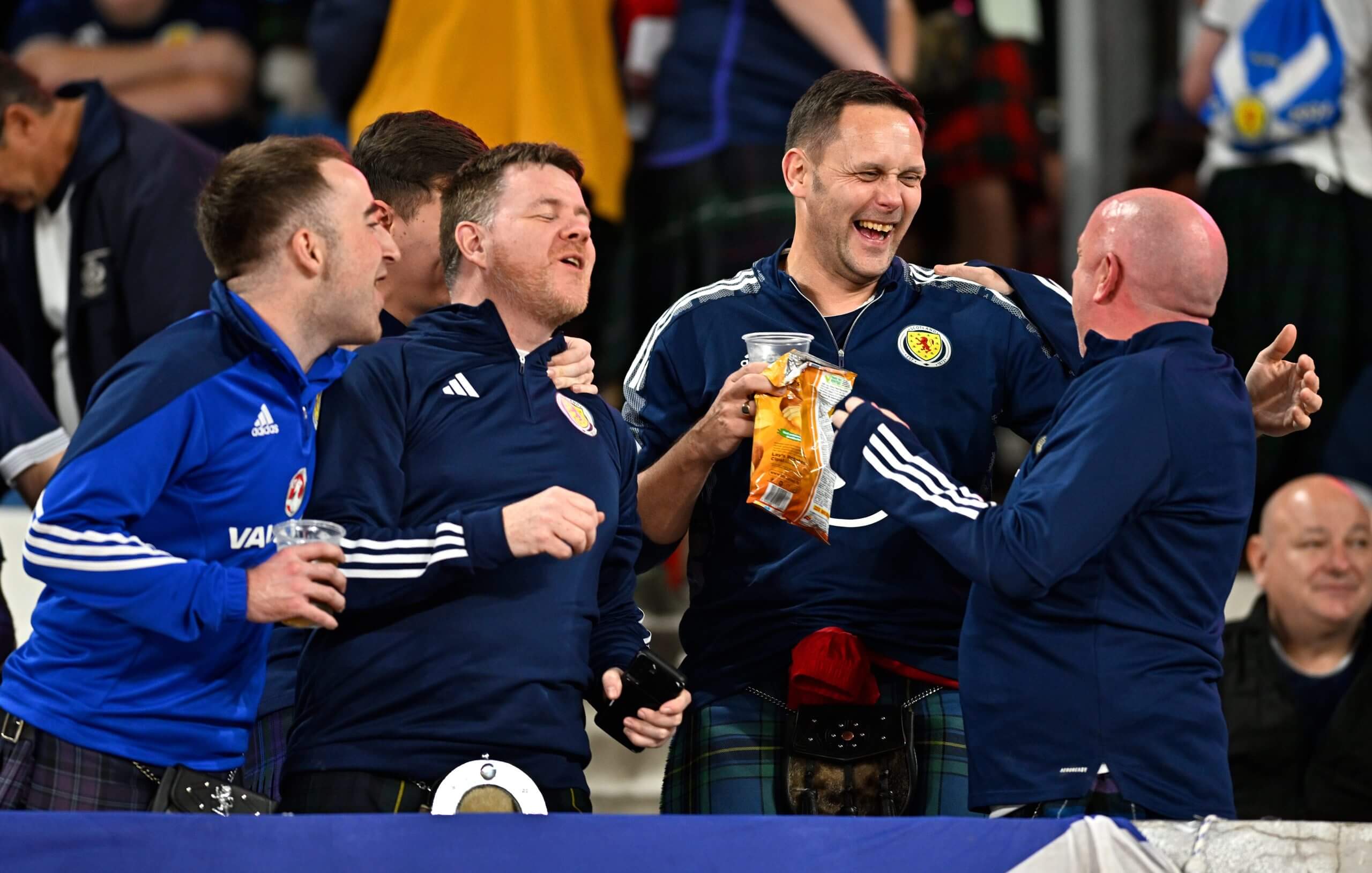
That is what it means to be on the road with the Scotland national team. It goes beyond football. Philanthropy, good humour and integrating into the local culture is at the heart of it.
What drove this altruistic, bohemian outlook? A desire to distinguish themselves from the jingoism that is associated with neighbours England.
“There was definitely a feeling that because England were so bad, Scotland thought, ‘Well, we are going to be f***ing angels’. Or just not wreck the place,” laughs Riddell. “If anyone steps out of line, then we self-police. It doesn’t always work but by and large it does, and that’s how we have earned that respect.”
Scotland fans enjoy themselves before a Euro 2024 qualifier (Levan Verdzeuli/Getty Images)
When Scotland were involved in the opening game of the 1998 World Cup, the players arrived at the stadium, Paris’ Stade de France, in kilts — the country’s traditional dress worn at weddings — and sunglasses. It is understood a similar offer was made this time, but ultimately the players decided against it. The demands of playing in the searing heat of a North American summer helped inform their decision.
On the eve of that match against Brazil, Buddha-Bar in Paris hosted the mother of all parties as the A-list of the Scottish celebrity world came together. Former James Bond actor Sean Connery was dancing, legendary Manchester United manager Sir Alex Ferguson was wearing a Viking helmet and one of the country’s great strikers, Ally McCoist, sang Bruce Springsteen numbers on karaoke.
Photographer David Yarrow and businessman Ian Falconer organised that famous bash and they did so again in Germany at the 2024 European Championship when Scotland fans travelled en masse to a major tournament for the first time in 26 years (Euro 2020 ended the country’s long qualification drought, but the draw and Covid-19 meant their three games were either on home soil at Glasgow’s Hampden Park or at Wembley Stadium in London and had severely limited attendances). It raised £100,000 for Street Soccer Scotland, a homeless charity founded by David Duke, who played in the Homeless World Cup for Scotland and turned his life around.
Another on the eve of Scotland’s first group game this summer against Haiti in Foxborough, near Boston — which most expect to be their first major-tournament victory since a 1-0 defeat of Switzerland at Euro 96 — is already arranged.
It all explains why they live by the motto: No Scotland, No Party.
“In Munich (during those Euros two years ago), you saw the impact the fans had. People just seem to love Scotland,” says Duke.
“We have this ‘It’s s**t being Scottish’ patter and we moan about the weather but you never feel prouder to be Scottish than when you leave it. People seem to feel at home with us because we don’t take ourselves too seriously.”
Sunshine Appeal chairman Forbes was invited to the German consulate in Edinburgh before and after that tournament. They thought the estimate of 100,000 travelling Scots was a joke until Munich, the beer capital of the world, was drunk dry before a ball had even been kicked.
It was a similar story in Czech capital Prague for a European Championship qualifier in 1999. The Scotland fans had congregated in the old town square, so when the area’s bars ran out of alcohol, the riot police arrived expecting trouble. Instead, when the lorries arrived with more beer, the Scots hopped aboard and helped unload the kegs themselves.
“I moved to Canada in 2017, and the thing people here say most often is, ‘No Scotland, No Party’. We bring the fun,” says Iain King, who reported on major tournaments for the Sunday Mail and Scottish Sun and is now an academy coach in Nova Scotia.
That 1998 day in Paris, the press box seating draw had King sandwiched between Roberto Rivellino, who was in the Brazil side that won the 1970 World Cup, and former England forward John Barnes. Despite Scotland equalising and being level at half-time, it ended in a familiar ‘Oh-so-near’ result as they lost 2-1 due to a Tom Boyd own goal. They expected to sweep aside Norway and Morocco in the other two group games, but picked up a single point from them.
For too long, the joie de vivre that Scottish fans brought to international football has been limited to the pubs and town squares of far-flung European cities rather than being reflected by their team on the pitch.
This was a nation that, having created the passing game and exported it across the world, used to see itself as a major power.
In 1978, the Tartan Army sent a squad including Kenny Dalglish, Graeme Souness and Joe Jordan off to Argentina with an official parade around Hampden Park in an open-top bus. There was genuine belief Scotland could win that World Cup but a 3-2 group-stage victory over a Netherlands side who went on to reach the final proved futile because of a 3-1 loss to Peru and a 1-1 draw with Iran in the other two matches.
The production of these great players dried up over the years that followed, and so did the nation’s footballing self-confidence.
For Gordon Sheach, founder of Scotland fans’ website The Tartan Scarf, his first memory of football set the precedent for two decades of despair and disillusionment. It was Euro 96, England vs Scotland at Wembley in the group stage, and the camera cut to a Scotland fan with the saltire painted on his face like a Pict warrior.
“Hands on hips, looking absolutely scunnered,” says Sheach.
That is a slang way of saying royally p***ed off. Scotland lost 2-0 that day, and another major tournament passed them by. Little did they know that the World Cup two years later would be their last tournament for 23 years, until a penalty shootout victory over Serbia in a play-off ended the hoodoo and sent the Scots to Euro 2020 (which was delayed until 2021 by the pandemic).
In that time, Scotland fans had plenty of enjoyable moments but disappointment was always lurking around the corner. “The high, the ultimate high… and then it all comes crashing down,” says Riddell.
James Morrison and Kenny Miller scoring terrific individual goals in defeats to the English at Wembley. Ikechi Anya’s equaliser against Germany. Leigh Griffiths netting two late free kicks to take a 2-1 lead against England at Hampden Park before Harry Kane scored in the 94th minute. A Gary Caldwell diving header against France. They never amounted to anything.
Steve Clarke’s current team have their own catalogue of euphoric moments, having reached the promised land in three of their four qualifying attempts. The most recent high point came in the final World Cup qualifier against Denmark in November, a 4-2 win which contained an overhead kick, a 90th-minute long-distance strike and a goal scored from inside their own half.
“There was the era of glorious failure, when we would find new and spectacular ways to cock up qualifying,” says Sheach.
“Sometimes we would take it to the last day, like against Italy (when trying to reach the 2008 Euros). Sometimes, like in 2014 (World Cup qualifying), we were the first team eliminated in Europe because we took two points from the first six games.
“We’ve gone from that to the campaign we just had. The performances were not great. There was that point in the penultimate game when we were losing 3-0 in Greece (who went on to win 3-2) and Denmark were 1-0 up against Belarus (a game that ended 2-2). If that held, we were praying for the play-offs.
“But this team under Clarke doesn’t know when it is beaten. They get back up and go again. What was so poetic when Kenny McLean lines up that shot from the halfway line, all the (BBC radio) commentator Alasdair Lamont says is, ‘Glorious! Glorious! Glorious!’. No failure anymore.”
The final monkey to shake off the Scotland team’s back is making it through to the knockout phase of a major tournament for the first time.

Scotland fans watch their team in Germany at the Euros two years ago (Jeff J Mitchell/Getty Images)
“As long as we don’t go and be a disappointment like we were in Germany in 2024,” says Riddell.
“It was such a burst balloon as we just didn’t turn up (losing to Germany and Hungary and drawing 1-1 with Switzerland). I’d like to think Clarke will go all guns blazing if this is to be his last tournament (after seven years as the manager). We don’t necessarily have those tools but if we’re going to go out, let’s go out swinging.”
Scotland should be helped by how stable the squad has been for the past five years. No players pull out of international duty and they have grown together, from having around 200 caps among them in 2019 to more than 800 now.
Andy Robertson is just nine appearances away from Dalglish’s record (102), while John McGinn (20) and Scott McTominay (14) are inching closer towards Dalglish and Denis Law’s shared goals milestone of 30.
“They have experience under their belt now — and in Germany, a lot of our players had a hefty run-in for their clubs (before those Euros),” says Duke. “Most of that squad have played at two tournaments now, so they know what to expect, and so do the coaches. You feel that it is country first, club second with this group.”
The Language of Soccer series is sponsored by Google.
The Athletic maintains full editorial independence. Sponsors have no control over or input into the reporting or editing process and do not review stories before publication.