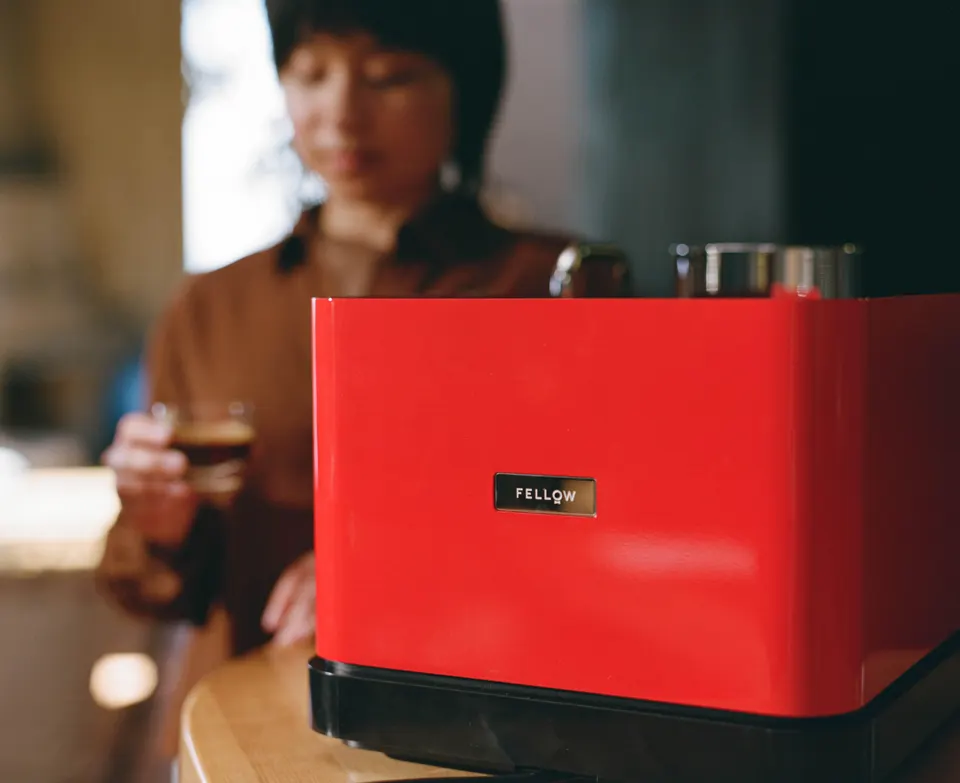

Fellow’s Espresso Series 1 Machine in Red, priced at $1,500.
Lauren Segal
Jake Miller had a front-row seat to watch specialty coffee take off. Before earning his MBA from Stanford, he worked at Caribou Coffee, then a chain of 400 cafes across the Midwest. He traveled to origin countries. He worked alongside roastmasters. He developed a love for what was happening in the cup. And then he noticed something that bothered him. The same people buying beautiful, carefully sourced coffees were going home to brew them on equipment that was, in his words, ugly and designed 40 years ago.
That observation became Fellow, the San Francisco-based coffee gear company he founded in 2013. That market is still going strong, 13 years later: the global specialty coffee market topped $111.5 billion in 2025 and is growing at more than 10% a year, while the home espresso machine market is valued at $13.15 billion in 2026 and projected to nearly double by 2035.
Over a decade later, Fellow sells in more than 40 countries, employs about 100 people and has just launched its most ambitious product yet, Miller says: the Espresso Series 1, a $1,500 home espresso machine nearly three years in development.
Getting there required 73 investor rejections, three Kickstarter campaigns, a first product that flopped and a willingness to double in size every year for a decade without taking a large institutional check.
From Caribou Coffee to A Kickstarter Brand That No One Believed In
The gap Miller spotted was specific: great roasters around the world were producing exceptional coffees, and home brewers were buying them, but the tools available to brew them at home were not keeping up. He left his job, went to Stanford for his MBA and came out with a plan to design equipment that lived up to the coffees his customers were falling in love with.
Jake Miller, founder of Fellow.
Fellow
What he did not have was money, a manufacturer or much of a network. Raising capital for a coffee hardware company in Silicon Valley in 2013 was, by his own description, basically impossible. His first attempt at a solution was Kickstarter. The campaign raised $200,000 in a month.
“I’m like, oh my God, this is easy. I’m rich,” he said. “It took 18 months and $300,000 just to deliver the campaign.”
The first product, a hybrid French press and pour-over called the Duo, was a modest Kickstarter success and then stalled. It had too many parts, and was hard to clean, he says, teaching him what actually matters to a user. From there, Fellow got better. It ran Kickstarter again, this time for the Stagg EKG electric kettle, raising roughly $500,000. A third campaign raised $1.2 million. He calls those early years the Kickstarter glory days.
Meanwhile, he was trying to raise real money from investors. The actual number of rejections was 73 before someone finally said yes.
“Each rejection, each no, is just one step closer to the eventual yes,” he said. “If you believe that, you just get up the next day and have the next conversation.”
Looking back, he thinks he was pitching the wrong type of investor. At Stanford, he was talking to tech investors. What he needed was someone who understood physical products and had the patience for a 10 or 15 year build. He eventually found that in Jerry Mix, who wrote a $250,000 check after meeting Miller at a Starbucks in Redwood City. That first yes unlocked a small angel network that participated in four rounds over the next several years.
He is also clear that not raising a large check early was probably a good thing.
“If someone would have given me $10 million ten years ago, I would have spent all that money on some product that the world didn’t need,” he said. “Because it would have felt like I needed to rethink coffee.”
Building A Brand One Kettle At A Time
For the first several years, all of Fellow’s products were non-electric. The move to an electric kettle, the Stagg EKG, was the first major inflection point: it introduced more complexity, firmware, and electrical certifications. If it had failed, he believes the company would have been done. Luckily, it did not fail. Instead, Fellow became, somewhat accidentally, a kettle company. At its peak, kettles represented 80% of sales.
“I didn’t set out to start a kettle company though,” he said.
So they pushed into grinding, then brewing, and then drinkware. Miller was able to get their product into Williams Sonoma in year two through a combination of LinkedIn connections and a lot of sales pitches, and the retailer put them in every store. They also made a deliberate push to get Fellow products into the best cafes in the world; a small team was dedicated entirely to selling to cafes so that when someone walked into a great coffee shop and saw a Fellow kettle being used for a pour-over, they would ask where it came from.
For roughly the first 10 years, the company grew about 100% year over year, Miller says.
The $6 Million Bet on Espresso
Espresso had always been on Miller’s original pitch deck, part of a product roadmap he thought would take five years to execute. It took 13 instead. In 2022, for the first time, he went out for a real institutional fundraising round, closing $30 million. The espresso machine was the reason.
“The vision for this company, the road map we want to run after, we actually can’t fund off of the balance sheet today,” he said of that decision.
The development took nearly three years and more than $6 million in R&D, with about 25 people working on it. Fellow’s design and engineering team, roughly half the company, is made up heavily of designers who came from Apple, Google and Tesla. They started from nothing, which Jake Miller sees as an advantage.
“When you start from nothing, you can make decisions that don’t lean on all the past decisions that you made as a big public incumbent,” he said.
One of those decisions was the booster boiler. During user research, the team had people walk them through their morning routines. The finding was consistent: users would turn on their machine, go brush their teeth, hang around and wait 10 or 15 minutes for it to be ready. This had been normalized. Fellow, however, set a goal of getting that down to two minutes. It took nine months of design work to get there.
The machine also includes pressure profiling, or letting users create and save their own shot recipes and download profiles from their favorite roasters to pull shots exactly as the roastmaster intended.
The reviews have been reassuring that Miller had the right vision. Bon Appetit named it the Best Espresso Machine Overall. Wired called it “quite simply the most impressive espresso machine I’ve tested in the past couple years.”
Fellow Espresso Series 1 in Black.
Lauren Segal
Why $1,500 And Not Less
Below $1,000, Jake Miller says there is not enough room to do anything genuinely interesting. The La Marzocco-tier machines that professionals and dedicated enthusiasts buy start at $4,500 or $5,000 and go up from there. He wanted to land in between with something that delivered comparable performance at a fraction of the price.
Staying at $1,500 meant making deliberate trade-offs, he explains. The machine’s wrap, for instance, is plastic, primed and painted three times. A stainless steel wrap would have pushed the price to $2,000 or $2,200.
“It was this aggressive fight to keep it at $1,500,” he said.
The positioning appears to be working. A third of Series 1 buyers have never owned an espresso machine before, he notes. In fact, he describes the machine as a sports car that comes with training wheels: buy in as a beginner, keep the training wheels on, and when you are ready, take them off.
“You can do pressure profiling,” he said. “You can create your own recipes. You can mimic shots of basically any machine ever invented.”
The machine is already appearing in small mobile cafes and pop-up setups across the country, though Jake Miller is clear that commercial is not where he is headed. “We’re designing for the home,” he said.
ReBrew: A Repair Program That Is Challenging the Industry
Tucked next to Fellow’s headquarters in San Francisco is a 10,000-square-foot service and repair center. It is the home of ReBrew, the company’s certified refurbished program, and it is one of the quieter things Fellow does that Miller believes deserves far more attention.
The premise is straightforward. Any Fellow product sent back by a customer goes to this center, where technicians test every function, sensor and moving part. Products that pass are certified refurbished, sold at up to 25% off and backed by a one-year warranty. Nothing that can be saved gets thrown away.
“I don’t want a $30 part to be the reason that a $1,500 espresso machine ends up in the landfill,” he said.
In the small appliance industry, the default response to a broken product is essentially: throw it away. A U.S. PIRG investigation of 58 appliances found that 63.8% received a failing grade for repairability, and companies behind 95% of products tested do not provide a service or repair manual. Industry return rates run anywhere from 2% to 7% depending on the company.
A growing consumer movement to end what advocates call the “captive repair economy” has pushed the issue to Congress: the bipartisan Fair Repair Act, introduced in early 2026, would extend repair rights to home appliances. At Fellow’s current scale, ReBrew has the potential to keep tens of thousands of units in circulation as the product line grows.
Fellow recently produced a short film about the center and the technicians who work there, including one named Dave, whose quiet expertise is, in Miller’s view, the human face of what ReBrew actually is. Miller described the film as one of the most meaningful pieces of storytelling the company has produced in years.
“It’s a genuine business story hiding inside a sustainability story,” he said.
ReBrew is not a marketing add-on. It is a 10,000-square-foot operational commitment sitting at the center of how Fellow thinks about product longevity, and Miller sees it as essential to the promise of building something worth $1,500 in the first place.
Matcha, Drops, and What Comes Next
Fellow launched a matcha set toward the middle of last year. It sold out almost immediately and stayed out of stock for four or five months, Miller says. The category fits the company’s framework: tools that help people make great beverages at home, whether the beverage is coffee or matcha or something else.
The company also runs a weekly coffee drops program. Three curators on staff taste 20 to 40 coffees a week and recommend their favorites to customers. A similar program for matcha is in the works.
The original product roadmap Jake Miller put together 13 years ago laid out essentially everything Fellow has built, though he thought it would take five years. He is less surprised by the scope of what the company has become than by the scale of it.
“I underestimated the size of the wave we were paddling up,” he said. “I thought we could build a really nice little business. What played out is that wave was much bigger than we thought, and we were well positioned to ride it.”
The steel supplier who worked with him on his first product is still working with him today. Jerry Mix, the investor who said yes after 73 rejections, believed in physical products and a long time horizon. Thirteen years later, that espresso machine is finally here.