Midway through Ernest Hemingway’s 1926 novel The Sun Also Rises, a conversation takes place between two of the characters, Bill Gorton and Mike Campbell. After Mike explains that he misses the opportunity to use a good tailor after going bankrupt, Bill enquires as to how this bankruptcy came about. ‘Two ways,’ said Mike. ‘Gradually, then suddenly.’
Looking backwards over another season of Premier League football, this description of the way things change feels particularly apt. Because Did You Notice that the Premier League has changed? And while that change may have been brought about gradually over the past few years, 2025-26 was when things changed suddenly.
Over the course of the campaign, I have been documenting these changes in the form of my Did You Notice videos — short presentations where I look to tell the tactical story of one of the big Premier League games in 60 seconds. Here are four of the biggest changes that I have noticed while making these episodes as the season unfolded.
1. Possession has become less controlling
We’ve already alluded to the gradual tactical change that has taken place over the past few seasons. That evolution, which catalysed around the turn of the decade, was primarily an out-of-possession one. Towards the late 2010s, we started to see a curious return of man-to-man ideas when teams were defending.
Of course, these approaches never completely disappeared after Arrigo Sacchi had so revolutionised the zonal approach to defending that it became ubiquitous in the early 1990s. But this was slightly different. We were now seeing teams use a more hybrid approach, where players would jump out of a zonal structure into a man-to-man press in certain phases of the game.
The idea is simple. Elite sides had become so comfortable at possessing the ball that they were able to force their opponents into situations that suited them, implementing a form of control on games that teams struggled to counteract.
But while it proved increasingly difficult for the non-elite sides to compete in this high-possession landscape that had emerged, there was an alternative solution: look to destabilise possession in order to divest the elite teams of their source of control.
By jumping into man-to-man phases as their opponents were looking to consolidate possession, the non-elite sides now had a fighting chance of pulling their talent-heavy opponents down to their level. Without an easy path from goal kick to comfortable possession, any team who wanted to control the game with the ball was going to have to rethink their approach.
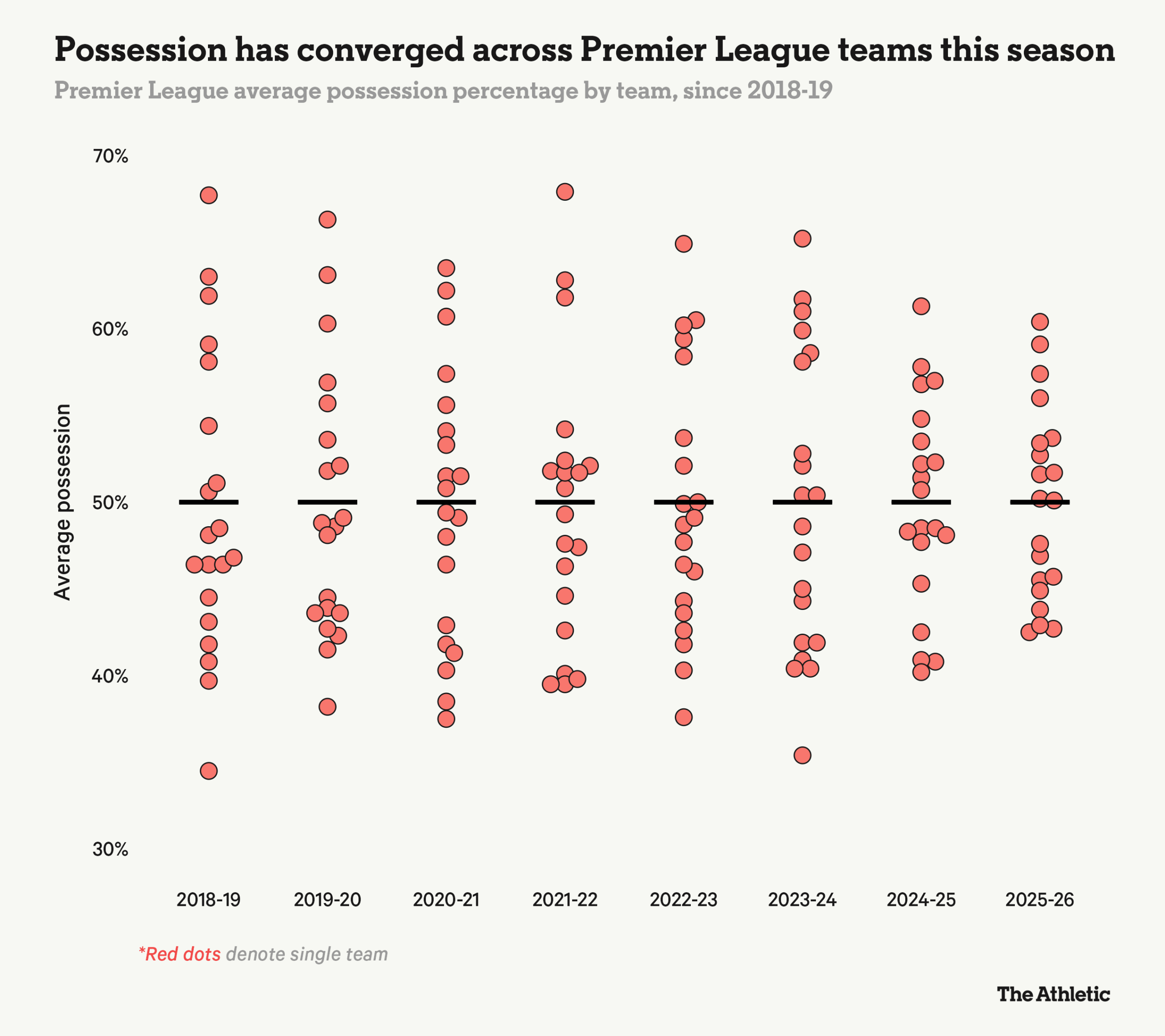
This has resulted in a somewhat confounding couple of seasons where possession has seemed to lose its edge. Yes, the teams in the title race this season — Arsenal and Manchester City — still put up high possession numbers. But both were down on last season’s. On top of this, the sides with the second and third-highest share of the ball — Liverpool and Chelsea — had largely disappointing campaigns.

At the other end of the spectrum, there were a number of clubs with lower possession numbers who crept into positions higher up the table. Manchester United’s possession went down this season compared to 2024-25, as they jumped from finishing 15th place to coming third. Bournemouth in sixth just shaded over into 50 per cent possession for the season and Sunderland, one position below them in the final table, only managed to have 44 per cent of the ball.
Although we did see similar outcomes last season — remember Nuno Espirito Santo’s Nottingham Forest? — this minor collapse in possession dominance is becoming a norm rather than an outlier.
2. The way teams possess the ball has changed
Perhaps unsurprisingly, the way that possession has become destabilised in recent seasons has changed the way sides retain the ball.
In the world before man-to-man marking became so prevalent, the space that opened up for teams in build-up was around their back line. Once settled possession had been achieved, it was the responsibility of the back line, particularly the centre-backs, to progress the ball through the thirds and closer to the opposition’s goal. This brought about the rise of the ball-playing centre-back.

But with man-oriented approaches now becoming the norm, the space is no longer around the back line but has shifted further up the field.
Where the aim of build-up used to be moving the ball through the thirds of the pitch in a controlled manner, it has now shifted. As teams press higher, space appears behind the press.

As a result, teams are now looking to find ways to play through or over these high man-to-man presses to access the vacated areas beyond. If they can do this, there is the potential to exploit this space, with your players often running at a relatively unprotected back line.
Here’s an example from Manchester United, during their 3-2 win against Fulham in February.
When Harry Maguire receives from the goal kick, you can see the Fulham players jumping into their man-to-man press.

Under pressure, Maguire passes out wide to Diogo Dalot, who is immediately closed down. Notice how the Fulham players have locked onto all the United ones around the ball.

Dalot turns back inside, and then immediately looks to play over the high press.

On the face of it, this might just look like a hopeful long ball, but he’s targeting the space between the Fulham press and their back line. And it’s clearly the plan, because Bryan Mbeumo is already dropping off into this area to receive, before finding Kobbie Mainoo.

When Mainoo gets the ball, he’s in behind the Fulham press with space ahead of him, allowing him to drive forward, with his team-mates putting Fulham’s back line under pressure.

Possession play, then, has become much more direct — either focusing on working the ball quickly through a high press or bypassing it entirely with a direct ball. This has sped play up, and whenever the play gets sped up, a more transitional game emerges, with possession changing sides more regularly.
A sped-up game in which the ball is being recycled more requires a very different kind of skill set to the more patient possession football of the preceding couple of decades. There is now less of a requirement for ball-playing centre-backs, and the profile has shifted towards the defensive aspects of that role.
Because of this, you might want your small-space technical players to be positioned deeper on the field now, to help work the ball through an aggressive press rather than simply staying forward to break down low blocks. We saw Manchester City manager Pep Guardiola use Phil Foden and Bernardo Silva in this way at times this season.
Once you have worked the ball through the press, though, speed is of the essence. This means that you want good ball carriers between the lines rather than more technical midfielders as you did in the past. Nico O’Reilly is a good example of this kind of player. A big part of City’s approach this season was about finding O’Reilly in the space behind the press for him to carry the ball forward.

Nico O’Reilly has been one of the most important tactical figures of the 2025-26 season (Paul Ellis/AFP via Getty Images)
Alternatively, you might prefer wingers who can attack space in behind rather than front up a full-back from a static position and then dribble around them. Again, City showed this shift by signing Antoine Semenyo, a very different profile to their existing wingers, in January.
The shift in the way teams possess the ball, then, has not just impacted the strategy that teams have adopted to move down the field. It has changed the profile of players they’re using to achieve these strategies across the pitch.
3. The way teams attack has changed
At this point, it may sound as though settled possession is a thing of the past, but that is not quite true. Although teams are trying to play more directly to work the ball through or over man-to-man presses, there is still the possibility of consolidating possession once the initial attack breaks down.
In these instances, if opponents are able to track back and fall into a block, the situation looks very similar to what might have happened if you were building up in the more controlled way during the possession-control era.
But there is a potential problem here.
Given that the more direct iteration of the game is leading to teams prioritising different profiles of players to be used in different roles, the task of breaking down blocks has changed somewhat. If you lean into signing players who suit a more direct style of football, then you might struggle to manipulate and pull apart a block quite as effectively as before.
On top of this, one of the best methods for destabilising a block is to use runners in behind to drag defenders around and open space that can be exploited by other players. But doing this doesn’t just weaken your opponents. It also weakens your own rest-defence structure and could make it easier for your the other team to mount a counter-attack should you lose the ball.
Because of this, we’re starting to see teams using a very different approach to manipulating a block, which is based around playing backwards to decompress the opponents’ defensive structure in order to then play forward into this more open block and attempt to generate a more direct attacking moment.
Here’s a nice example of this from City against Liverpool in April’s FA Cup quarter-final. Look at the starting position they find themselves in, up against the Liverpool block.

Although City do try to progress the ball around the block, they very quickly recycle it back around to Rodri again, who has dropped into the back line. Notice how much deeper he is in this position. City are already looking to draw the Liverpool block out.

Again, City try to progress the ball but, at the point Rodri plays a pass to the feet of O’Reilly, Liverpool’s press jumps out onto both City midfielders, and so O’Reilly is happy to just feed the ball back where it came from.

At this point, City are content to bait the opposition press up the pitch. Look at how much space opens up between Liverpool’s back line and their pressing players.

Virgil van Dijk is covering Bernardo Silva between the lines here, but as City drop further back, dragging the Liverpool players with them, he stops tracking Bernardo and allows him to become a free man deeper on the field.

With the Liverpool block decompressed, Rodri turns, opening a passing option to Bernardo, which triggers a forward sequence from City into the space that’s been created.

O’Reilly then runs off his marker, Dominik Szoboszlai, into the space between Liverpool’s lines and carries the ball forward towards their now-exposed back four.

He plays a ball to Doku in the channel and, once the winger hits a return pass to him, he’s able to find Erling Haaland in the box for City’s final goal in a 4-0 win.


This is the perfect example of how teams are now using settled possession moments to create the sorts of direct attacks that they generate in build-up.
By decompressing the opposition block, they create the conditions for a more transitional moment which suits the players at their disposal.
4. The way teams defend is changing… again
The shift towards man-oriented defensive approaches has developed over the past five years or so. But now that has become normalised, things are starting to change more quickly.
Teams are already finding solutions to these hybrid defences, triggering a man-to-man phase and then targeting the space that opens out behind it.
This has led to a couple of different responses.
The first is more conservative. Some sides have reduced the volume of man-to-man phases in their press to avoid getting caught out in this way. A fourth-place finish from Aston Villa, who are very comfortable sitting in a deeper mid-block and only very rarely stepping up onto the opposition back line, shows that there is still some life left in a more conservative approach.
But perhaps the most interesting tweak we saw in this vein was City’s shift to a high block in the second half of the season. We first saw this approach in the Carabao Cup final against Arsenal in March, and it posed a very interesting problem to the eventual title winners.
In a world where teams are going man-to-man against you, finding space takes a very different form. Opponents are no longer looking to cover space structurally but to achieve proximity to the individuals on your team. So rather than looking for pockets within a zonal defensive structure, you need to generate separation from man-markers.
Arsenal do this very well by using player movement. By rotating guys around, switching their positions, or having them drop deeper into the field to lose their markers, they are able to generate the separation needed to progress the ball down the field.
But when City set up in 4-2-4 high block at Wembley, which was more zonal, it caused Arsenal problems.

With the City players no longer looking to generate proximity to Arsenal’s in build-up, the latter’s attempts to pull their defensive structure apart proved fruitless, and with space opening out around their own back line, suddenly the Arsenal centre-backs were expected to do a lot of the heavy lifting when it came to ball progression.
In this sense, Guardiola set opposite number Mikel Arteta an old problem which his team weren’t able to solve in the moment, and it contributed to City winning that final 2-0.
But we’ve also seen another response to the slight decline in hybrid defending; a more proactive one. This is a response which we haven’t seen a lot of in the Premier League, outside of Liam Rosenior’s Chelsea — which will no doubt cause some people to question the usefulness of it. However, we have seen it at the very elite level in the Champions League.
In a match that was widely called one of the best of all time, Paris Saint-Germain and Bayern Munich scored nine goals between them in 5-4 thriller of a semi-final first leg, which ended in the French team’s favour. But it wasn’t just the scoreline that made the game so entertaining. The tactical approach taken by the two coaches was very interesting.
Rather than looking to use a hybrid approach to defending — shifting between a zonal and man-to-man structure — both teams went man-to-man across the pitch, simplifying the game by reducing it to a series of one-vs-one match-ups.
“You only have two ways,” Bayern manager Vincent Kompany told Amazon Prime after the game. “The first one is to go full (attack), or the second one is to retreat fully. The in-between doesn’t work against (PSG’s) level of player, and it doesn’t work against our level of player.”
Now, I’m not entirely convinced by Kompany’s pronouncement that “the in-between doesn’t work”, but I am sure that we will see more of these more extreme forms of man-to-man entering the Premier League space. It’ll be interesting to see if any sides adopt this more aggressive approach to defending when 2026-27 gets underway in August.

Did PSG 5-4 Bayern last month launch a new type of football? (Frank Fife/AFP via Getty Images)
The 2025-26 season will go down in history as the one where Arsenal finally won the Premier League under Arteta — a title that feels long overdue, given the high level that team have operated at over the past half-decade.
As a result, the tactical narratives will orbit around the things that Arsenal did well: elite defensive performance, possession control and set pieces. For many fans, this has become a stick to beat them with, and there has been a groundswell of opinion that the season was not enjoyable because of it.
But for me, this narrative misses just how precarious the Premier League has become from a tactical point of view.
Of course, the elite teams still hold the advantage — the sides with the most talent always will. But under the surface, the real story of this season has been much more subversive. It’s a story of narrowing competition, of the collapse of the old consensus about possession control, of a new way of approaching the game.
History is always more difficult to comprehend when you’re living through it. And this season we have been living through it: because we have been living through one of the greatest upheavals in the history of football tactics since Sacchi revolutionised zonal defending or Guardiola burst onto the scene at Barcelona.
No doubt in the future we will look back on this period as an interregnum — a point between two settled periods. But until then, we can only look forward to next season, to see where the game will take us next.