Key Points
The Tesla (NASDAQ: TSLA) robotaxi rollout has not exactly gone smoothly.
Recent reports and user demonstrations have shown some Tesla robotaxis struggling with basic navigation, requiring remote operator intervention — which in two instances led to low-speed crashes in Austin, Texas — and in at least one case taking a dramatically inefficient route in Dallas that turned a short trip into an ordeal.
Will AI create the world’s first trillionaire? Our team just released a report on the one little-known company, called an “Indispensable Monopoly” providing the critical technology Nvidia and Intel both need. Continue »
That doesn’t sound particularly reassuring. But for investors, the bigger question is whether these problems actually change the outlook for Tesla stock. The answer? Probably not — at least not yet.
Beginning stages
The reality is that nearly every disruptive technology looked messy in its early stages.
Early smartphones had poor battery life and unreliable software. Early electric vehicles had limited range and almost no charging infrastructure. Today’s AI systems still hallucinate information regularly, despite trillions of dollars now flowing into the sector. Self-driving taxis are unlikely to be any different.
The truth is, Tesla is attempting something far more ambitious than simply launching a ride-hailing service. The company is trying to build a scalable autonomous transportation platform powered primarily through vision-based AI instead of expensive lidar-heavy systems used by competitors like Waymo, whose vehicles reportedly cost well over $120,000. This isn’t trivial, because the valuation implications here could be enormous if Tesla succeeds.
Perhaps $1 trillion up for grabs
Wedbush analyst Dan Ives has estimated that Tesla’s AI and autonomous-driving opportunity could eventually be worth more than $1 trillion. Ark Invest has gone even further, arguing that robotaxis could eventually represent roughly 90% of Tesla’s enterprise value by 2029 as the global autonomous ride-hailing market potentially grows toward $10 trillion.
Put simply, Tesla’s long-term upside is no longer tied solely to how many cars it sells. The market is increasingly valuing the company based on the possibility that autonomous transportation, AI software, and recurring mobility revenue will eventually become significantly larger businesses than vehicle manufacturing itself.
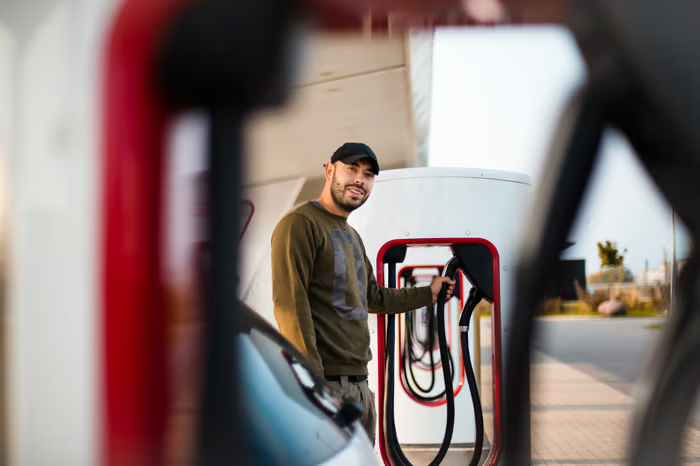
Image source: Getty Images.
Scale and execution
Tesla has delivered more than 8 million vehicles globally, with roughly half already equipped with Full Self-Driving (Supervised) hardware. That gives Tesla one of the world’s largest real-world driving datasets, which is a major advantage for training autonomous AI systems.
But execution risk remains very real.
Unlike traditional software products, autonomous driving systems face near-zero tolerance for errors. A buggy smartphone app is annoying. A buggy autonomous vehicle system can become a regulatory and legal disaster almost instantly not to mention a danger to human life.
That said, autonomous systems improve through real-world exposure, data collection, and iterative machine learning. If Tesla eventually succeeds at scaling autonomous transportation globally, even a fraction of the trillion-dollar market estimates currently being discussed could dramatically increase the company’s long-term valuation.
If Tesla can capture just 10% to 20% of that $1 trillion estimate, that would imply an additional $100 billion to $200 billion beyond Tesla’s traditional automotive business.
That is ultimately why you should continue to pay close attention to robotaxis, even when the rollout looks messy.
Don’t miss this second chance at a potentially lucrative opportunity
Ever feel like you missed the boat in buying the most successful stocks? Then you’ll want to hear this.
On rare occasions, our expert team of analysts issues a “Double Down” stock recommendation for companies that they think are about to pop. If you’re worried you’ve already missed your chance to invest, now is the best time to buy before it’s too late. And the numbers speak for themselves:
- Nvidia: if you invested $1,000 when we doubled down in 2009, you’d have $558,537!*
- Apple: if you invested $1,000 when we doubled down in 2008, you’d have $58,859!*
- Netflix: if you invested $1,000 when we doubled down in 2004, you’d have $477,813!*
Right now, we’re issuing “Double Down” alerts for three incredible companies, available when you join Stock Advisor, and there may not be another chance like this anytime soon.
*Stock Advisor returns as of May 23, 2026.
Jeff Siegel has no position in any of the stocks mentioned. The Motley Fool has positions in and recommends Tesla. The Motley Fool has a disclosure policy.
The views and opinions expressed herein are the views and opinions of the author and do not necessarily reflect those of Nasdaq, Inc.