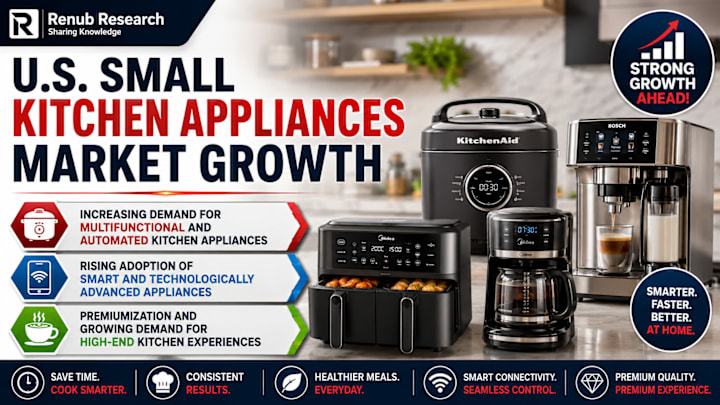
What was once a simple space for meal preparation has evolved into a technology-driven lifestyle hub filled with smart appliances, multifunctional devices, and premium culinary tools designed to simplify modern living.
Across the United States, consumers are increasingly investing in compact yet advanced kitchen appliances that save time, improve convenience, and deliver professional-quality cooking experiences at home. From AI-enabled ovens and app-connected coffee makers to multifunctional air fryers and automated rice cookers, small kitchen appliances are becoming central to modern households.
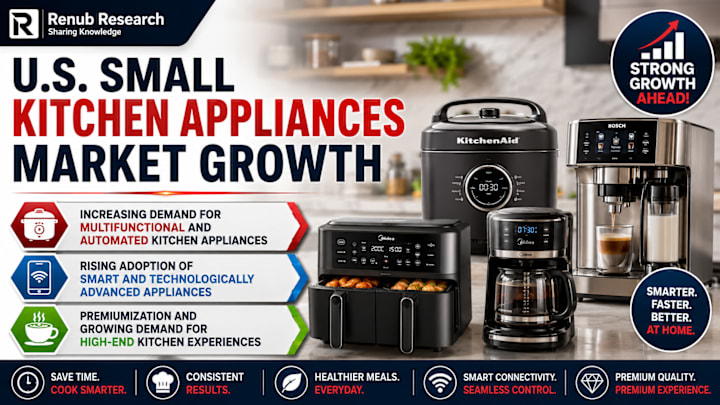
According to Renub Research, the United States Small Kitchen Appliances Market is expected to grow from US$ 4.98 Billion in 2025 to US$ 7.54 Billion by 2034, expanding at a CAGR of 4.72% between 2026 and 2034. The growth reflects changing lifestyles, rising home cooking trends, increasing adoption of smart technology, and growing consumer demand for efficiency-driven kitchen solutions.
Today’s consumers are no longer looking for basic appliances alone. They want products that combine automation, personalization, energy efficiency, and sleek modern design.
This transformation is redefining not only how Americans cook, but also how appliance manufacturers compete in one of the fastest-evolving segments of the home technology industry.
Convenience Has Become a Major Consumer Priority
One of the strongest drivers behind the small kitchen appliance boom is convenience.
Modern consumers live increasingly busy lives, balancing demanding work schedules, family responsibilities, and fast-paced routines. As a result, people are searching for appliances that simplify cooking while reducing preparation time and manual effort.
Small kitchen appliances provide exactly that.
Products such as:
- Air fryers
- Multi-cookers
- Blenders
- Food processors
- Coffee machines
- Toasters
- Electric kettles
- Compact ovens
have become essential tools for everyday living.
Consumers are especially drawn to appliances that perform multiple functions in a single device. Multifunctionality not only saves time but also reduces kitchen clutter, which is particularly important in urban apartments and smaller homes.
The growing popularity of home cooking has further accelerated demand.
During recent years, many Americans developed stronger cooking habits at home, leading to increased investment in appliances that improve convenience, consistency, and cooking quality.
Consumers are now more willing to spend money on products that help them recreate restaurant-style meals and café-quality beverages from their own kitchens.
Multifunctional Appliances Are Dominating the Market
One of the biggest trends reshaping the market is the growing demand for multifunctional appliances.
Consumers increasingly prefer all-in-one devices capable of handling several cooking tasks at once.
This shift has encouraged manufacturers to launch advanced appliances with automation, programmable controls, and multiple cooking modes.
A strong example came in March 2024 when KitchenAid introduced an automatic grain and rice cooker featuring 21 presets for different grains and beans. The appliance automatically dispenses the correct amount of water, removing much of the guesswork associated with cooking grains manually.
This type of innovation appeals strongly to consumers looking for intuitive, time-saving kitchen solutions.
Multifunctional appliances are becoming especially attractive because they support:
- Faster meal preparation
- Reduced cooking errors
- Space-saving convenience
- Easier cleanup
- Greater versatility
Consumers increasingly view these products as long-term lifestyle investments rather than simple household tools.
The popularity of compact all-in-one devices is also closely linked to urban living trends, where smaller kitchens require appliances capable of performing multiple tasks efficiently.
Smart Technology Is Transforming the Modern Kitchen
Technology integration has become one of the most important growth drivers in the U.S. small kitchen appliance industry.
Today’s consumers are embracing connected appliances that offer automation, app control, AI-driven features, and smart customization.
Manufacturers are rapidly expanding their smart appliance portfolios to meet this growing demand.
Modern appliances now feature:
- Wi-Fi connectivity
- Smartphone integration
- Voice assistant compatibility
- Touchscreen displays
- AI-powered optimization
- Programmable cooking functions
- Remote monitoring systems
These technologies provide consumers with greater convenience and personalization.
For example, Midea showcased several advanced products during the Inspired Home Show (IHS) 2024 in Chicago, including the Double Decker Dual-Zone Air Fryer, Barista Brew Smart Coffee Maker, and Easy Sauté Multicooker. These products reflected growing consumer interest in intelligent kitchen devices capable of simplifying cooking experiences.
Smart appliances are becoming especially appealing among younger consumers who already live within connected digital ecosystems.
As smart homes become increasingly common, kitchen appliances are evolving into integrated lifestyle technologies rather than standalone products.
Consumers now expect appliances to communicate seamlessly with apps, schedules, and personalized settings.
This trend is likely to intensify over the next decade as artificial intelligence and automation continue advancing.
Premiumization Is Driving Consumer Spending
Another major trend influencing the market is premiumization.
American consumers are increasingly willing to invest in high-end appliances that offer professional-grade performance, advanced features, and enhanced aesthetics.
The coffee machine category is a particularly strong example.
Consumers are no longer satisfied with basic coffee makers. Instead, they are seeking café-style experiences at home through advanced espresso machines and smart brewing systems.
In May 2024, Bosch launched its 800 Series Fully Automatic Espresso Machine featuring the Aroma Max System, ceramic grinder, intelligent flow heater, smart pump technology, and more than 35 beverage options accessible through the Home Connect app.
This launch highlighted how consumers are increasingly prioritizing personalization and luxury in their kitchen experiences.
Premiumization trends are also visible in:
- Air fryers
- Precision cookers
- Blenders
- Specialty beverage machines
- Dehydrators
- Compact ovens
Consumers are increasingly attracted to appliances that combine performance with elegant design and premium materials.
Social media and food culture have amplified this movement.
Cooking influencers, recipe creators, and coffee enthusiasts continuously expose audiences to premium kitchen experiences online, encouraging consumers to upgrade their appliances.
E-Commerce Is Accelerating Market Expansion
Online retail has become a major force in the small kitchen appliances market.
Consumers increasingly prefer shopping online due to:
- Greater product variety
- Competitive pricing
- Easy product comparisons
- Customer reviews
- Home delivery convenience
E-commerce platforms allow brands to reach wider audiences while helping consumers discover emerging appliance categories more easily.
Promotional campaigns, influencer partnerships, and digital marketing strategies have also strengthened online sales growth.
Consumers now frequently research kitchen appliances through YouTube reviews, TikTok demonstrations, and social media recommendations before making purchasing decisions.
This digital-first shopping behavior is influencing how brands market and design products.
Packaging, aesthetics, user experience, and smart functionality are becoming increasingly important because products must appeal visually and technologically in online environments.
California Leads in Smart Appliance Adoption
California remains one of the most influential markets for small kitchen appliances in the United States.
The state’s technology-driven consumer culture and high adoption of connected home devices create strong demand for smart kitchen products.
Consumers in cities such as Los Angeles, San Francisco, and San Diego show especially strong interest in:
- Smart coffee machines
- Multifunctional cookers
- Air fryers
- Premium beverage appliances
- Health-focused kitchen devices
California’s wellness-oriented population also supports strong sales of blenders, juicers, and appliances designed for healthier cooking methods.
The state’s combination of innovation culture, high disposable income, and digital lifestyle adoption makes it a key market for premium appliance brands.
Florida’s Market Is Growing Through Lifestyle Convenience
Florida’s small kitchen appliances market is expanding steadily due to population growth, home ownership, and modern retail expansion.
Consumers in Florida strongly favor appliances that offer quick meal preparation and convenience.
Products such as:
- Air fryers
- Toasters
- Compact cookers
- Beverage makers
- Blenders
continue seeing strong demand.
The state’s warm climate also supports demand for iced beverage machines and smoothie-focused appliances.
Florida’s aging population values appliances that are intuitive, easy to operate, and efficient for everyday use.
New York Consumers Prefer Compact and Multifunctional Designs
New York’s appliance market reflects the realities of urban living.
Limited kitchen space and fast-paced lifestyles drive strong demand for compact, multifunctional appliances.
Consumers in New York City and surrounding urban areas often prioritize products that maximize efficiency without occupying excessive counter space.
Popular products include:
- Portable blenders
- Compact ovens
- Smart coffee makers
- Multi-cookers
- Space-saving food processors
New York’s cultural diversity also contributes to demand for specialized cooking appliances designed for international cuisines.
Texas Is Becoming a Fast-Growing Market
Texas continues emerging as a major growth region for small kitchen appliances due to its expanding population and strong economic activity.
Consumers across cities such as Houston, Dallas, and Austin are increasingly adopting:
- Smart cooking devices
- Coffee machines
- Air fryers
- Multi-cookers
- Connected kitchen systems
Texas also benefits from rapid retail expansion and strong e-commerce penetration.
As households prioritize convenience and modern home technology, demand for mid-range and premium appliances continues increasing across the state.
Competition and Market Saturation Remain Major Challenges
Despite strong growth projections, the market faces significant challenges.
One major issue is intense competition.
The small kitchen appliance industry is crowded with brands competing across categories such as:
- Air fryers
- Coffee makers
- Mixers
- Blenders
- Smart cooking systems
Because many products offer similar features, companies must invest heavily in innovation, marketing, and customer engagement to stand out.
Frequent product launches can also create consumer hesitation, as buyers wait for newer and more advanced models.
Retailers face inventory pressure as rapid product cycles increase the risk of unsold stock.
To remain competitive, brands must focus on:
- Unique features
- Product durability
- Smart integration
- Eco-friendly designs
- Customer service quality
Rising Costs and Supply Chain Pressures Continue Affecting the Industry
Manufacturers are also dealing with rising production costs and supply-chain disruptions.
Components such as:
- Electronic chips
- Heating systems
- Motors
- Stainless steel materials
have experienced cost fluctuations in recent years.
Shipping delays and rising logistics expenses have further complicated production planning.
These rising operational costs often lead to higher retail prices, which can reduce affordability in price-sensitive categories.
At the same time, stricter energy-efficiency standards and sustainability regulations are increasing compliance costs for manufacturers.
To address these challenges, companies are increasingly investing in:
- Localized manufacturing
- Supply-chain diversification
- Automation systems
- Energy-efficient technologies
Recent Industry Developments Highlight Ongoing Innovation
The U.S. small kitchen appliance market continues seeing rapid innovation and product launches.
Some notable recent developments include:
Panasonic introduced the HomeCHEF Connect 4-in-1 Countertop Multi-Oven in March 2025, combining microwave, convection bake, air-fry, and broil functions with AI-enabled cookware recognition.
KitchenAid launched new Juniper and Black Ore finishes with customizable hardware options during KBIS 2025, reflecting growing demand for personalized kitchen aesthetics.
SharkNinja reported a 29.7% increase in Q4 2024 net sales, highlighting strong consumer demand for innovative kitchen appliances.
These developments demonstrate how companies are competing aggressively through technology, design, and product versatility.
Key Market Segments
By Product
- Coffee Makers
- Food Processors
- Toasters
- Grills and Roasters
- Tea Makers/Electric Kettles
- Other Small Kitchen Appliances
By Distribution Channel
- Hypermarkets & Supermarkets
- Electronic Stores
- Exclusive Brand Outlets
- Online
- Others
By End User
Major Companies Operating in the Market
Leading companies in the U.S. small kitchen appliances market include:
- Hamilton Beach Brands Holding Company
- Newell Brands
- Spectrum Brands
- Breville Group Limited
- Gourmia
- Smeg SpA
- Electrolux AB
- Whirlpool Corporation
These companies continue investing in smart technology, premium product development, and connected home integration to strengthen their market position.
Final Thoughts
The United States small kitchen appliances market is undergoing a major transformation fueled by convenience, smart technology, and changing consumer lifestyles.
Modern consumers are no longer purchasing appliances solely for basic functionality. They are investing in products that deliver efficiency, automation, personalization, and premium culinary experiences.
According to Renub Research, the market is expected to expand from US$ 4.98 Billion in 2025 to US$ 7.54 Billion by 2034, reflecting strong long-term demand for intelligent and multifunctional kitchen solutions.
As smart homes continue evolving and home cooking remains deeply integrated into consumer lifestyles, small kitchen appliances are expected to become even more advanced, connected, and personalized.
The brands that successfully combine innovation, convenience, affordability, and user experience will likely define the future of America’s modern kitchen economy.
