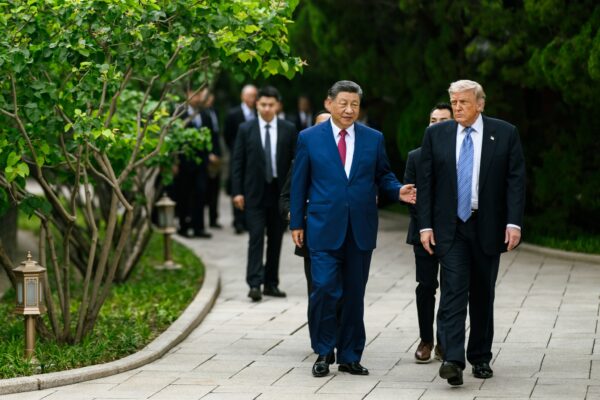
U.S. President Donald Trump recently concluded his two-day visit to Beijing, which he described as a “very successful” meeting with Chinese President Xi Jinping. Regarding Taiwan, Trump largely stayed within Washington’s long-held position of strategic ambiguity. Unlike former President Joe Biden, Trump did not proactively emphasize U.S. interest in Taiwan Strait stability. Nor did he make clear promises to Xi about how he would deal with Taiwan.
But the summit itself was not the decisive moment. The more consequential test will come afterwards, when Trump decides whether to proceed with $14 billion in U.S. arms sales to Taiwan. That decision will reveal whether Washington’s strategic ambiguity still includes meaningful military support for Taipei, and whether Beijing is prepared to punish any deviation from the stability framework it tried to establish with Trump.
The Trump-Xi summit, as expected, did not end with Washington formally changing its declaratory policy to “opposing Taiwanese independence.” Beijing instead used the meeting to reinforce its red line: the stability of China-U.S. relations depends on Washington’s handling of Taiwan.
Trump claimed he did not respond when Xi raised the issue of U.S. military support to Taiwan. Yet in another interview, he described U.S. arms sales to Taiwan as a “very good negotiating chip.” Chinese state-backed media have also highlighted Trump’s comment about not wanting to see Taiwan “go independent” with U.S. backing, language echoing Beijing’s accusation of Taipei “relying on the U.S. for Taiwanese independence.”
Beijing has been carefully steering U.S.-China-Taiwan dynamics through leader-level diplomacy between China and the United States. Before the summit, Taiwanese President Lai Ching-te visited Taiwan’s last ally in Africa, Eswatini, despite Beijing’s effort to derail Lai’s visit. Beijing condemned Lai as a “troublemaker,” but refrained from military reactions before Xi and Trump met. This restraint was notable. Since Lai became president, Beijing has launched four major military exercises around Taiwan, framing them as responses to Taiwanese separatism or foreign interference. Beijing has never wavered in punishing Taipei for Taiwanese diplomatic breakthroughs. This time, however, Beijing appeared careful not to give Washington a reason to focus the summit on Taiwan Strait instability.
Beijing instead focused on stability across the Pacific by introducing the phrase “constructive strategic stability” for ongoing China-U.S. relations. It implies a relationship in which Washington prioritizes great power stability and refrains from actions Beijing sees as encouraging Taiwanese separatism. Taiwan is therefore not characterized as one negotiable issue among many, but as a precondition for broader stability.
Furthermore, Xi took the opportunity to imprint Beijing’s Taiwan narrative on Trump. Trump later claimed that, after a “whole night” conversation with Xi, he now knows more about Taiwan than he knows about “almost any country in the world.” Beijing’s perspective also seems to have registered with other senior American officials. U.S. Secretary of State Marco Rubio reiterated that U.S. policies regarding Taiwan have not changed and that Washington would remain strategically ambiguous. Rubio also said that he understood the Chinese preference as achieving unification through Taiwan “willingly” and “voluntarily,” rather than by force.
Beijing would consider such language as a small but positive shift. Compared to Biden’s repeated and clear statements of defending Taiwan and proactive emphasis on Taiwan Strait stability, China would certainly welcome the Trump administration’s return to ambiguity and focus on other issues than Taiwan.
For Washington, Beijing’s version of “constructive strategic stability” may fit the Trump administration’s current priorities. The phrase echoes Rubio’s earlier remarks of Washington and Beijing reaching “strategic stability.” More importantly, the summit gave the White House a chance to highlight China-U.S. alignment on Iran and trade at a time when Trump is seeking foreign policy breathing space ahead of the midterm elections.
Trump believes that the longer-than-desired conflict with Iran will play a large role in the upcoming midterms. U.S. officials emphasized that Beijing agreed with Washington’s position on Iran not obtaining nuclear weapons and opening the Strait of Hormuz. There was also a Chinese commitment not to materially support Iran.
The U.S. readout reflected these priorities. Iran featured prominently; Taiwan did not. This omission echoed the previous readout after Xi and Trump met in Busan last year. The message was clear: while Taiwan remains strategically important, it is not currently the administration’s dominant concern.
Taiwan also appears lower on Washington’s priority list because the Trump administration does not seem to view a Taiwan Strait conflict as imminent. The White House’s 2025 National Security Strategy no longer publicly identifies China as a “revisionist power” as Trump’s first-term strategy did. Regarding Taiwan, Trump repeatedly expressed his confidence that an outright Taiwan Strait conflict would not happen under his watch. He also downplayed the last major People’s Liberation Army exercise around Taiwan, saying that it did not worry him as China has “been doing naval exercises for 20 years in that area.” U.S. intelligence assessments appear to back up the president’s confidence, judging that China is not planning to invade Taiwan in 2027. Washington therefore does not see war over Taiwan as imminent within the so-called Davidson window.
Moving forward, the pressing Taiwan challenge for Trump will be to decide on U.S. arms sales to Taiwan. Trump will be contemplating whether instability with China is an acceptable risk for selling weapons to Taiwan. The decision will likely factor in the Trump administration’s perception that Taiwan’s security is not under imminent threat.
This decision matters because Trump has already come close to weakening the U.S. Six Assurances to Taiwan, which include a promise to Taipei that Washington will not consult Beijing on U.S. arms sales to Taiwan. This has made U.S. strategic ambiguity more uncomfortable for Taipei, testing the already wobbling Taiwanese confidence in U.S support. Should Trump decide to halt sales or delay the decision, it will set a precedent in which Beijing believes it can maneuver Washington to dial down military support for Taiwan.
Yet Trump’s decision also creates uncertainty for Beijing. China has placed a premium on direct talks between Xi and Trump, characterizing 2026 as an important year for high-level engagements to improve China-U.S. relations. If Trump proceeds with the arms sale, Beijing will have to decide how much pressure to apply without derailing the very diplomatic process it has tried to cultivate.
The costs could extend beyond a delayed or canceled Xi visit to the U.S. Beijing has warned that mishandling Taiwan could lead to conflict or war. Chinese attention will likely focus not only on U.S. weapons sales, but also on whether Lai transits the continental United States. Unlike former Taiwanese President Tsai Ing-wen, Lai has yet to visit symbolically important American cities like New York, and Beijing would press Washington to keep it that way.
The Trump-Xi summit did not settle the Taiwan question; it merely deferred the real test. Trump’s decision on arms sales will show whether Washington’s return to strategic ambiguity still includes credible support for Taiwan, or whether great power stability with Beijing now takes precedence. For Beijing, the same decision will test how far it is willing to go to enforce its Taiwan red line without derailing the high-level diplomacy it has carefully cultivated. In that sense, the most consequential moment for Taiwan may come not at the summit table, but in the decisions that follow it.