Elon Musk, Tim Cook, Jensen Huang, and more than 20 other American CEOs and business leaders joined U.S. President Donald Trump for a state visit to Beijing. The full roster read like a round-up of the world’s most successful people, all there to back Trump’s mission in China. The cream and wealth of American business and technology were there to emphasize one thing: We are the best in the world at what we do. Now let us do more of it in China.
But if China – or for that matter, the U.S. side – thought that Trump’s trip to China was mostly about securing trade deals, then they at least partially miscalculated. Trump was there to sell a vision: that China and the United States can be genuine partners, grounded on the foundation of friendship between Trump and China’s leader, Xi Jinping.
Or at least that’s the superficial stance. Trump also knows that Xi is tough, and that the Chinese leader can be merciless. Trump is not fooled, but he is on a mission to turn the China-U.S. relationship from a threat to “strategic stability.”
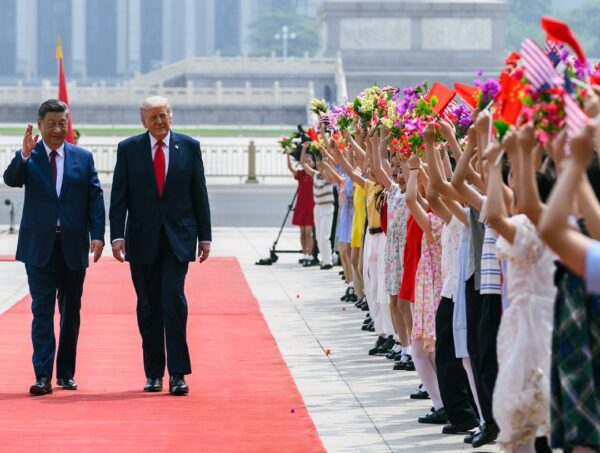
During his three days in China, Trump was pageanted and praised by the Chinese state in ways that no American president since Nixon has been feted.
In return, they got a version of the American president that was, in some ways, more Chinese than the Chinese themselves.
Staying very much on topic, Trump peppered his public comments with continued praise of Xi. He complimented the Chinese people. He lightly touched Xi’s arm at least six times, and that was just on the first day, in the public-facing events of Trump’s arrival, reception, and banquet.
Indeed, China hawks in the United States and beyond may have been disappointed that Trump didn’t take a harsh public line against Xi Jinping or the Communist Party of China (CCP). Trump himself was aware of that. “I say it to everybody: you’re a great leader,” he told Xi in the opening remarks of their summit on May 14. “Sometimes people don’t like me saying it, but I say it anyway because it’s true.”
As the visit rolled on, it became clear that Trump’s mission was to insert charm and his own personality into the relationship with Xi, rather to confront him with difficult truths that just don’t seem to go away. Fentanyl, rare earths, intellectual property theft, and out-and-out spying in United States are all still on the table. If Trump was looking for a breakthrough, he didn’t necessarily look for it in major manufacturing or other deals; he found it in reiterating many times over that Xi Jinping is his friend.
The irony of this approach is that it mirrors Chinese behavior when they are trying to woo a competitor, a customer, or a collaborator. There are some stylistic differences in play – a Chinese counterpart may call you an “old friend” even though you’ve only met once before, and rather recently – but it conveys the same message.
From the Chinese point of view, the existence of difficult blood between two people or two countries does not mean that they cannot be friends. They can help each other, they can even genuinely like one another, but they may differ and disagree on the means and methods of getting things done. For Xi Jinping, getting things done means making China as strong as it can possibly be, while absolutely remaining under the leadership of the Chinese Communist Party. For Xi, that is non-negotiable. Trump, too, has a non-negotiable position. He can accommodate the Chinese leader’s position, as long as there is a genuine benefit to the United States, one that helps to Make America Great Again.
The state visit gave Trump the opportunity to reflect on the history of the China-U.S. relationship.
In his reciprocal toast to Xi, Trump addressed the issue of the Chinese workers who were key to the building of American railroads in the 19th century. On the one hand, it was important that an American president, for the first time in a state visit to China, acknowledge the contribution that Chinese workers made to the building out of the United States’ railroads. The Chinese will have appreciated that nod to the common man of 19th-century China. Of course, what Trump’s script did not include were the details of life as a Chinese worker in the America of that day: underpaid; overworked; badly housed; the targets of openly blatant racial discrimination and afterwards, exclusion from the United States completely.
Nonetheless, Trump’s recognition of the Chinese role in building one of the most important U.S. infrastructure projects of the 19th century, from the venue of the Great Hall of the People in the heart of Beijing, in a toast to the Chinese leader, undoubtedly touched a feeling of appreciation among leadership and everyday citizens alike.
Trump also made reference to the contribution made by Theodore Roosevelt toward the founding of Tsinghua University in Beijing, generally agreed upon to be China’s best institution of higher learning, and, as Trump pointed out, Xi’s alma mater. This little note – tying Xi to the U.S. government’s philanthropy over a century earlier, touched a nerve, one must imagine. From an American perspective, it was a nice touch. Perhaps not so much from a Chinese point of view.
A further detail deserves mention. There is worldwide speculation that Trump drank alcohol for the reciprocal toasts, breaking his famous and lifelong teetotal policy. The glass, many have written, had bubbles in it, so the inference is that it must have been champagne or sparkling wine.
As someone who has been both guest and host at hundreds of banquets in China (including two at the Great Hall of the People itself), I can attest to the Chinese practice of substituting, for someone who requests it, the alcohol normally served at a banquet with a non-alcoholic look-a-like. The Chinese place no stigma on this slight deviation from the normal protocol. Culturally, Chinese take health and its preservation very seriously, and do not belittle the person who chooses to protect it; quite the contrary. Indeed, anyone who declines to drink alcohol for the sake of health is generally admired and respected.
Suffice it to say that the practice of serving tea, water, or juice at official functions in China is considered a normal departure from serving alcohol. Everyone involved in the preparations surrounding the toasts and the state visit overall would have paid keen attention to a request from the U.S. side to serve Trump a non-alcoholic drink when a toast was called for.
In fact, it is possible, even probable, that no one at the banquet was served alcohol, and that they were all drinking bubbly juice. In May 2025, Xi Jinping outlawed the serving of alcohol and cigarettes at official meetings and receptions throughout the country, another plank in his “Regulations on Practicing Thrift and Opposing Waste.” The new guidelines were put out by the Chinese Communist Party Central Committee and the State Council “to rein in bureaucratic excess and promote frugality.”
As for the trade deals, such commitments – if there were any – appear so far to be mostly verbal, not signed contracts. According to the White House, Beijing approved “an initial purchase” of 200 planes from the U.S. aerospace company Boeing, whose CEO was one of the dozens to join Trump on his trip to China. That was a much smaller number than had been expected, driving Boeing stock down when the announcement was made.
The outlook for agricultural farm goods is more promising. The White House confirmed that “China will purchase at least $17 billion per year of U.S. agricultural products in 2026 (prorated), 2027, and 2028, in addition to the soybean purchase commitments that it made in October 2025.” This is a political win for Trump, whose commitments to U.S. farmers have given him a significant platform for many of his America First policies.
In addition, the access to Chinese markets for American poultry and beef will be restored.
Toward the end of the visit, Xi took Trump to Zhongnanhai, which sits almost directly across the main avenue from the Great Hall of the People. It is the leadership’s compound, reserved for those with sufficiently elevated positions in both the Communist Party and government. It is also where Xi himself grew up. He is the son of one of China’s most respected revolutionaries, Xi Zhongxun, who was a cohort of Mao Zedong and became vice premier of the State Council of China in the late 1950s and early 1960s.
This early privilege in Xi Jinping’s life – a privilege stripped from him and his family amid the chaos and terror of the Cultural Revolution – is as important to understanding the Chinese leader as his later ordeals in rural China, poor and hungry, living in the most basic of conditions. It would be interesting to know if Xi, while touring Zhongnanhai, told Trump, “I grew up here.” Zhongnanhai is as much of a foundation story of Xi’s as Trump’s early years in Queens, New York City, are to him. In Queens, Trump lived in a 23-room mansion, only to lose that environment to the stark discipline of military school.
These two men have more in common than one would initially suspect.