
Hyundai Motor has signed a memorandum of understanding (MoU) with nine other companies to develop a hydrogen ecosystem in Hong Kong, alongside an intergovernmental agreement between South Korea and the territory.
The ten-member consortium spans the full hydrogen value chain and brings together organisations from South Korea, Hong Kong, mainland China and France.

Discover B2B Marketing That Performs
Combine business intelligence and editorial excellence to reach engaged professionals across 36 leading media platforms.
Its central ambition is to produce low-carbon hydrogen by converting landfill gas sourced from within Hong Kong.
Hyundai Motor takes the lead role, with responsibilities covering waste-to-hydrogen production, refuelling infrastructure and the deployment of commercial vehicles.
Hyundai Engineering & Construction will design and build the production facilities, while Korean firm JEA ENG is tasked with designing and establishing refuelling stations.
Hong Kong utility Towngas is a strategic partner across production, distribution and end use, and French environmental services group Veolia will provide on-the-ground support for facility construction.
Chinese firm GUOFUHEE supplies liquid hydrogen equipment and offers technical guidance for liquid hydrogen refuelling stations, and China Inspection Company handles regulatory matters and product certification.
Templewater advises on Asia-Pacific expansion and technology scouting, Chun Wo Construction & Engineering supports refuelling station build-out, and Chun Wo Bus Services will operate the hydrogen bus fleet.
Planned applications include fuel cell buses serving tourism and airport shuttle routes, with refuelling infrastructure to be positioned at high-footfall locations.
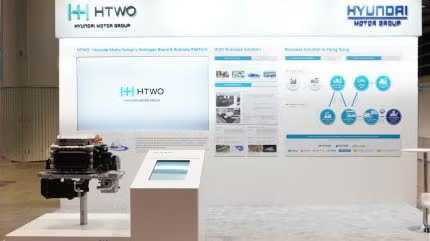
Fuel cell systems for commercial vehicles will come from HTWO Guangzhou, Hyundai Motor Group’s first overseas fuel cell manufacturing facility.
The project is structured as a joint development framework, with Hong Kong envisaged as a regional gateway for the Group’s broader Asia-Pacific hydrogen ambitions.
The consortium is targeting a self-sustaining ecosystem by end-2030, with site confirmation and facility design scheduled for 2027.
The initiative aligns with Hong Kong’s Climate Action Plan 2050, which sets a carbon neutrality goal for mid-century.
Hong Kong published a dedicated Hydrogen Roadmap in 2024 and subsequently introduced vehicle and infrastructure incentives via its New Energy Transport Fund.
Hyundai Motor Group has drawn a parallel between Hong Kong and South Korea, noting that both territories are heavily reliant on imported energy and have limited scope for domestic renewable generation.
The Group has been engaged in Hong Kong’s hydrogen policy space for at least two years, having presented its waste-to-hydrogen capabilities at the city’s inaugural Hydrogen Development Symposium in 2024 and at the 2025 Asia-Pacific Economic Cooperation Workshop.
Hyundai Motor energy and hydrogen policy sub-division executive vice president and head Seung Kyu Shin said: “This MoU was signed as Hyundai Motor’s commitment to advancing Hong Kong’s proactive hydrogen policies and driving the acceleration of its hydrogen ecosystem utilising the Group’s hydrogen business capability and experience.”