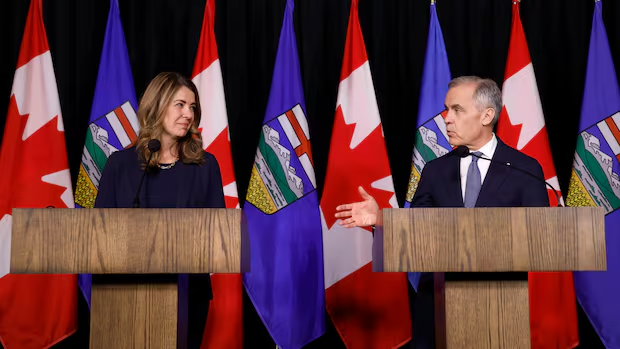
Now that Prime Minister Mark Carney and Alberta Premier Danielle Smith have signed a pivotal energy agreement that could usher in a new oil pipeline, representatives from both governments and industry are sharing their expectations on what comes next.
The agreement sets out a plan for Alberta to increase its effective industrial carbon emissions price in Alberta to $130 per tonne by 2040, and the headline price to $140 by that time. That’s up from its current price, which was frozen at $95 per tonne.
In exchange, Alberta will submit a proposal for a new oil pipeline to Carney’s Major Projects Office by July 1. The federal government says it will “pursue” to designate the pipeline as a project of national interest by Oct. 1.
In a Sunday morning interview on CBC’s Rosemary Barton Live, Intergovernmental Affairs Minister Dominic LeBlanc said the construction of a pipeline is “contingent” on going ahead with the Pathways project — a proposed carbon capture, utilization and storage project.
“These two projects, if ultimately they go ahead, would go ahead together,” LeBlanc told host Rosemary Barton. “We’ve been clear about that from the beginning.”

Alberta’s Social Services Minister Jason Nixon said he doesn’t believe the two projects have to move ahead at “exactly the same moment,” but noted there’s a commitment to “move forward with both of these phases of this agreement.”
“We’re hearing from industry that they believe they can accomplish [Pathways]. There’s obviously going to continue to be hurdles along the way as we make sure that we get this done,” Nixon told Barton in a separate interview.
If all goes to plan, the Alberta government has said design and construction of the pipeline “may commence as early as Sept. 1, 2027.” But significant variables remain, like buy-in from the B.C. government and B.C. First Nations.
B.C. Premier David Eby, who has been a vocal opponent of a new pipeline to the coast, said the federal government is “rewarding bad behaviour” in light of a potential secessionist referendum brewing in Alberta.
Plus, there’s the question of the business case.
Adam Waterous, executive chairman of Strathcona Resources, said he views the whole agreement as a mixture of good and bad news. While Ottawa is less resistant to a new pipeline, the raised carbon price is still a tough pill to swallow.
“That’s a pretty tough message to hear, as you can appreciate,” Waterous said. “That’s the first dominant reaction on carbon pricing.”
A Friday statement from the Oil Sands Alliance, which represents five of Canada’s largest oilsands companies, said the new agreement “provides greater clarity” on the industrial carbon tax but ultimately adds uncompetitive costs to Canada’s industry.
Waterous also said the oil industry has a “different view” on how valuable “decarbonized oil” is on the world stage, contrary to the prime minister’s comments.
“They have not seen evidence that buyers will pay a premium for decarbonized oil,” Waterous said.
The term “decarbonized oil” is not clearly defined, but Smith and Carney have used it in the past to describe oil with less carbon in it due to carbon capture and processing technologies.
Environmentalists have disputed this notion and argue the term is a form of greenwashing.
The key private proponent
Also at issue is whether a private proponent will emerge to take on the project. There currently isn’t one, but the Alberta government has said it will act as the proponent in submitting the proposal to the major projects office.
Nixon said conversations with industry are going “very, very well” and if Canada’s regulatory environment continues to change, the Alberta government is confident it can find people who can get the pipeline built.
When asked whether Alberta would have a private proponent by the July or October deadlines, Nixon said it will be up to Alberta’s Department of Energy.

Nixon also said the new carbon pricing agreement provides stability to industry players, who can assess the impact of the carbon price, though it will mean higher costs for those companies.
LeBlanc said after Alberta submits its proposal, the federal government “will obviously look at the details of that proposal” and make a decision in the fall whether it meets the criteria of a project in Canada’s national interest.
“There are a series of criteria that go into those considerations, one of which, of course, is consultation with Indigenous rights holders. So all of that is very much part of this process,” LeBlanc said.
Concern from environmental groups
The agreement has raised serious concerns among Canadian environmental groups over whether the federal government is abandoning the climate targets it set under former prime minister Justin Trudeau.
On Friday, the Pembina Institute said the deal will “undermine clean energy investment and accelerate climate change,” while the Canada Climate Institute said it will “put Canada’s target of net zero by 2050 well out of reach.”
Carney dismissed those concerns, arguing that the federal and Alberta governments had agreed in writing to reaching net zero emissions by 2050, and that the deal “more than compensates” for the potential emissions increase from a new pipeline.

After reaching an agreement with Alberta to update their emissions price increase to $130 per tonne by 2040 from the national schedule of $170 per tonne by 2030, Prime Minister Mark Carney said the federal government has started consultations with other provinces ‘with the intention of having a consistency across the federal backstop.’
“This is climate action. This is investment, this is moving forward,” he said.
Former environment minister Catherine McKenna said on social media the agreement is “so disappointing.”
“Dismantling Canada’s climate plan to meet the demands of a reckless premier and rich oil and gas companies not only increases our emissions, it undermines our competitiveness as the clean energy transition accelerates — and it leaves our kids to pay the price.”
It’s not clear how the agreement will impact the federal government’s emission reduction targets. The federal government did not provide modelling of its own as it detailed the announcement on Friday.
When asked about Canadians who may feel they’ve been duped over the Carney’s government position on climate change, LeBlanc said: “I don’t think they were duped at all.”
“I understand that people tend to focus on one particular project,” LeBlanc said, but he added that the Alberta agreement should be viewed in “a context of a government that’s doing a great deal” on renewable energy and upgrading Canada’s electricity grid.