-
Bill Connelly
Close
Bill Connelly
ESPN Staff Writer
- Bill Connelly is a writer for ESPN. He covers college football, soccer and tennis. He has been at ESPN since 2019.
Multiple Authors
At the start of the Premier League season, the top questions were clear: Could Liverpool repeat? The defending champions had spent over $500 million to deepen and freshen up their squad, but did that throw off their balance? And what might Mohamed Salah have in store after the contract year of all contract years?
The answers: No, yes, and not much. Liverpool lost six of seven league matches in a spell from late-September through late-November, then went another five matches without a win in January. Their rapid demise opened the door for a different champion, and Arsenal marched right in.
We think. The Gunners lead a charging Manchester City by two points in the table, they probably still have to win their last two matches, and they really haven’t been the best team in the league since January or February. But they’re close.
We’ll see if they can finish the job over the next two weekends. But in the meantime, it’s time to check on everyone’s form one last time before the season ends.
Below are our final updated power rankings for the 2025-26 season, followed by some analysis of the most notable changes from our previous rankings in February. Arsenal and City lead the way, but pretty much every team between No. 3 and No. 15 is up for debate. Here’s what we came up with.
The updated Premier League team rankings
Our re-rankings — the combination of the individual rankings from Bill Connelly and Ryan O’Hanlon — are listed along with the last rankings from February, and each team’s present points total and ranking in the Premier League table.
 Man City are back to No. 1. What took so long?
Really, Manchester City are always supposed to rank No. 1 on a list like this.
They have the most celebrated manager of the 21st Century leading what has been, per Transfermarkt, the most high-value roster in the league every season since 2016-17. (That season, they were the second-most valuable behind the Chelsea of Eden Hazard, N’Golo Kanté and Thibaut Courtois.) Best talent + best coach = best team — that’s not particularly advanced math there.
This is, however, the first time City have ranked No. 1 on this list since early in the 2024-25 season. After the typically excellent start to their Premier League campaign that season — 23 points in nine matches and a one point lead over a torrid Liverpool — Pep Guardiola’s squad fell into a funk that, depending on how you define it, lasted well over a year.
In 51 league matches from Nov. 2, 2024, through Jan. 19, 2026, Man City lost 14 (27.5%) — that’s a total most teams would happily accept on the spot, but it was a spectacular letdown for a team that had lost only 15 of their previous 153 league matches (9.8%) before that run.
They spent €218 million to bring in five players in January 2025, and then spent another €302 million on nine more arrivals in this season’s two transfer windows. They brought in new attackers, new midfielders, new defenders and new goalkeepers. But it took until midway through the January window for City to finally begin looking like full City again.
What was the problem? What held them back to such a significant degree that they spent more than a year as, gasp, merely the second- or third-best team in the best league in the world? The answer is the same as it’s always been: transition defense.
Typically when City fall into a funk, for however long, it comes because opponents have found holes in their transition game. Guardiola always plugs those holes, but it took a while this time: Among the 17 teams that played in both of the Premier League seasons in this 51-match span, City ranked dead last in xG, or expected goals, allowed per shot. Arsenal ranked fourth. You can overcome that if you’re allowing fewer shots, but while City ranked fifth in shots allowed per possession, Arsenal ranked first. Checkmate.
City enlivened their attack with recent additions like Rayan Cherki and Antoine Semenyo, but they almost always have a better attack than Arsenal. When the tide turned back toward Manchester City is when they began defending again.
They’re unbeaten in their last 14 league matches, a span in which they’ve both scored the most and allowed the fewest goals in the league. They’re seventh in xG allowed per shot in this span; if they rank in the single digits in that category at any time, they’re probably the best team in the league.
City have climbed back to within two points of Arsenal with two matches left in this year’s title race. With any Arsenal slip-up, they might still be able to sneak away with another title. Regardless, they’ve again looked like they’re supposed to in the home stretch. — Connelly

 The collapse of the Champions League clubs
Now that we’ve got the good teams out of the way, let’s check in on the defending Premier League champs and defending Club World Cup champs.
It’s … not great!
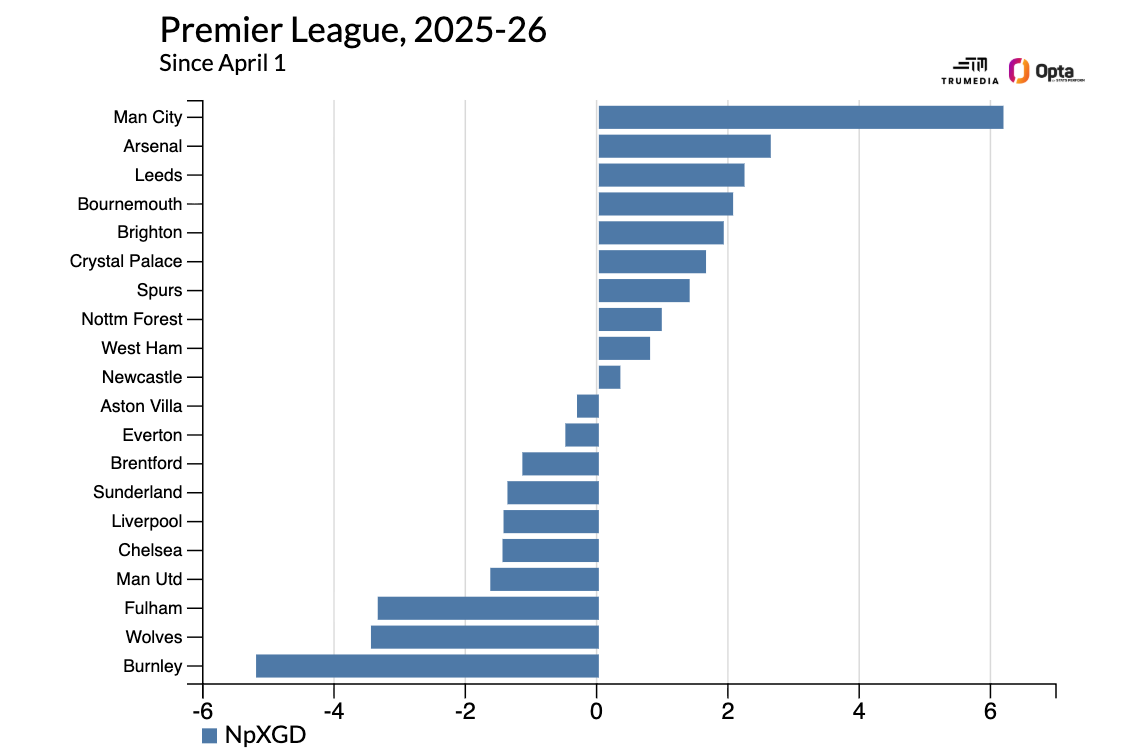
Yes, you’re interpreting that correctly. Both Liverpool and Chelsea have negative non-penalty expected goal differentials since the start of April. In fact, the only two sides who have been definitively worse are Fulham, Wolves, and Burnley — two already-relegated sides and one old team with very little to play for.
The collapse of Liverpool and Chelsea has been accompanied by a descent into what I like to call the “Fulham Zone,” or what may be soon called the “Carrick Zone.” This is the limp state of tactical affairs when your team are able to maintain possession outside of the attacking third but also completely unable or unwilling to press the opposition high up the field.
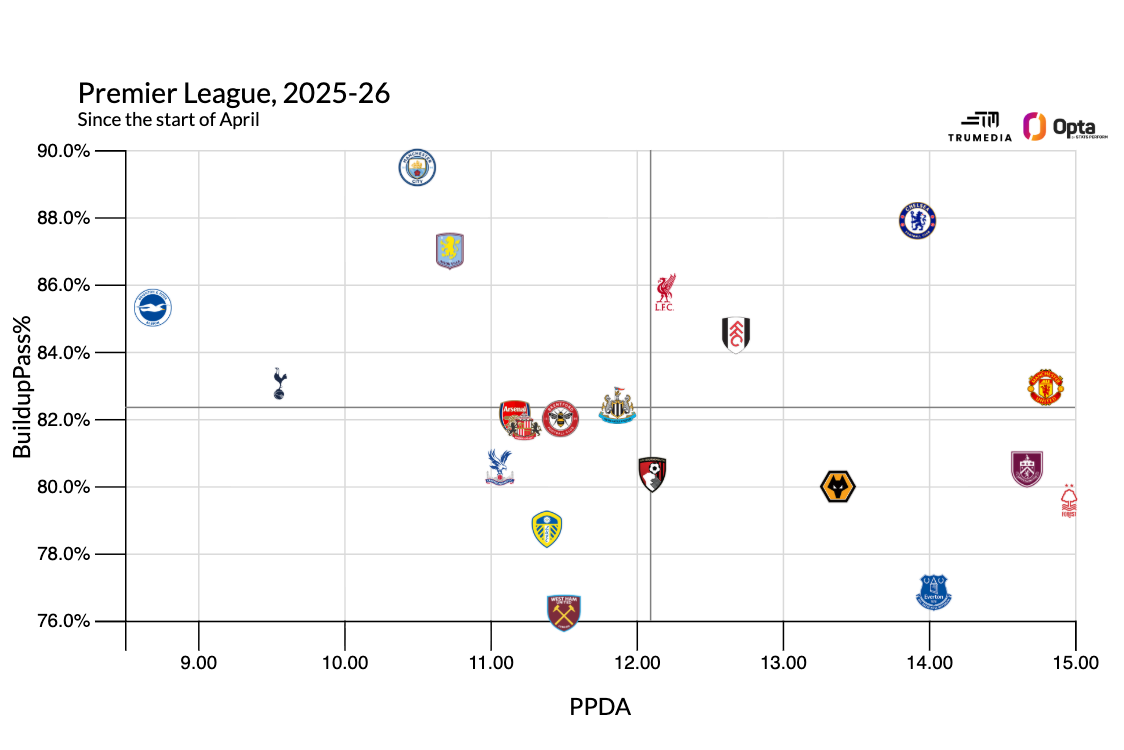
A good chunk of the explanation for Liverpool’s struggles — both to press and then generate any kind of sustained threat with all of their possession — is injury. None of Florian Wirtz, Salah, Hugo Ekitike, or Alexander Isak have played even 75% of the minutes. Wirtz is the only one above 70%, while the other three are at 50% or below.
Most of the team’s attacking investment — either through salary or transfer fee, or both — this season went toward these four guys, and they’ve barely been able to lean on any of them since the start of April.
While Liverpool have still ground out enough results for the collapse to not really put their Champions League hopes in danger, Chelsea had that whole six-game losing streak that cost Liam Rosenior his job and torpedoed their hopes of being back in the competition next season. Over that stretch, they scored one goal from 7.66 xG and conceded 14 from 9.05. That’s both incredibly unlucky and very poor.
To all that we can add Manchester United’s relatively unimpressive underlying performances. Then we have Newcastle in the bottom half of the table; Isak is still their leading Premier League scorer since the start of last season despite leaving in September. There’s Aston Villa getting by on smoke and mirrors, and don’t think we forgot about you, relegation-threatened Tottenham.
Outside of Arsenal and City, all of the Premier League’s best clubs are, well, kind of bad. — O’Hanlon


 The top-six (?) race
What about some teams who are actually playing well, both relative to the money they can spend and relative to everyone else in the league?
At this point, I’d say Brentford, Brighton, and Bournemouth are the three best-run clubs in the league. They all consistently win more games than they should despite losing their best players seemingly every summer. They all seem to be a step or two ahead of everyone else — they understand what actually wins games, and they know how to cultivate it despite their strange place within the weirder European-soccer market.
Any of these three sides finishing in, say, seventh, is a massive success, but that never gets the credit it deserves because it doesn’t involve Champions League qualification, so we rarely talk about it.
Until this year — maybe.
If Aston Villa finish fifth and win the Europa League, the sixth-place finisher in England will also qualify for the Champions League. Per the projections from Simon Tinsley, there’s currently a 63% chance that Villa finish fifth. And based on the most recent odds from Draft Kings, Villa’s implied odds of beating Freiburg in the Europa League final are 71%. Combine those two percentages together, and there’s about a 45% chance that sixth-place becomes a Champions League place.
If that happens, who is going to get it? Per Tinsley’s projections:
• Bournemouth: 49% chance of finishing sixth
• Brighton: 33%
• Brentford: 3%
There’s also a 9% chance Brentford and a 4% chance Brighton actually finish in the top five and don’t need to hope Liverpool stop the rot and Villa beat Freiburg.
Bournemouth are the favorites because they’re in sixth right now, while Brighton are two points back and Brentford are five behind. The Cherries lost their best player, Antoine Semenyo to Manchester City in the middle of the season, and then went on to win the most points of any club not located in Manchester.
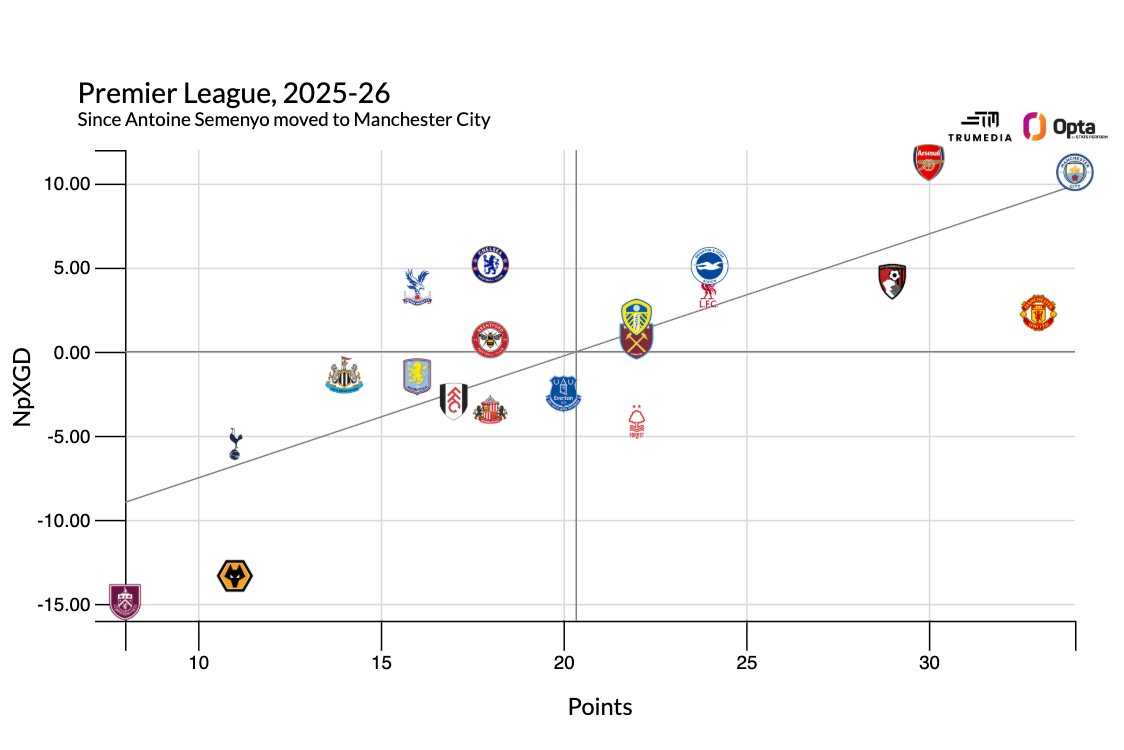
Brentford lost their manager and their two starting forwards in the offseason, and then immediately got better? While Brighton have probably been the best of the trio of top-six challengers from start to finish — despite none of their young attackers or midfielders really making the leap this season. Instead, it’s been their young Dutch goalkeeper, Bart Verbruggen, and their young Dutch center back, Jan Paul van Hecke, who have developed into stars.
At the very least, one of these teams deserve to be in the Champions League next season. — O’Hanlon
 Villa’s attack needs sprucing up
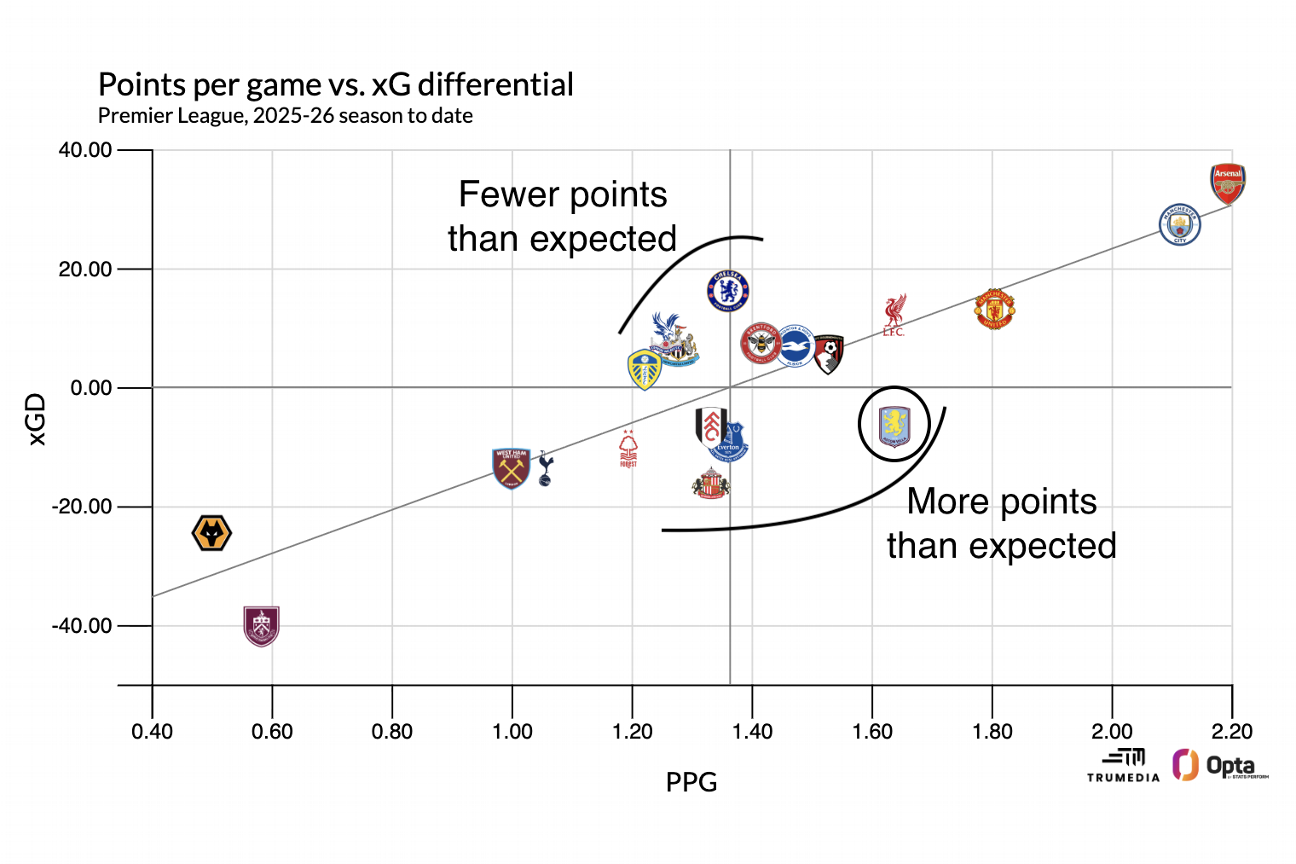
There are basically two ways to finish near the top of the Premier League: Either you figure out how to control games and create better opportunities than your opponents (as represented by your xG differential), or you figure out how to steal points when you don’t.
Arsenal and Manchester City have done both very well in 2025-26; that’s why they’re the top two teams. Aston Villa, meanwhile, will likely play in the Champions League next season because of their masterful work in the latter category.
Villa have suffered a negative xG differential in 20 of their 36 games this season, the same percentage as 11th-place Fulham and a higher-percentage than 13th-place Newcastle, 14th-place Leeds or 15th-place Crystal Palace.
But they’ve nearly clinched a top-five finish because they’ve generated 24 points from those 20 matches. Only Everton (25 in 23 matches) have generated more points from negative xG differentials. And it’s created a situation in which, with just a plus-4 scoring margin, Villa are in line for a great finish.
Granted, most of those points were earned earlier in the season. Over the last couple of months, they’ve simply stunk in Premier League play: They’ve suffered a negative xG differential in six of their last eight league matches, and they’ve taken only two points from those six.
We might ascribe some of these struggles to their push for the Europa League title — they reached the final by thumping Nottingham Forest last week — but since they haven’t clinched a top-five finish by any means, we can’t say they’ve simply punted on these league matches either.
No takebacks, of course. If they qualify for the Champions League next year — either by holding onto their current four-point lead over sixth-place Bournemouth or by beating Freiburg in the Europa League final — they’ll be there no matter what xG thinks of them.
And besides, Unai Emery is a persistent overachiever versus the stats: Villa have ranked higher in points per game than in xG differential each year that Emery’s been at Villa Park. But at 12th in xG differential, they’re quite a bit lower than they finished in either 2023-24 (seventh) or 2024-25 (eighth). That’s an alarm bell.
Villa’s shot quality has regressed significantly this season: They’re 17th in xG per shot, and while they certainly missed midfielder creator Youri Tielemans when he was injured, they would still rank just 13th looking at only the games he’s played. They’ve created almost no easy opportunities — despite playing with a defensive line high enough for them to rank second in the league in offsides drawn, they’re 17th in high turnovers forced (8.4 per game) and 19th in ball recoveries.
Runs of high-level finishing from players like Morgan Rogers (nine goals from shots worth 6.8 xG) and Emiliano Buendía (six goals from 3.3 xG) have earned Villa enough points to remain in the big-time. But they’ll need an attacking energy boost before next season. — Connelly
 Leeds have been legitimately strong for six months
Back on Dec. 3, Arsenal beat Brentford to move to five points ahead of Manchester City in the Premier League, Real Madrid thumped Athletic Club to stay within one point of Barcelona in LaLiga and Leeds United began to look like a Europe-worthy team.
With goals from Jaka Bijol, Ao Tanaka and Dominic Calvert-Lewin, they pummeled Chelsea 3-1 at Elland Road. And while a win over Chelsea would come to seem less impressive than it did at the time, it kickstarted a run of Leeds form that they have mostly maintained since.
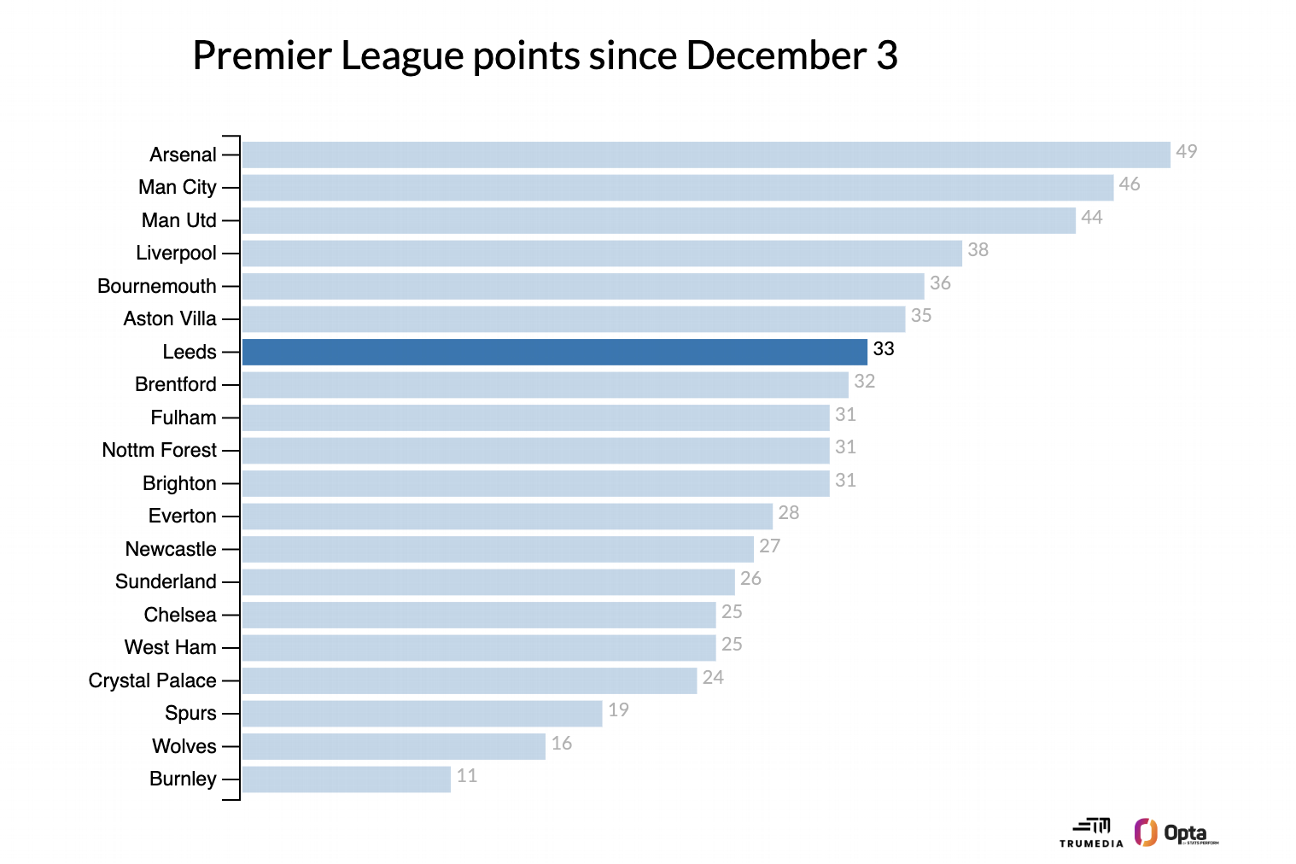
Since Dec. 3 — an arbitrary starting point, but one that creates a reasonably significant sample of 22 to 23 matches for Premier League teams — Leeds are seventh in the league in points per game, sixth in xG differential and fifth in goal differential. In this span, only Arsenal and Liverpool have scored more from set pieces (and no one’s attempted more shots from them), only Bournemouth have made more defensive interventions, only Manchester City have started a higher percentage of possessions in the attacking third, only Brighton have created more high turnovers, and no one has scored more goals from high turnovers. No one has attempted more aerial duels either.
Daniel Farke’s team have mastered a unique blend of pressing, directness and old-school crosses and ball-into-mixer tactics, attempting to win the ball back in vulnerable areas, then retreating into good counterattacking positions, lumping the ball forward (or asking someone like Ethan Ampadu or Gabriel Gudmundsson to carry it long distances), aiming for Calvert-Lewin’s forehead whenever possible and happily forcing corners at every opportunity. So many specific players have found fun, specific roles:
• Calvert-Lewin first in the league in this span in goals (11), xG (13.8) and aerial attempts (222!)
• Anton Stach is third in chances created (46), first in crosses from corners (76) and fifth in ball recoveries in the attacking third.
• Brenden Aaronson eighth in assists (four) and ninth in ground duel attempts (198).
• Ampadu is third in interceptions (36) and seventh in ball recoveries (117).
• Gudmundsson ninth in ground duels won (98).
• Pascal Struijk is third in defensive interventions (344).
Does this mean anything for next season? It’s hard to say with confidence. Farke hasn’t created some new, unstoppable style of play — he’s just figured out what his guys are good at and crafted something competent around them. The Premier League always adapts to you, and Leeds will have to figure out some new surprises next season.
But after years of watching promoted teams immediately get relegated because of a pure lack of talent and/or ideas, Leeds’ adaptability and reasonably long spell of solid play is to be celebrated. They were 17th in the table on Dec. 3, just three points outside the drop zone, and they have since comfortably saved themselves. — Connelly
 Is Roberto De Zerbi the new Sam Allardyce?
Spurs just might do the thing everyone expected at the start of the season: not be relegated to the Championship with one of the most expensive squads in the world. They don’t deserve any praise here, but it’s at least worth pointing out how it might happen.
While most of their issues are down to the team’s terrible squad construction, they’ve also been managed quite poorly. Thomas Frank tried and failed to bring his Brentford approach to Tottenham, and midtable-type tactics — intensity off the ball but very little control — led to relegation-level results. Then, Igor Tudor did a Sam Allardyce and told everyone it was time to accept the reality: we stink, so we need to just defend, defend, and defend, and hope that we score enough goals.
That ended up being even worse, and his spell with Spurs will go down as one of the worst managerial runs the league has ever seen. The vibes and the performances got even worse.
Now, bringing in Roberto De Zerbi, perhaps Europe’s least-capable vibes-improver, seemed questionable, but he’s made an immediate impact. The team is clearly better with him on the sideline, despite more players being injured than under either of his two predecessors:
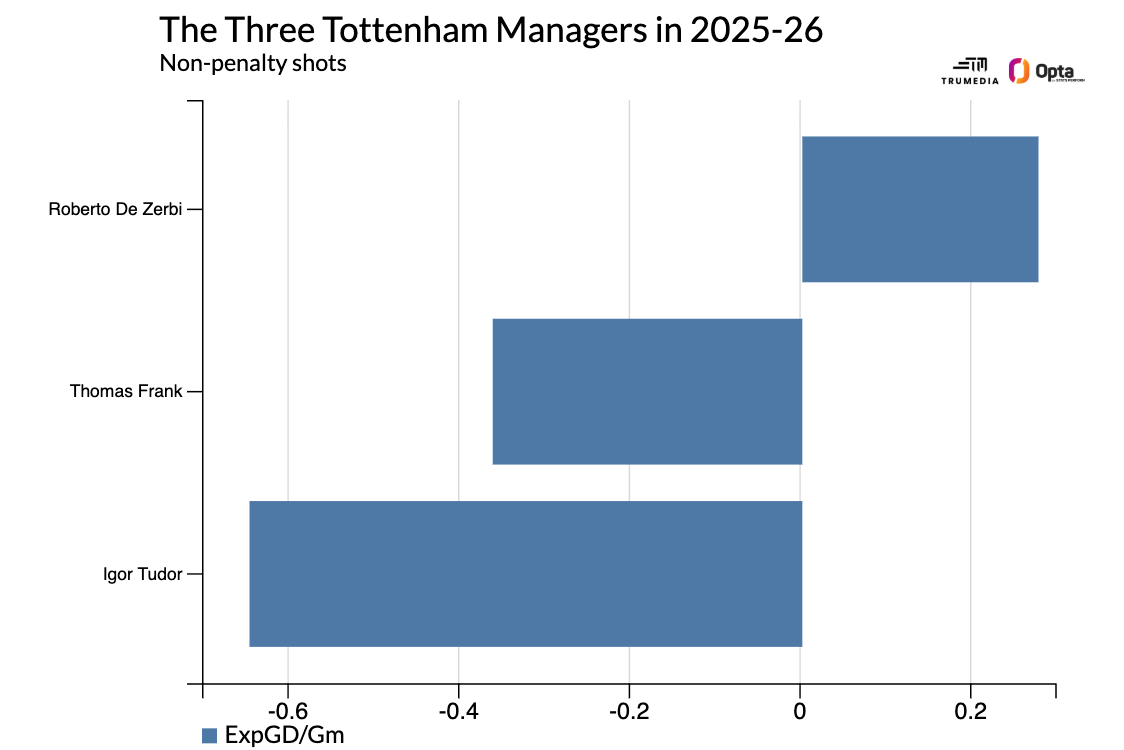
So, how has he done it? By getting the team to keep more of the ball.
Spurs still don’t have any creative passers, but they have a bunch of players who have played on teams where they’ve taken a lot of touches and at least retained possession with their passing. And so, De Zerbi’s Spurs are averaging a full seven fewer possessions per game than under the previous two managers.
They’re playing a much lower percentage of their passes forward, but they’re also averaging over 50% for final-third-adjusted possession for the first time this season — thanks to a more controlled approach on the ball and by pressing more intensely.
The really interesting thing is that De Zerbi has improved the team by making them more aggressive in keeping and winning the ball back. But it hasn’t made the attack better; no, it’s improved the defense, which has conceded 0.7 xG per game, a 50% decrease from under Tudor and Frank. Given the lack of available attacking talent on this roster, conceding fewer goals was always the more attainable path toward immediate improvement; it just took a a different approach to actually get there.
Tottenham have about an 85% chance of surviving at this point, based on a couple different projections; they’re still not in the clear, and a couple bad bounces or one more bad performance could still doom them. If they do stay up, it’ll be a traditional story in one sense: tightening up the defense. But a unique one, too: a team avoiding relegation by deciding to push forward and keep more possession. — O’Hanlon