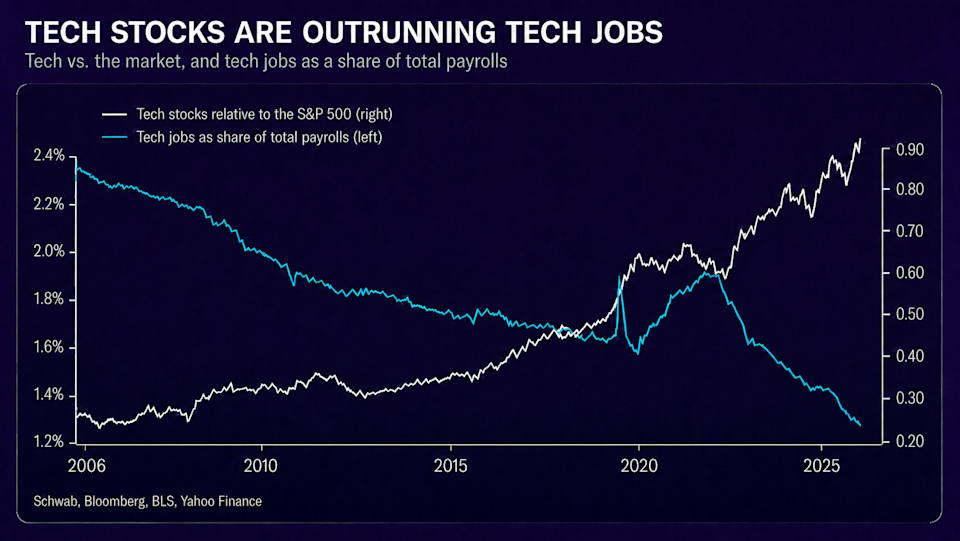
Tech is dominating the stock market and shrinking inside the labor market.
That classic K-shaped divide — usually used to describe the US consumer — showed up again Friday after the April jobs report. But this time, the divergence is inside tech itself: Wall Street is paying the highest premiums in at least two decades for the sector’s stocks while its workforce keeps losing ground.
A chart from Kevin Gordon, head of macro research and strategy for the Schwab Center for Financial Research, captures the divide. Tech stocks are trading at an all-time high relative to the S&P 500. (^GSPC) At the same time, tech jobs — using BLS information payrolls as a proxy — have fallen to an all-time low as a share of total US payrolls.
The latest payrolls report made the labor side harder to ignore.
The US economy added 115,000 jobs in April, and unemployment held at 4.3%, but the gains came from areas such as healthcare, transportation and warehousing, and retail. Information employment — the BLS category used here as a proxy for tech jobs — fell by 13,000. The Bureau of Labor Statistics said the group is now down 342,000 jobs, or 11%, from its November 2022 peak.
That’s creating the new K shape in tech. The upper arm is capital: stocks, market value, AI infrastructure, and companies promising more revenue per employee. The lower arm is labor: software, web, telecom, media, and other tech-adjacent jobs no longer growing the way investors might expect from a sector trading at elevated levels of relative strength.
Corporate news is moving in the same direction.
Cloudflare (NET) fell on Friday after the company said it would cut roughly 1,100 jobs, or 20% of its workforce, while citing AI. Coinbase (COIN) said this week it would cut 14% of workers, or about 700 employees, as CEO Brian Armstrong restructures the crypto exchange for AI efficiency.
This is not a classic tech bust. In a downturn like the dot-com bust, investors usually punish the stocks, and companies cut workers because demand is collapsing. Instead, investors are rewarding companies that can use AI to scale faster, automate more work, and spend heavily on the physical backbone of the boom — chips, data centers, networking, and power — without adding headcount the old way.
There is an important caveat. When the BLS reports payrolls, it uses a category called “information,” which is not a perfect proxy for tech workers. The category includes more than software jobs, and plenty of tech employees work in other industries.
The chart is not implying the stock market is wrong. It’s showing what investors are paying for.