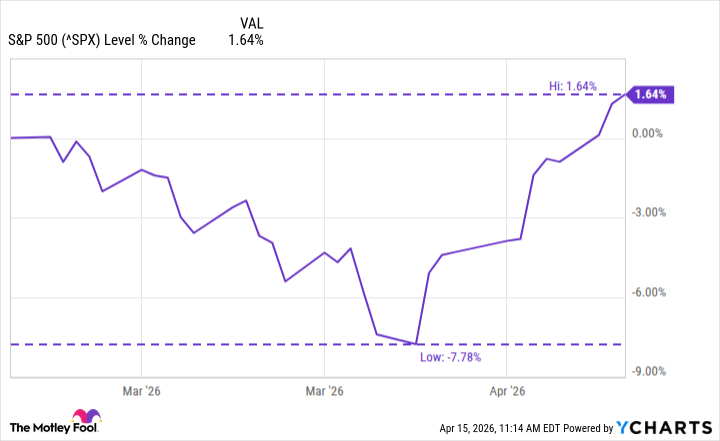
When the Iran war began, most major indexes sold off sharply, including the broader S&P 500 (SNPINDEX: ^GSPC). Geopolitical issues often spook investors, and oil prices spiked after Iran essentially closed the Strait of Hormuz, through which a fifth of global oil flows under normal circumstances.
Furthermore, investors became concerned that the conflict could escalate into boots on the ground or a multi-year affair. Memories of the war in Afghanistan are still fresh in the minds of Americans.
Will AI create the world’s first trillionaire? Our team just released a report on the one little-known company, called an “Indispensable Monopoly” providing the critical technology Nvidia and Intel both need. Continue »
However, the S&P 500 has erased all losses incurred during the conflict and is now up from when the war began.
Here is why long-term oriented investors are now being rewarded.
The market became more optimistic after Iran and the U.S. struck a fragile two-week ceasefire. While initial talks failed to produce a longer-term agreement, President Donald Trump has hinted that talks could soon resume and said the war is “close to over.”
Now, that doesn’t mean things won’t escalate again, but long-term investors aren’t focused on the near term. Research by The Motley Fool shows that the market tends to bounce back from war-induced sell-offs fairly quickly.
While the S&P 500 typically struggles in the three months leading up to a war, when everyone is on edge and anxiety is high, it has been positive three months after the start of a major conflict in every major war, aside from World War II.
In fact, three months after the start of the Korean War, the Gulf War, the Iraq War, and the Afghanistan War, the S&P 500 was up in the double-digit percentile.

Additionally, long-term investors know that historical data shows the longer one holds stocks, the less likely they are to lose money. That doesn’t mean history will always repeat itself, but it supports the idea that long-term investing is a recipe for success.
Finally, astute investors might have noticed that S&P 500 earnings estimates have remained remarkably strong this year. Heading into earnings season, the Wall Street consensus estimate projected the S&P 500 would grow earnings by over 16% in the first quarter of 2026, the highest level observed in four years.
While there has been a lot of noise this year about artificial intelligence, private credit, or the Iran war, investors may be reluctant to sell when the Street is expecting such strong earnings growth. I actually think the market had a fairly modest sell-off, given that oil prices rose so rapidly and exceeded $100 per barrel.