Asked on the Automotive News panel at the New York International Auto Show what he thought was the biggest shift in the car market since 2024, José Muñoz, president and CEO of Hyundai Motor Company, didn’t hesitate. “Two years ago, we thought that by 2026 we’d be heading to full electrification,” he said. “The EV market is growing, but at a slower pace than we thought. The important lesson we learned is to be more flexible. We didn’t see the EV growth, but we’ve seen 60 percent growth in hybrids—and our dealers are grateful.”
Muñoz said that Hyundai, which competes with Chinese-made cars in every market except the US, said it’s impossible to go up against Chinese-made cars on price. “If you enter into that, you’re dead,” he said. “You have to counter Chinese cars with quality and a great dealer network.”
Staying on the China theme, John Bozzella, president and CEO of the Alliance for Automotive Innovation (representing carmakers), accused Chinese companies of selling below cost. “We support international competition, but only if it’s fair,” he said. “We want a level playing field. If [the Chinese] can’t play that way, they shouldn’t be in our market or building here.”

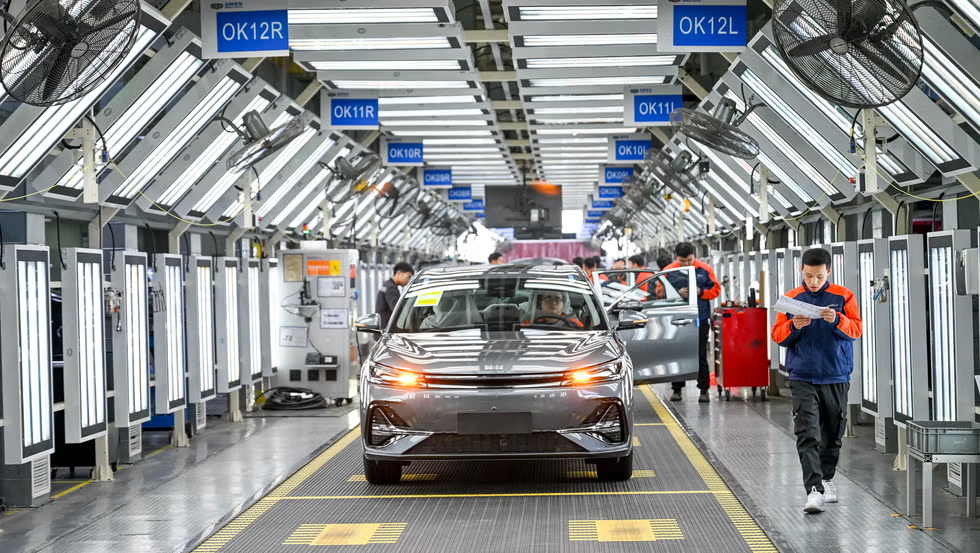
An automobile manufacturing company in China.
The National Automobile Dealers Association (NADA) President and CEO Mike Stanton voiced strong support for the Trump administration’s anti-EV stance and efforts to keep Chinese automakers out of the US market. “Two years ago, we were focused on what the government wanted—now we’re offering what the customers want,” he said. “Our dealers want to keep the Chinese out of the US. They see what happened in Canada, and they don’t want us to follow suit.” The Trump administration recently said that Chinese EVs won’t be able to cross into the US from Canada.
Beyond China, the panelists seemed to be looking for scarce stability in the auto market. Bozzella said, “It’s a complex industry and critically important to the US economy and national security. And we’ve experienced regulatory whiplash, with the whole playbook changing with each election. What we want is some certainty, and there’s more uncertainty in the industry now than I’ve seen in my 25 years in the business.”
A step in the right direction, Bozzella said, would be ratification of an updated United States-Mexico-Canada Agreement (USMCA). “We benefit from seamless trade with Mexico and Canada,” he said. Reading the wind direction is what convinced Hyundai to move as much production to the US as possible. “Eighty percent of what we sell in the US will be built in the US by 2030,” Muñoz said.
Stanton said the dealers are in a good place now. “We can weather the storm if we remain nimble,” he said.
Jim Motavalli is an auto writer and author (nine books) who contributes to Autoweek and Barron’s Mansion Global. He has written two books on electric cars, Forward Drive (2000) and High Voltage (2010), and hosts the Plugging In podcast.
Motavalli’s writing has appeared in the New York Times, CBS Moneywatch, Car Talk at NPR, Forbes, US News and World Report, Sierra Magazine, Audubon, and many more. In his spare time, he reviews books and jazz.