
As the art world urgently searches for fresh commercial and institutional models to respond to the shifting tastes and behaviors of younger audiences, a new art space launching during Hong Kong’s Art Week is already showing the potential to operate differently—even before opening the physical doors of its first Salon. Serakai Studio describes itself as a forward-thinking investor in the real estate sector, a cultural think tank and an R&D hub, developing new hybrid cross-industry models to support artistic and cultural production while embracing contemporary creativity in all its forms. This month, Serakai Studio is launching GOLD, the first of a series of forthcoming Salons in Hong Kong, Tokyo, and Bangkok, designed to support, amplify and expand creativity in Asia while exploring how culture intersects with the built environment to reshape neighborhoods and empower local creative ecosystems.
Leading it is Tobias Berger, former director at Tai Kwun Contemporary and now curatorial director at Serakai, who conceived the new hybrid platform with executive director Daniel Szehin Ho and a dynamic, relatively young but highly motivated and knowledgeable team from different disciplines and cultural backgrounds. Some members come from design and fashion rather than the visual arts; others are involved in performing arts, music or technical production. And Serakai’s founder, Benjamin Cha, has worked on some of Asia’s most dynamic retail, mixed-use and cultural landmarks. Together, they want to rethink and redesign what a cultural and art space can be.
Housed at street level in a former bank and jewelry shop in the heart of the dynamic Wong Chuk Hang district, GOLD will be a hybrid cultural test lab, serving simultaneously as an exhibition space, concept incubator and gathering point for creative exchange—where disciplines mix while testing new models of sustainability for artistic and creative production. “Serakai Studio represents a much bigger vision,” Berger tells Observer. “The idea is for it to function as a place for research, a kind of test lab, but also as a way of gathering information about things we are currently interested in and believe are important for the present and the future of contemporary culture in Asia.”

This emphasis on researching new models—and the think-tank dimension required to develop them—is exemplified by Serakai Studio’s first launch: a highly curated annual journal of critical long-form essays, CONG, which has already established itself as a taste-defining publication. “A magazine can be many things. For us, it quickly became an interesting tool: we knew it could allow us to explore many different areas, and it almost functions as a kind of research magazine,” Berger explains. “The magazine became a way to investigate topics that range from art to design, fashion and new technologies. To meet people, to stay up to date and to build connections across places—from Hong Kong to Tokyo and Bangkok.”
The idea came partly from the realization that they could not find anything quite like it anywhere in Asia or the world. There were publications that touched on individual aspects of what they had in mind, but none that brought everything together in the same fluid way—particularly in the form of long, deeply researched pieces. Very few magazines today publish ten articles of five thousand words that truly dive into a subject in depth. In that sense, Berger noted, they later realized how clearly the magazine filled a gap. “We wanted to explore certain topics, to create artist pages and also to rethink what a print magazine could be today.”
For Berger, print is closely connected to art and curating. “Editing a magazine is about sequencing—placing certain things next to each other, putting certain images after other images, creating a rhythm. That’s something you simply cannot reproduce online.” In that sense, the publication was meant to remind readers that culture is not limited to the digital sphere and that there is still much to explore through physical formats.
He describes the project as a subtle pushback against the accelerated rhythms of contemporary digital culture. While platforms like Instagram and other forms of social media can be valuable, they can also foster a sense of superficiality and fragmentation. What Serakai has observed across audiences in Hong Kong, Japan and Southeast Asia is a growing appetite for slower, more thoughtful forms of engagement: long-form writing, deeper research and conversations that ask probing questions.
“Many are less drawn to large-scale immersive spectacles or blockbuster-style presentations and instead seek work that feels more experimental, challenging and intellectually engaging,” Berger explains. “Young viewers across Asia—particularly those between 18 and 30—are eager to encounter art that pushes boundaries.” They wanted to serve that audience, and the journal allowed them to begin developing the project’s intellectual framework while the search for a physical site was still underway and a community was already forming around it. In all of this, Serakai Studio serves as the overarching framework. “It includes the magazine, the salon—hopefully several salons in the future—and now also things like merchandise production. We function as an experimental platform.”
The ambition was to create something fluid—a platform capable of experimenting with new models for producing and researching contemporary culture. Both Berger and Cha have worked with institutions for many years, and those institutions are most often focused on a single field. “A museum might focus on digital art or visual culture in a very defined way,” the former says. “We wanted to try something different, something more open and experimental.”
They explored several areas of Hong Kong, including Sham Shui Po and North Point. Ultimately, Wong Chuk Hang was the right location, though making that determination took almost two years. In that period, the neighborhood changed significantly and had become more interesting than when they had first begun looking. Once a quiet industrial neighborhood on the south side of Hong Kong Island, Wong Chuk Hang has transformed over the past decade into one of the city’s most important clusters for contemporary art and cultural production. After the long pandemic hiatus in Hong Kong, the neighborhood has returned with renewed momentum, expanding significantly amid a growing ecosystem of galleries, studios, the Arts Development Council, smaller institutions, creative businesses and even technology firms.
This year, for instance, Shanghai-based Antenna Space is opening its first Hong Kong branch on the 19th floor of the Leader Centre in Wong Chuk Hang, while de Sarthe has been expanding its space. Other galleries—including Tang Contemporary, Rossi & Rossi, Whitestone and Axel Vervoordt, which have long been located in the district—have recently been joined by newer spaces such as Podium. “We see it as a place that is really developing and gaining momentum. And of course, other initiatives are also arriving,” Berger notes, acknowledging how the district is clearly in motion and that GOLD aims to contribute to that momentum.
Serakai Studio is specifically interested in fostering these dynamics of urban regeneration, Benjamin Cha clarifies as he joins the conversation. “We are very interested in neighborhoods and in the built environment. First, from the perspective of someone who invests in it, and more broadly, in terms of place-making, context and what exists beyond the walls of the salon itself. Those things are hugely important for us.”
Because contributing to the neighborhood was one of their central aims, securing a ground-floor space—something extremely difficult in Hong Kong—was essential, Cha explains. “It’s about accessibility and about being part of the community. We’re not planning a big, flashy entrance—we want to keep it quite humble—but having a presence at street level already makes a difference.” The building already hosts other cultural initiatives, creating opportunities for mutual support and collaboration, and according to Cha, this proximity has already begun to yield positive and unexpected interactions.
The goal is also for the forthcoming salons in Tokyo and Bangkok to position themselves firmly within their respective cultural ecosystems. While some programming may naturally lean toward local contexts, the aspiration is to focus primarily on the discourse, dialogue and conversations that connect these three cities. The Hong Kong salon will function as the prototype, Cha explains. “What we are trying to do occupies a space—both literally and figuratively—that is still quite new. From an operational point of view, from a curatorial perspective and also from a business-model perspective, it will be a process of discovery.”
The key mission, Berger and Cha emphasize, is to test different models—whether in exhibition design, in the dialogue between disciplines or in the broader structure of programming and sustainability. While they are determined to preserve a curatorial and research-driven approach, GOLD will move more fluidly between culture and commerce in ways that differ from both traditional institutions and galleries, exploring new ways for creativity to live, circulate and take root in urban communities across Asia and beyond.
The salon’s financial model will combine different streams, including ticketed exhibitions and performances as well as collaborations with brands, galleries and other actors across the creative industries—areas that the traditional art world has perhaps not explored enough. Because the project is intentionally cross-disciplinary, some activities may involve shared sales or partnership models. “One of the best ways to support a young artist or designer is actually to sell their work and to sell it fairly,” Berger explains.

GOLD will also host performance-based programming, including music-centered events. The broader ambition is to explore the possibility of what Berger calls an “alternative cultural ecosystem”—one beyond pre-established scripts or conventional power and value dynamics that have long governed relationships between art, commerce and community, built instead on synergies across creative sectors.
After all, as Berger reflects, luxury brands are increasingly interested in crossover collaborations with contemporary artists, seeking to elevate the symbolic value of their products. “The kind of creative energy that can emerge when the fashion world meets the contemporary art world can be really exciting. When it’s done well, it’s wonderful and genuinely interesting. There is clearly a lot of activity around it.” At the same time, the fashion and luxury industries are undergoing a period of transformation. “The market has been slowing down, sales are down, and there’s been a lot of movement among designers at the big houses. But alongside that, there are also new ways for younger designers and emerging brands to reach audiences.”
For Serakai Studio, this moment of flux represents an opportunity. “If the work remains creatively led, it can be a chance to participate in shaping what the next equilibrium might look like,” he says. In this context, it is particularly interesting that projects like GOLD and Serakai Studio are emerging in Asia, where cultural ecosystems—especially in places like Japan—have historically been more comfortable with fluid exchanges between creative disciplines. Hong Kong, in particular, provides an ideal context for such experimentation because the city already has a well-developed art infrastructure, including museums, nonprofit institutions, commercial galleries at multiple levels, artist-run spaces and art schools. And because the project is not tied to a government institution, it is free to be more innovative and take risks that traditional institutions might find more difficult. “Of course, in the long term, the space should also be economically sustainable, but we have the time to develop that. That’s actually a very fortunate situation.”

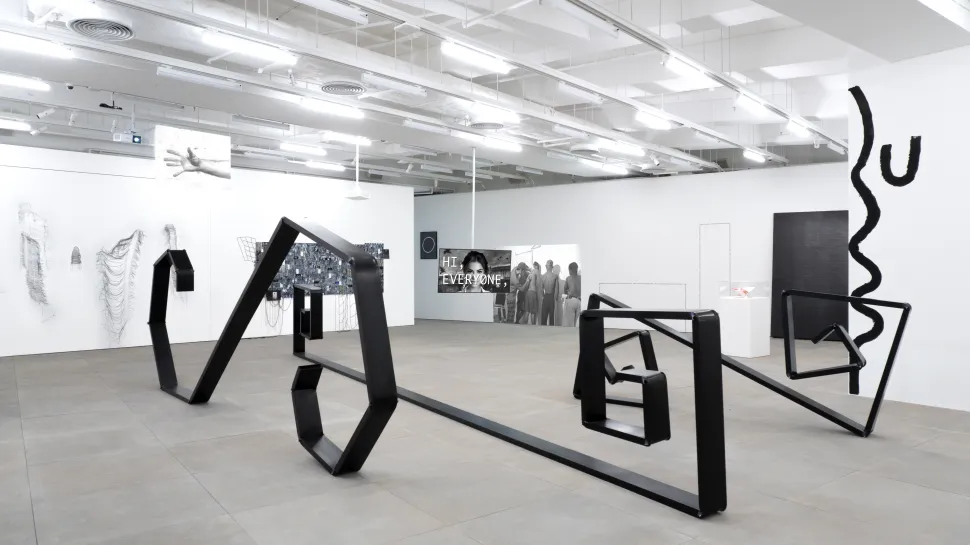
The spirit of experimentation is embodied in the inaugural exhibition, which focuses on uncertainty despite its title suggesting the opposite. Curated by Berger, “CERTAINLY” takes inspiration from artist-composer La Monte Young’s seminal 1960 instructional work Composition 1960 #10, a score consisting of a single directive: “Draw a straight line and follow it.” What initially appears simple and straightforward gradually reveals itself as something far more complex—the line wavers, resists and deviates, becoming a metaphor for creativity, decision-making and the unpredictable forces that shape us. It is precisely within that space between script and intuition, between control and freedom, planning and improvisation, that art flourishes. The lineup reflects this fluid cross-disciplinary approach, bringing together works across media and geographies by artists and creators such as Pak Sheung Chuen, Lousy, Young-Hae Chang Heavy Industries, Santiago Sierra, Shinro Ohtake, Peter Robinson and Weng Io Wong, among others.
But most importantly, the exhibition’s theme also reflects the ethos of this new space: its exact trajectory remains unknown, but by embracing uncertainty, new possibilities can emerge. “We’ve already seen that in other parts of the project,” Berger reflects. “Even with the magazine, we didn’t expect it to become what it did, but it turned out to be amazing. The same happened with some of our other initiatives. We didn’t expect to start so strongly with the first activations and meetings in Tokyo either, but it happened because we took chances, we talked to people, we experimented—and somehow something remarkable is emerging.”
More Arts Interviews