Key Points
Data centers are the facilities that provide artificial intelligence (AI) software with the hardware it needs to operate. Gartner projects that data center spending by big tech companies is set to grow almost 32% to $650 billion.
All that money will be flying in lots of different directions, and it can be hard to keep track of where to put your money in order to capitalize on that opportunity. If you can only buy one stock to profit from the AI hardware trend, what should it be?
Will AI create the world’s first trillionaire? Our team just released a report on the one little-known company, called an “Indispensable Monopoly” providing the critical technology Nvidia and Intel both need. Continue »
The answer, I believe, lies in semiconductors. No matter what software a piece of hardware is running, be it a sophisticated AI algorithm or a garden-variety web browser, it relies on semiconductors.
These chips combine the properties of an electrical conductor and a resistor. They are what have allowed computers to become both smaller and more powerful over the past half-century.
They are why the smartphone in your pocket has millions of times the computational horsepower of NASA’s Apollo 11 guidance computer had when NASA first landed a man on the moon.
And in the semiconductor industry, there is one name that looms large above all the others: Taiwan Semiconductor Manufacturing (NYSE: TSM).
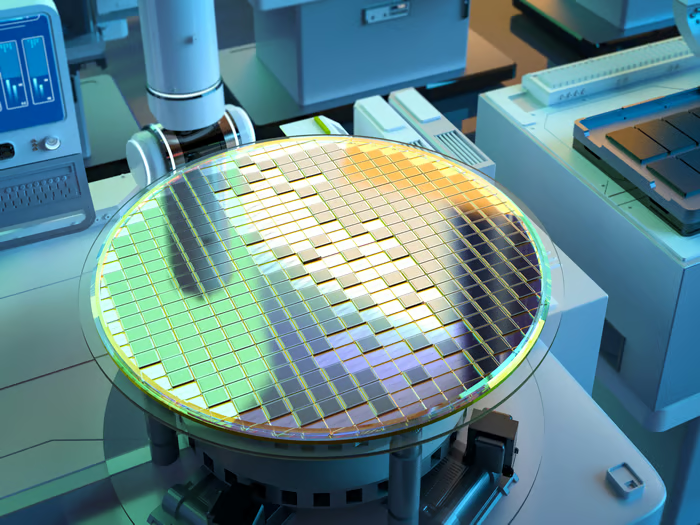
Image source: Getty Images.
Picks and shovels for the silicon rush
Taiwan Semiconductor is perhaps the ultimate pick-and-shovel play in the tech industry. One of the only other companies that could potentially claim that title is ASML Holding, which produces the lithography machines you need to make semiconductors.
Taiwan Semiconductor dominates the foundry market. That means it doesn’t design any of its own chips, it simply produces them for other companies — including basically every major player in the AI hardware industry.
The company’s two biggest customers are Apple and Nvidia, the latter of which has its Blackwell chips manufactured at Taiwan Semiconductor’s Arizona factory. Advanced Micro Devices, Broadcom, Qualcomm, and Intel all contract with Taiwan Semiconductor to produce hardware they designed.
Those contracts are how Taiwan Semiconductor has become the overwhelmingly dominant company in the pure foundry market with 72% market share as of the third quarter. Its nearest competitor in the space, Samsung, has just 7% market share.
And the company is expanding its manufacturing footprint as well. The U.S. and Taiwan reached a trade deal on Jan. 16 that will see Taiwanese companies invest $250 billion in American factories and operations. The largest single player in that agreement was Taiwan Semiconductor, which has committed $100 billion to expand its manufacturing facilities in the United States.
Semiconductor wafers are thin; the profits are anything but
In the fourth quarter, Taiwan Semiconductor recorded net revenue of $33.75 billion, a 25.5% increase from last year. It saw its earnings per share climb 35% and grew profits across the board.
By the end of the quarter, Taiwan Semiconductor managed to grow its gross margin 3.3 points to 62.3%, its operating margin grew 5 points to 54%, and its net profit margin grew 5.2% to 48.3%.
The vast majority of the company’s revenue, a full 77%, came from the advanced chips, those 7 nanometers or smaller. Those are the chips you need to run advanced programs like those involving AI.
And year over year, it’s the high-power computing segment, which includes AI chips, that’s the fastest-growing revenue source for Taiwan Semiconductor. It was up 48% and accounted for 58% of Taiwan Semiconductor’s revenue in 2025. The smartphone market accounted for 29% of the company’s revenue in 2025, so it is somewhat diversified, which means safety for your portfolio in the case of an AI bubble.
Taiwan Semiconductor’s cash and cash equivalents at the end of Q4 2025 totaled $97 billion, compared to total liabilities of $78.2 billion, of which $28.3 billion is long-term interest-bearing debt. It also grew its free cash flow 42.7% year over year in Q4 2025.
All in all, I’d say it’s a good time to be in the semiconductor industry, when everyone is building data centers. Give Taiwan Semiconductor a look, it’s shaping up to be the 21st century’s pick-and-shovel play.
Should you buy stock in Taiwan Semiconductor Manufacturing right now?
Before you buy stock in Taiwan Semiconductor Manufacturing, consider this:
The Motley Fool Stock Advisor analyst team just identified what they believe are the 10 best stocks for investors to buy now… and Taiwan Semiconductor Manufacturing wasn’t one of them. The 10 stocks that made the cut could produce monster returns in the coming years.
Consider when Netflix made this list on December 17, 2004… if you invested $1,000 at the time of our recommendation, you’d have $456,188!* Or when Nvidia made this list on April 15, 2005… if you invested $1,000 at the time of our recommendation, you’d have $1,133,413!*
Now, it’s worth noting Stock Advisor’s total average return is 916% — a market-crushing outperformance compared to 194% for the S&P 500. Don’t miss the latest top 10 list, available with Stock Advisor, and join an investing community built by individual investors for individual investors.
*Stock Advisor returns as of February 27, 2026.
James Hires has no position in any of the stocks mentioned. The Motley Fool has positions in and recommends ASML, Advanced Micro Devices, Apple, Intel, Nvidia, Qualcomm, and Taiwan Semiconductor Manufacturing. The Motley Fool recommends Broadcom. The Motley Fool has a disclosure policy.
The views and opinions expressed herein are the views and opinions of the author and do not necessarily reflect those of Nasdaq, Inc.