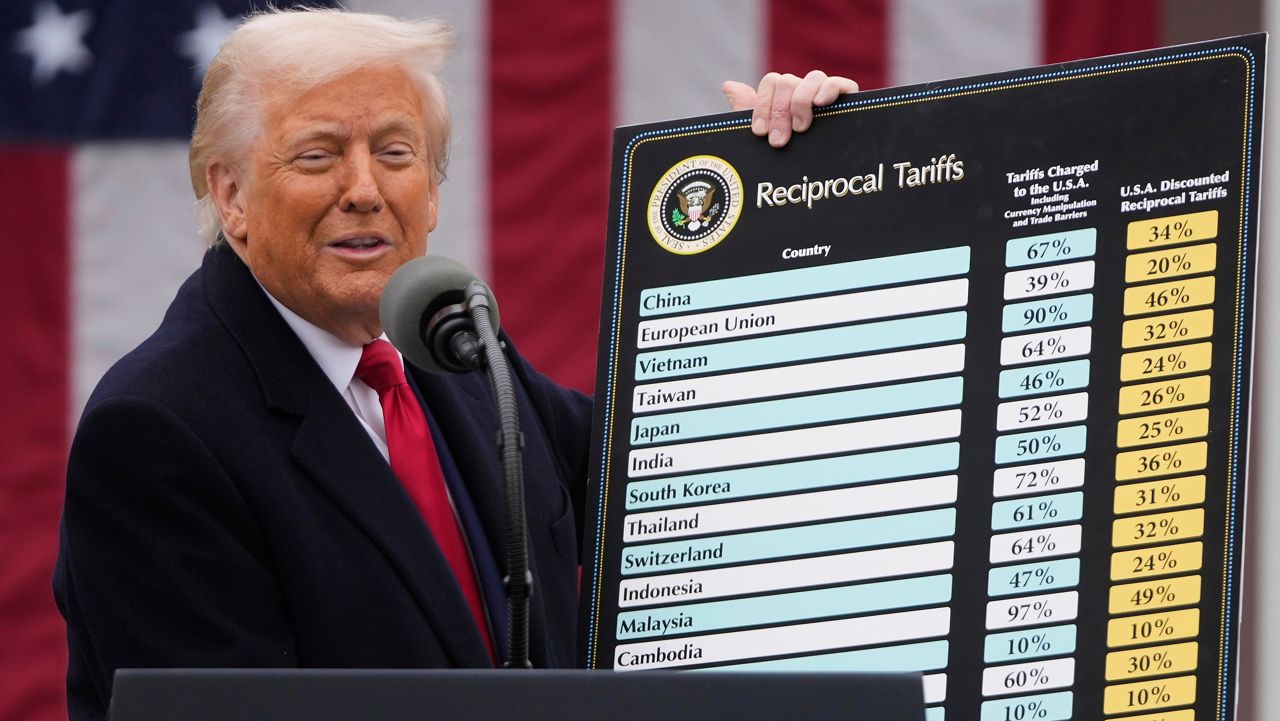
In a 6-3 decision, the Supreme Court struck down President Donald Trump’s far-reaching global tariffs. The country’s top court issued its long-awaited decision Friday, ruling the president does not have the authority to impose sweeping tariffs under the International Emergency Economic Powers Act, or IEEPA, passed in 1977.
“IEEPA’s grant of authority to ‘regulate . . . importation’ falls short. IEEPA contains no reference to tariffs or duties,” the opinion stated. “The Government points to no statute in which Congress used the word ‘regulate’ to authorize taxation. And until now no President has read IEEPA to confer such power.”
“We claim no special competence in matters of economics or foreign affairs. We claim only, as we must, the limited role assigned to us by Article III of the Constitution. Fulfilling that role, we hold that IEEPA does not authorize the President to impose tariffs,” the opinion concluded.
During a wide-ranging interview with The New York Times ahead of the decision, Trump had suggested that he may seek to repackage his tariffs as licensing fees if the Supreme Court ultimately decided to invalidate them.
The president had also repeatedly warned of potential fallout, saying on his Truth Social site, “If the Supreme Court rules against the United States of America on this National Security bonanza, WE’RE SCREWED!” He later called his import taxes “Country Saving Tariffs” in a post last week.
In November, the nation’s top court heard oral arguments for a consolidated challenge from several Democratic-led states and a handful of small businesses over the president’s “Liberation Day” tariffs, as well as ones he levied on China, Mexico and Canada over what his administration described as “the flow of contraband drugs like fentanyl to the United States.”
In both, Trump contended that the situations constituted national emergencies and relied on IEEPA as the justification for imposing tariffs.
During nearly three hours of oral arguments before the justices late last year, attorneys for the plaintiffs insisted that only Congress has the power to tax and argued that tariffs are not included in the scope of IEEPA. They were followed by U.S. Solicitor General D. John Sauer, who contended that tariffs fell under the president’s authority to “regulate foreign commerce.”
Liberal and some conservative justices at the time seemed to express skepticism about the Trump administration’s arguments.
Justice Amy Coney Barrett had asked about logistics of giving refunds to importers if the Supreme Court ruled in favor of the plaintiffs and remarked that the process may be “a mess.”
During that exchange, Neal Katyal, who was representing small-business plaintiffs, contended that only the companies that were party to the suit would be entitled to receive their money back, and other businesses would have to individually seek repayment.
To protect their right to request refunds, retail giant Costco and hundreds of other businesses have launched legal challenges.
Customs and Border Protection estimated in December it collected more than $200 billion from new tariffs last year. Of that figure, approximately $133.5 billion was brought in from IEEPA import duties through Dec. 14, 2025, but that number is believed to have ticked up in the weeks since. Reuters reported Friday that more than $175 billion in tariffs may need to be refunded if the Supreme Court rules against Trump, citing an estimate from Penn-Wharton Budget Model economists.
Reuters recently reported the total amount had reached $175 billion.
Trump had previously speculated that the amount would be even higher.
“The actual numbers that we would have to pay back if, for any reason, the Supreme Court were to rule against the United States of America on Tariffs, would be many Hundreds of Billions of Dollars,” he said Jan. 12 on social media.
Before Trump’s tariffs took effect last year, the U.S. saw a surge of imports of foreign goods in the first few months. The trade-gap then narrowed for most of the rest of the year, the Commerce Department reported Thursday.
But, while the overall trade deficit of goods and services fell to $901 billion last year, the gap between the amount of goods imported versus exported rose to a record-high $1.24 trillion in 2025, the report found, meaning the U.S. ultimately brought in more foreign products than American exporters sent overseas.