Wednesday’s Champions League meeting between Benfica and Real Madrid brings together two managers who know each other very well.
A strong bond was forged between Benfica boss Jose Mourinho, 63, and Madrid’s new coach Alvaro Arbeloa, 43, during three intense years they shared at the Bernabeu between 2010 and 2013.
Mourinho’s time as Madrid coach was tempestuous and divisive — the Portuguese left after falling out with many big names in the dressing room, but tough-tackling defender Arbeloa remained his most loyal soldier throughout.
In an interview with El Chiringuito de Jugones in April 2017, rebroadcast after he replaced Xabi Alonso as Madrid manager earlier this month, Arbeloa was asked to define the ‘Mourinhismo’ approach which so impressed him.
“It’s a way of doing things, always tackling things head on, not being afraid of being who you are,” he replied. “I try to be as Mourinhista as possible.”
That conversation took place just a few months before Arbeloa retired as a player. At the end of the previous season, in May 2016, Mourinho had written an open letter in Spanish paper Marca paying tribute to Arbeloa as he left Madrid, soon to join West Ham for his final campaign as a player.
“To me, Arbeloa is a friend, not just a player,” wrote Mourinho, manager of Manchester United at the time. “He exemplifies passion for his profession, love for his club, dedication to the team and its goals, and humility and honour in his relationships with everyone he works with every day.
“Arbeloa doesn’t have that high profile, but he’s certainly one of those who has given Real Madrid, its fans, all his coaches, and all his team-mates, everything he had — and even what he didn’t have. In my 16 years as a coach, he is undoubtedly among the most important players I have worked with. A great player and an exceptional man.”
Such warm feelings may be put to one side when the two tough competitors meet again in Lisbon. Madrid likely need a draw to secure an automatic place in the Champions League knockouts, while Benfica must win to have any chance of continuing in the competition.
Yet the story of their intense time on the same side, over a decade ago, offers useful pointers on how Arbeloa will approach his new job — often described as the toughest and most demanding in the game.
When Mourinho took over at Madrid in 2010, Arbeloa was a low-profile member of a Bernabeu dressing room that included big-name players such as Cristiano Ronaldo, Kaka, Iker Casillas, Sergio Ramos and Karim Benzema.
Arbeloa told Jot Down magazine in 2014 how Mourinho immediately told his new group they needed to work harder, whoever they were.
“We learned very quickly who Mou was during pre-season,” Arbeloa said. “We were 2-0 down against LA Galaxy at half-time. He roared at everyone, even Cristiano. He said: ‘You don’t want to run? No problem for me. The bench. You neither? No problem for me — you’re out.’ You could be a world champion, or Kaka, or a youth teamer. We remembered that talk a lot.”
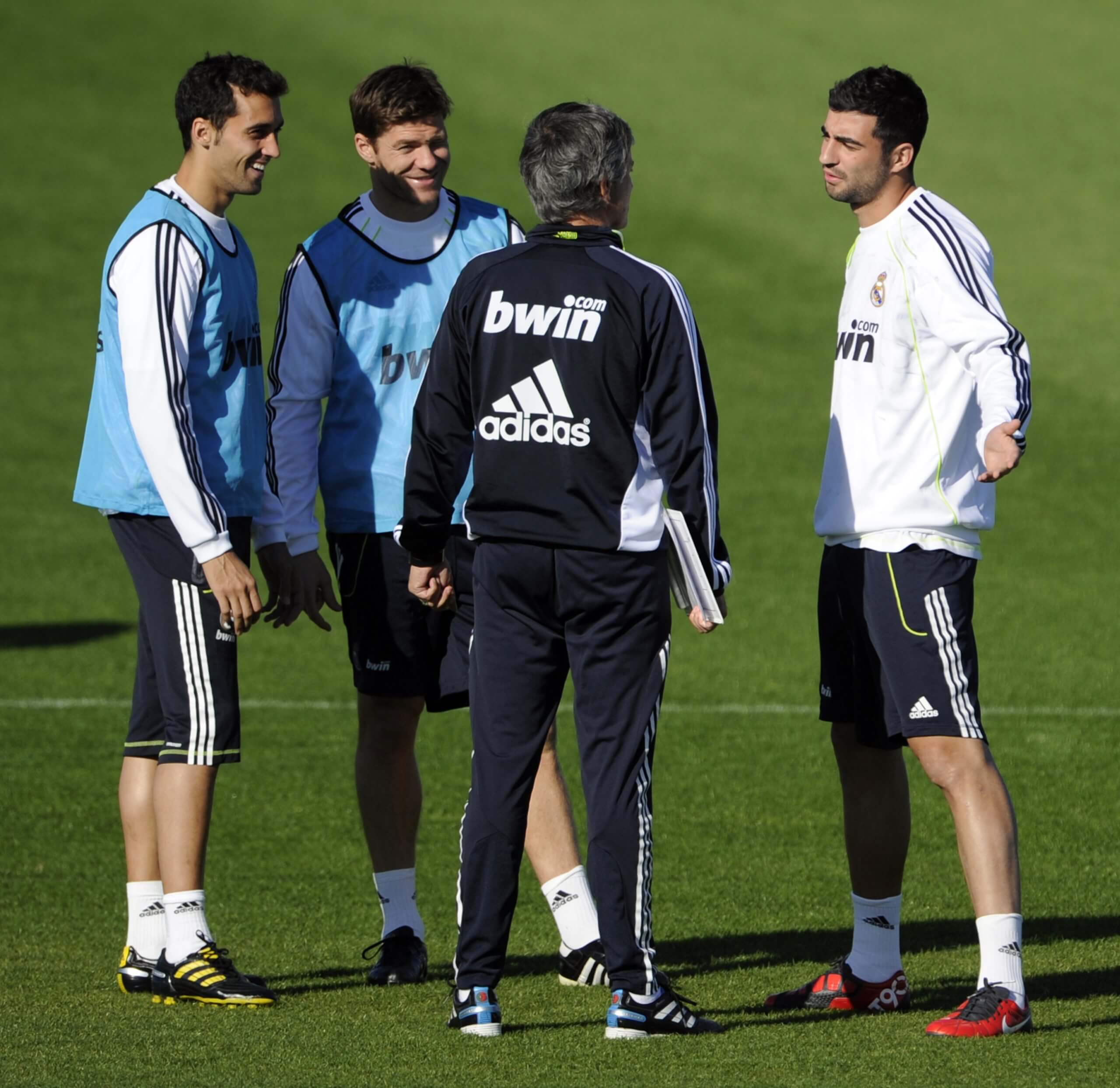
Arbeloa, Alonso, Mourinho and Raul Albiol in Real Madrid training in 2010 (Javier Soriano/AFP via Getty Images)
Mourinho’s challenge was to better Pep Guardiola’s all-conquering Barcelona side of that time, a team that featured Lionel Messi, Andres Iniesta and Xavi. After some early setbacks, his Madrid learned to physically and mentally combat their Catalan rivals. They won a fiery Clasico Copa del Rey final in 2011, then impressively claimed the 2011-12 La Liga title.
That success was celebrated at the Bernabeu, but Mourinho’s willingness to use every possible weapon he could to gain an advantage also brought friction.
Senior dressing room figures, including Casillas and Ramos, rebelled against their boss — especially after he infamously poked the eye of then-Barca manager Tito Vilanova during a touchline brawl at the 2011 Spanish Supercopa. Arbeloa had his own Clasico controversy when he stood on the ankle of Barca attacker David Villa during that 2011 Copa final.
Arbeloa, the man who came to be known as El Espartano (The Spartan), always remained a loyal soldier of Mourinho, and his own personal falling-out with Casillas took a surreal turn when he accidentally kicked the goalkeeper during a Copa game at Valencia in January 2013, sidelining the club captain for a month with a broken bone in his hand.
That drama came during a torrid 2012-13 season, in which Mourinho’s relationship with many other players — including Ronaldo — broke down dramatically.

Mourinho takes Real Madrid training in April 2013 (Dominique Faget/AFP via Getty Images)
When Mourinho left Madrid at the end of that campaign, Arbeloa suggested some team-mates had let their manager down by “selfishly” thinking more about their own reputations than the team’s success.
“Mourinho was willing to take a beating for this club, he always thought of Real Madrid ahead of himself,” Arbeloa said in the Bernabeu mixed zone after the final game of that La Liga season.
“I don’t know if all the players can say the same. We all share responsibility. It’s strange that here, with the best squad he has had, he has won much less than everywhere else.”
Even after Mourinho was replaced by the much more conciliatory Carlo Ancelotti, Arbeloa regularly talked about the positive influence the Portuguese left on the club, including revealing a supposed bias against the Bernabeu outfit among Spain’s media and football authorities.
“Mourinho denounced everything he considered unjust for the club,” Arbeloa told well connected fan site La Galerna in 2016, while still a Madrid player.
“He opened the eyes of many connected to Madridismo. Jose saw things with the referees, with the match calendars, that were not coherent. And the stuff with the media, of course. There are always double standards.”
After Arbeloa retired in 2017, aged 34, he became a regular in the Spanish media, taking Mourinho’s side in continuing debates about the impact and legacy of his turbulent three years at the Bernabeu.
“I’m not sorry about defending Mourinho,” Arbeloa said in that Chiringuito interview. “You learn to live with it, but it hurts your family and friends more. I did what I had to do. It’s easier to not take on the critics, to hide, so you don’t annoy anyone and nobody puts you on their list.”
Arbeloa then worked as a pundit on Real Madrid TV, and acted as an official club ambassador while taking his coaching badges. In February 2018, at a press conference for Mambo FC, a celebrity team he briefly managed in a league where Spanish media competed, he was asked what advice he thought Mourinho would give him.
“The most important thing would be to win the respect of the players,” Arbeloa replied. “That it is very important for coaches to show they’re in charge, they know what they’re doing, and they understand the player. Mou does that very well.”

Arbeloa on Real Madrid TV in August 2017, along with Roberto Carlos (Power Sport Images/Getty Images)
Although each of Mourinho’s three seasons with Madrid ended with defeat in the Champions League semi-finals, Arbeloa always maintained he had laid the foundations for the four titles won in five seasons after his departure.
“I remember many people saying: ‘When Mourinho leaves, he’ll leave an empty site behind,’” Arbeloa told El Mundo in 2022.
“But look what he left. It’s taking nothing away from Carlo Ancelotti or Zinedine Zidane to say that Mou’s work was the basis for what we achieved afterwards. He deserved to win a Champions League with Madrid. Many Madridistas have realised, with time, the good Mourinho did for Madrid.”
After five years coaching in Madrid’s La Fabrica youth system, Arbeloa was promoted to replace his former Madrid team-mate Xabi Alonso as manager earlier this month. At his presentation, he was inevitably asked about his connection to Mourinho.
“I knew this question was coming,” Arbeloa replied with a smile. “It was a privilege and an honour to be coached by him. He influenced me a lot and I still carry that inside. But I will be Alvaro Arbeloa.”
Arbeloa has not yet shown the same intent to take on big name players as Mourinho displayed when he arrived back in 2010.
Instead of publicly challenging players such as Vinicius Junior or Jude Bellingham, who had been underperforming under Alonso, he has offered praise and support, even after his first game in charge brought an embarrassing Copa del Rey exit at second-tier Albacete.
The most obvious connection so far has been Arbeloa following Mourinho in seeing conspiracies against Madrid and its hierarchy inside and outside the club — for instance when Vinicius Jr and Bellingham, and club president Florentino Perez, were whistled at the Bernabeu during a 2-0 win over Levante in La Liga.
“I know where the whistles are coming from, and where the campaigns are coming from,” Arbeloa said in his post-match press conference. “These are not people who don’t like Florentino. These are people who don’t like Real Madrid. They won’t trick me.”
Such support from Arbeloa for Perez has helped his quick rise, without having ever before managed in any top division.
Mourinho has not yet spoken directly on this decision, but the veteran did appear to refer to Arbeloa (and Chelsea’s new coach Liam Rosenior and Manchester United’s interim manager Michael Carrick) in interesting comments made last week.

Arbeloa and his coaching team at Villarreal on Saturday (Ivan Terron/Europa Press via Getty Images)
“It’s a surprise when coaches with no history, or body of work, have the opportunity to manage the most important clubs in the world,” Mourinho told a press conference after Benfica’s 2-0 Champions League at Juventus last Wednesday.
That suggested Mourinho perhaps felt put out at never getting a second chance at coaching Madrid (as Ancelotti and Zidane both did). When his words were put to Arbeloa, the 43-year-old replied diplomatically.
“You all know what Jose Mourinho means to me,” Arbeloa in a press conference. “When someone with that experience and history speaks, I always try to listen and analyse.”
The evidence so far is that Arbeloa has a strong Mourinhista streak, but is more pragmatic in managing both the dressing room and the boardroom, and Saturday’s 2-0 La Liga win at Villarreal was a big positive for the new Madrid boss.
Being able to blend what he learned from the Special One, while adapting to the special circumstances at the Bernabeu, may offer the rookie coach the best chances of success, both on Wednesday in Lisbon and over the longer term.