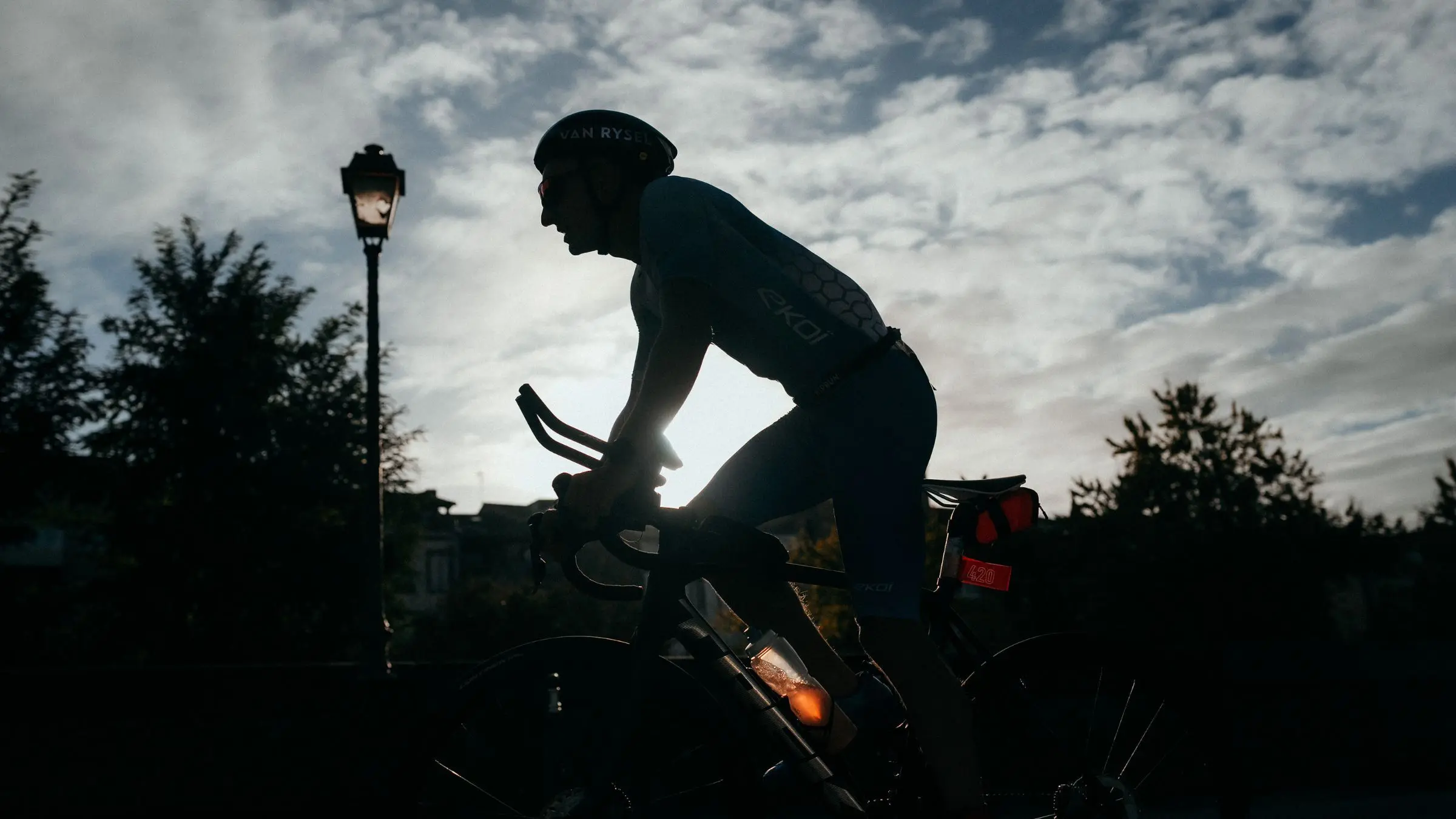
Are you training too much? Mental health and endurance sport researcher Jill Colangelo breaks down a study on how endurance athletes misuse food and exercise.
Mental health and endurance sport researcher Jill Colangelo breaks down her latest research into the correlation between training hours per week and eating disorders/disordered eating. (Photo: Supertri)
Published January 22, 2026 06:00AM
Let’s be honest here: people in our sport do weird stuff with food and eating. Living on gooey, jelly, chalky sugar blocks for a whole day of racing? Makes sense. Eating an entire pizza the day after that race? Probably justified. But the truth is that our sport may be hiding a big secret behind all of that weirdness, and my new research calls it out: ultra endurance athletes might be at significant risk for eating disorders (ED) and disordered eating (DE).
This isn’t exactly shocking, of course (I can see you rolling your eyes from here), but what may blow your mind is to know that the study also found a positive correlation between training volume and ED/DE risk. That means that the more hours per week athletes trained, the higher their risk. In fact, we were able to isolate a threshold number of training hours per week beyond which ED/DE risk truly escalated. That number is 14. Still rolling your eyes? Or are you checking your training logs?
Let’s define the terms
The National Eating Disorders Association (NEDA) defines disordered eating as a set of problematic eating behaviors and attitudes toward food, weight, shape, and appearance. Some of these behaviors include things like dieting, skipping meals, using laxatives, purging through exercise, and restricting food or macronutrient groups. An eating disorder is a mental illness that incorporates the aforementioned behaviors (and others), but is persistent, severe, and impairs function.
Both can cause significant psychological distress as well as physiological injury. And ED/DE does not discriminate. Anyone, of any gender, of any age, athlete or not, can experience ED/DE.
Is it me? Or is it triathlon?
Is there something about triathlon that increases ED/DE risk, or is there something about the people who gravitate toward these sports that makes them more susceptible to ED/DE? While we don’t yet have concrete answers, there is evidence to suggest that both may be true. There are ED sufferers who come to triathlon looking for healing. Triathletes report both body dissatisfaction and intentions to change body composition through training. Some of the personality traits of endurance athletes may also be present in ED/DE. The chronic stress of training may trigger dysfunction of the hypothalamic-pituitary-adrenal (HPA) axis, which could affect mental health and/or trigger ED/DE. Underlying all of these possibilities is the fact that our culture is obsessed with and rewards leanness, thinness, and the illusion of perfection, so it can be hard to not get caught up in all of that validation once we start fitting into a tiny tri suit.
The 14-hour problem
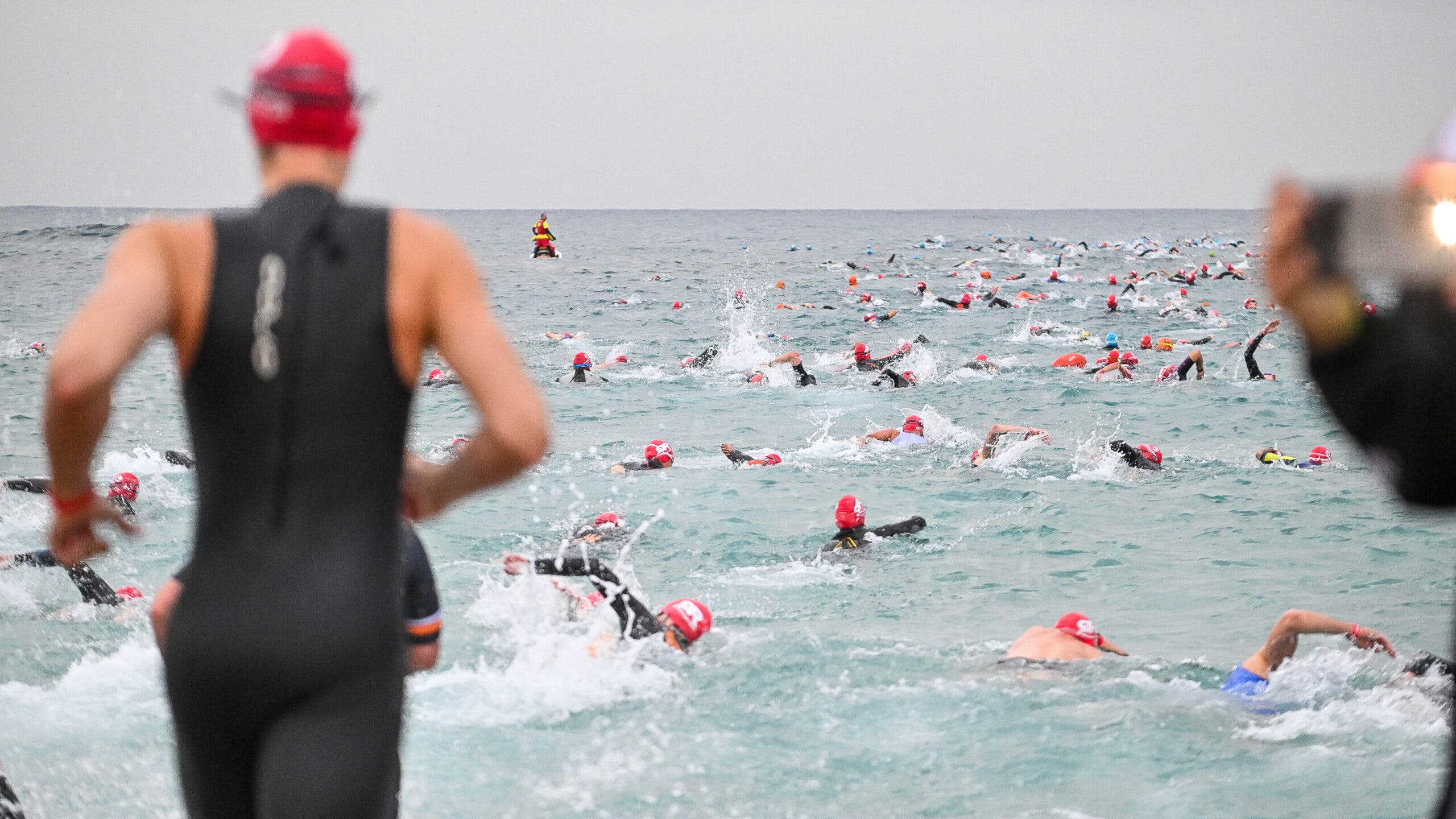
Though the research shows elevated risk at 14 hours per week, it does not suggest that you should never train more than that. However, as weekly training hours increase, you may not only have to be more diligent about making good nutritional decisions, but also about keeping your intentions clear. Are you adding hours because the events you’d like to compete in merit-increased training? Or is it just because it feels good?
It’s important to understand the difference because although we train for our races, the reality is that we also train for other reasons that have little to do with race preparedness, like giving ourselves permission to eat, controlling our body shape/size, gaining approval from others, and burning off calories.
Red flags: common vs. disordered behaviors in triathlon training
A complication is that some questionable behaviors are normalized in triathlon. We often engage in a transactional relationship with food and exercise where we believe that training “pays” for the food we eat. This is disordered thinking, yet so ingrained in our culture that we hardly see it as a bad thing. If you find yourself constantly thinking about how much time you need to spend in the pool to justify last night’s dinner, make no mistake–that could be a red flag.
A great way to tell if you may have problematic feelings about food and eating is to think about what would happen if you could no longer train. How high is your anxiety level just thinking about that scenario? High? That could be a red flag.
Other common things that can easily veer into disorder: Becoming overly irritable if training must be canceled or shortened; making meticulous plans for eating indulgent foods around training efforts; counting calorie burn, calories consumed, and/or macronutrients religiously; getting a big dose of training in the morning of a big eating holiday; obsessing about where/what to eat or following lots of foodie accounts on social media; sneaking in an extra run when you feel like you overate. All of these things are red flags.
The fix
It’s probably obvious by now, but let me be clear: You can’t train yourself out of ED/DE. No matter how much we want it to be true, triathlon is not a substitute for therapy or treatment, especially when it comes to ED. Do not look to other triathletes to demonstrate “normal” or “healthy” eating habits. The triathlon community is notorious for downplaying any health concern that would require us to acknowledge limits, so don’t trust your pals to model good behaviors.
Also, recognize that adding more training volume is not always justified. Sometimes you’re just adding junk on your feet because you think it will fix the junk in your head. The best way to manage it all is to reach out to an ED/DE-informed mental healthcare practitioner and/or a registered dietitian who can help you work through complex feelings about food, eating, body image, and sport.
Yes, it requires more effort to fix your issues than it does to bury them in training, but less than recovering from injury when ED/DE gets the best of you. There’s some truth to chew on.