
COURTESY U.S. GEOLOGICAL SURVEY
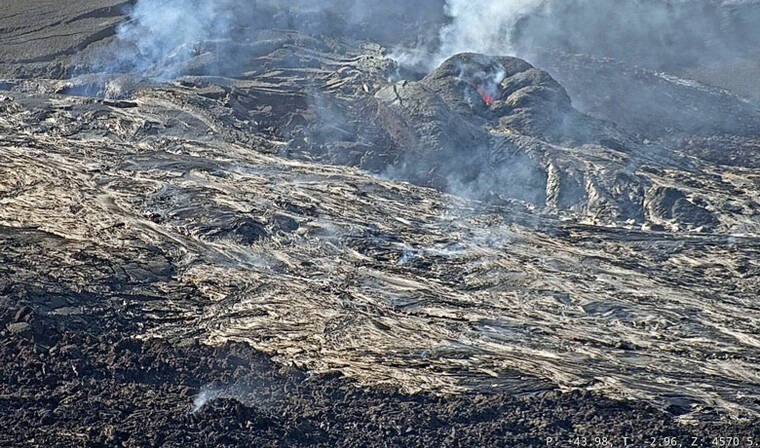
A screenshot of the webcam view from the south rim of the caldera.
The eagerly anticipated “Episode 40” of the ongoing Kilauea eruption with high fountains did not arrive overnight, but U.S. Geological Survey scientists say it could happen anytime between now and Saturday.
Hawaiian Volcano Observatory said the forecast has been extended due to prolonged precursory activity. Lava overflowed nearly continuously from Halemaumau crater’s north vent overnight with pulses of dome fountaining and overflows from the south vent.
“Activity has decreased this morning to about one overflow per hour from the south vent and only spattering from the south vent. Kilauea summit region showed deflation on tiltmeter UWD since about 4 p.m. yesterday,” according to a summary from HVO.
Kilauea’s East Rift and Southwest Rift zones remain quiet.
HVO reports nearly continuous overflows from the north vent most of Saturday and throughout the night. Intermittent dome fountains continued to form within the southern vent over the past day and Saturday night. Overflows from the south vent resumed feeding an active lava flow extending over 1,500 feet across the crater’s floor.
“Activity at the north vent decreased after 3 a.m. this morning, with lava only intermittently overflowing the vent. As of this morning, only spattering is visible within the north vent and large overflows from the south vent have slowed to about one per hour with the last overflow ending just before 9:10 a.m.,” according to a summary.
Don’t miss out on what’s happening!
Stay in touch with breaking news, as it happens, conveniently in your email inbox. It’s FREE!
Since Dec. 23, 2024, Kilauea has been erupting episodically, mostly from the north and south vents within the Halemaumau crater. The episodes, which have lasted for less than 12 hours, are separated by pauses lasting as long as more than two weeks.
The current volcano alert level is watch, while the current aviation color code is orange.