Budget leaks ‘create havoc’ as UK investors pull out of funds
Uncertainty over the contents of last month’s budget has been blamed for a record-breaking selling spree of equities by UK investors.
Data provider Calastone has reported that “the most prolonged and most severe bout of equity fund outflows continued unabated” last month.
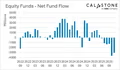
They report that UK investors withdrew a net £3.02bn from equity funds during November, with North American and UK-focused equity funds hardest hit. That’s the second-worst month on record, only beaten by October, as investors fretted that the chancellor might make changes to pension lump sum withdrawals rules, or hike capital gains tax rates.
However, the arrival of the budget caused a sudden halt to outflows. Inflows resumed on Budget Day (Wednesday 26), Thursday 27th and Friday 28th. Every other day of November in the run up to Budget Day except one saw net selling.
This adds to the evidence that the flurry of pre-Budget leaks – now to be investigated – affected investors, as well as knocking business and consumer confidence.
Calastone’s latest Fund Flow Index for November also shows that UK investors have cut their holdings in equities by £10.39bn since the start of June, having sold down equities for a record six consecutive months.
Edward Glyn, head of global markets at Calastone, says investors have been unsettled by uncertainty over budget plans.
“The political narrative has played havoc with UK savers in recent months. Never have we seen such consistent or large-scale selling before. The sudden halt in equity-fund outflows that took place after the budget was delivered is clear evidence that many investors were selling their holdings as concerns rose at the possible curtailment of pension lump sum withdrawals, or of further capital gains tax hikes.
“The recent period of policy uncertainty has clearly unsettled investors and, in some cases, prompted reactive decisions they may later regret. Savers benefit most from clarity and consistency, so they can plan properly for long-term goals.”
Key events
Budget uncertainty plunges building sector into worst slump since May 2020
Newsflash: Britain’s construction sector has suffered its sharpest downturn since the first Covid-19 lockdown forced building sites to shut five and a half years ago.
Activity across housebuilding, commercial building work and civil engineering all tumbled last month, a new survey of puchasing managers at building firms has found.
Construction firms are blaming fragile market confidence, delays with the release of new projects and a lack of incoming new work.
The report, by data firm S&P Global, shows there was “a sharp and accelerated reduction in output levels across the construction sector”. Many builders reporting that market conditions were challenging, with new orders slumping at the fastest rate in five and a half years, and job cuts rising.
Many construction companies commented on weak client confidence, alongside delayed spending decisions linked to uncertainty ahead of the Budget, S&P Global says.
This dragged the UK construction PMI down to 39.4 in November, down from 44.1 in October, the lowest since May 2020. Any reading below 50 shows a contraction.
Lower volumes of construction output have now been recorded for eleven months in a row, S&P Global reports.
Sub-sector data showed that housing activity (index at 35.4), commercial construction (43.8) and civil engineering (30.0) all experienced the fastest downturns in activity for five-and-a half years.
Tim Moore, economics director at S&P Global Market Intelligence, said:
“November data revealed a sharp retrenchment across the UK construction sector as weak client confidence and a shortfall of new project starts again weighed on activity.
Total industry activity decreased to the greatest extent for five-and-a-half years, led by steep falls in infrastructure and residential building work. Commercial construction also faced severe headwinds during November as business uncertainty in the run up to the Budget pushed clients to defer investment decisions. “Lower workloads, alongside pressure on margins from rising wages and purchasing costs, continued to dampen staff hiring in November. The latest round of job cuts was the most marked since August 2020.”
“Construction companies also signalled a slide in business activity expectations for the year ahead as hopes of an imminent rebound in sales pipelines faded in November. The degree of optimism dropped to its lowest since December 2022 amid reports of cutbacks to client budgets and pervasive worries about long-term UK economic growth prospects.”
Budget leaks may also have hit demand for electric cars last month.
The UK new car market declined slightly in November with new registrations falling by -1.6% to 151,154 units, the Society of Motor Manufacturers and Traders (SMMT) has reported.
The falll was driven by a -5.5% drop in purchases by private buyers, while sales to business customers rose.
Sales growth in battery electric vehicles slowed to its lowest rate in almost two years – up 3.6%. This lifted the BEV market share to 26.4%, up from 25.1% a year ago.
In early November, it was reported that electric vehicle (EV) drivers would be hit with a new tax in the budget, and be charged 3p per mile on top of other road taxes, as Reeves indeed announced on 26 November.
The SMMT fears that these plans for a “pence per mile” electric Vehicle Excise Duty (eVED) will endanger the UK’s net zero transition.
Mike Hawes, SMMT chief executive, says:
Even in a fragile market, zero emission vehicle uptake continues to rise, which is exactly what we need. But the weakest growth for almost two years – ahead of government announcing a new tax on EVs – should be seen as a wake-up call that sustained increase in demand for EVs cannot be taken for granted.
We should be taking every opportunity to encourage drivers to make the switch, not punishing them for doing so, else the ambitions of government and industry will be thwarted.
Budget leaks ‘create havoc’ as UK investors pull out of funds
Uncertainty over the contents of last month’s budget has been blamed for a record-breaking selling spree of equities by UK investors.
Data provider Calastone has reported that “the most prolonged and most severe bout of equity fund outflows continued unabated” last month.
They report that UK investors withdrew a net £3.02bn from equity funds during November, with North American and UK-focused equity funds hardest hit. That’s the second-worst month on record, only beaten by October, as investors fretted that the chancellor might make changes to pension lump sum withdrawals rules, or hike capital gains tax rates.
However, the arrival of the budget caused a sudden halt to outflows. Inflows resumed on Budget Day (Wednesday 26), Thursday 27th and Friday 28th. Every other day of November in the run up to Budget Day except one saw net selling.
This adds to the evidence that the flurry of pre-Budget leaks – now to be investigated – affected investors, as well as knocking business and consumer confidence.
Calastone’s latest Fund Flow Index for November also shows that UK investors have cut their holdings in equities by £10.39bn since the start of June, having sold down equities for a record six consecutive months.

Edward Glyn, head of global markets at Calastone, says investors have been unsettled by uncertainty over budget plans.
“The political narrative has played havoc with UK savers in recent months. Never have we seen such consistent or large-scale selling before. The sudden halt in equity-fund outflows that took place after the budget was delivered is clear evidence that many investors were selling their holdings as concerns rose at the possible curtailment of pension lump sum withdrawals, or of further capital gains tax hikes.
“The recent period of policy uncertainty has clearly unsettled investors and, in some cases, prompted reactive decisions they may later regret. Savers benefit most from clarity and consistency, so they can plan properly for long-term goals.”
Smaller business will see an increase in network charges under Ofgem’s plans.
The regulator says that by 2031, indicative network charge increases range from around £60 a year for a small holiday let or retail kiosk to £1,700 for small offices or hotels and £9,760 for a medium factory.
National Gas, who run Britain’s gas network, have crunched today’s pricing decision from Ofgem , and worked out they have been given a “baseline funding level” of £3.2bn.
That’s up from the draft determination of £2.46bn made in the summer.
National Gas chief executive, Jon Butterworth, said:
“This funding outcome confirms the critical role that the gas transmission system plays in Britain’s energy security now and for decades to come. For just 3p per day, less than 0.5% of the average consumer dual-fuel bill, Britain’s national gas transmission system continues to deliver excellent value for money for consumers – keeping our lights on, industries powered and homes warm.
“Over the past few months, our teams have worked extensively and constructively with Ofgem to provide additional evidence on the case for further investment in Britain’s national gas network to safeguard our country’s energy security and deliver benefits for consumers.
“In the coming weeks, we will undertake a more detailed review of Ofgem’s decision to ensure it enables us to deliver a safe, resilient network that secures Britain’s energy, maintains our industrial competitiveness and supports the country’s clean energy ambitions.”
Greenpeace is urging Ofgem to ensure energy customers are not hit with unnecessary bill increases.
Greenpeace UK’s senior climate advisor, Charlie Kronick, said:
“Britain’s energy grid is no longer fit for purpose. And without vital upgrades now our electricity system risks suffering a similar fate as our water network – much higher costs and underperformance further down the line.
“This money must be spent effectively, however, with robust safeguards and strong regulation to protect bill-payers, and ensure these upgrades deliver genuine value for money, offering fair but not excessive returns. We hope Ofgem have, and will continue to, strain every sinew in ensuring that new technologies of storage and flexible demand are adopted to minimise costly upgrades.
“Energy costs are a major pressure on households and businesses and, as we move to a cleaner energy system, prices must eventually come down. The government should be prepared to step in to ensure our energy system works for billpayers, not profits.”
DESNZ: essential to upgrade gas and electricity networks
The UK government has welcomed Ofgem’s decision to approve £28bn of new investment in the energy grid.
It says the spending is vital, after years of underinvestment in the energy system.
A Department for Energy Security and Net Zero spokesperson said:
“This government is taking action to bring down energy bills for families, with the Budget taking an average £150 of costs off bills in April, and expanding our £150 Warm Home Discount to over six million families.
“Upgrading our gas and electricity networks after years of underinvestment is essential to keep the lights on and ensure energy security for our country. Without these plans, which were first set out under the previous government, costs would spiral and our security would be compromised.
“The only way to bring down bills for good and get off the fossil fuel rollercoaster is with this government’s mission to deliver clean homegrown [energy] that we control.”
Introduction: £28bn energy upgrade gets green light
Good morning, and welcome to our rolling coverage of business, the financial markets and the world economy.
Plans to spend £28bn to upgrade Great Britain’s electricity grid have been signed off, in a move that should improve the energy networks, speed the transition to new forms of energy…and increase household bills.
Energy regulator Ofgem has just announced that energy companies have been given approval to “strengthen the stability, security and resilience of our energy networks”. by upgrading the energy grid.
The majority of the spending – £17.8bn – announced today is to maintain Britain’s gas networks.
There’s also £10.3bn to improve the nation’s high-voltage electricity network – the biggest expansion of the grid since the 1960s.
In total, it’s around £4bn more than was provisionally signed off in the summer.
Ofgem says the investment is the most cost-effective way to harness clean power, support economic growth and protect the country from a repeat of the 2022 gas price shock.
Customers will see the impact on their bills, which will rise to cover the cost of the investment. The regulator says £108 will be added to bills per year by 2031; £48 for gas and £60 for electricity.
But it claims, the investing will actually save customers £80 each compared to a word where the grid is not expanded.
So overall, the net increase in bills to cover all costs by 2031 works out at £30.
Jonathan Brearley, Ofgem CEO, insists the regulator isn’t allowing “investment at any price”, adding:
Every pound must deliver value for consumers.
Ofgem will hold network companies accountable for delivering on time and on budget, and we make no apologies for the efficiency challenge we’re setting as the industry scales up investment.
We’ve built strong consumer protections into these contracts, meaning funds will only be released when needed and clawed back if not used. Households and businesses must get value for money, and we will ensure they do.”
The agenda
-
9am GMT: UK new car sales data for November
-
9.30am GMT: UK construction PMI report for November
-
10am GMT: Eurozone retail sales for October
-
12.30pm GMT: Challenger US job cuts report
-
1.30pm GMT: US weekly jobless claims 1.30pm