Unlock the White House Watch newsletter for free
Your guide to what Trump’s second term means for Washington, business and the world
The number of children dying before their fifth birthdays is forecast to rise for the first time this millennium as rich countries have cut international aid, Bill Gates has warned.
The rise in child deaths comes as global health aid is set to fall by more than a quarter this year compared with 2024, according to research by an organisation part-funded by the Gates Foundation.
“Most people don’t know the miracle of cutting childhood deaths in half since the turn of the century,” the philanthropist and Microsoft co-founder said in an interview. “So the reversal is disappointing.”
Gates’ warning chimes with wider fears about the impact of shrinking global health funding, which researchers have warned will result in millions of extra deaths of people of all ages from diseases over the next five years. Rich countries including the US and the UK are scaling back aid commitments as they divert resources to higher military spending, and rising healthcare and pension costs for ageing populations.
Deaths of under-5s are forecast to rise from 4.6mn last year to 4.8mn in 2025, according to the Institute for Health Metrics and Evaluation (IHME). In 2000 the figure was more than 9mn.
The projection warns that if global health funding cuts persist, up to 16mn more children could die by 2045.
Gates said donor generosity and technological innovations could still put the trend “back on track”, although he acknowledged that it was a “very tough time in global health”.
Efforts to protect children have been further undermined by falling immunisation rates for some diseases, with figures including US health secretary Robert F Kennedy Jr promoting vaccine scepticism.
Gates painted a stark picture of the impact of the cuts on countries where programmes have depended heavily on aid. The Trump administration has dismantled the US Agency for International Development and high-profile international initiatives to tackle diseases from malaria to HIV/Aids have been disrupted.
“In the HIV field, a lot of things just aren’t being funded,” Gates said.
He emphasised that the cuts were happening in Germany and the UK as well as the US. He called the UK — where international aid spending has been cut from 0.7 per cent of gross national income in 2021 to 0.3 per cent from 2027 — “kind of an extreme case”.

British voters should be “proud of the incredible impact” of health programmes, they’d funded up to now, Gates said, even if “the newspapers will take the negative examples and count them”.
“The quality of the aid spending is really super strong — and people should know that,” he said.
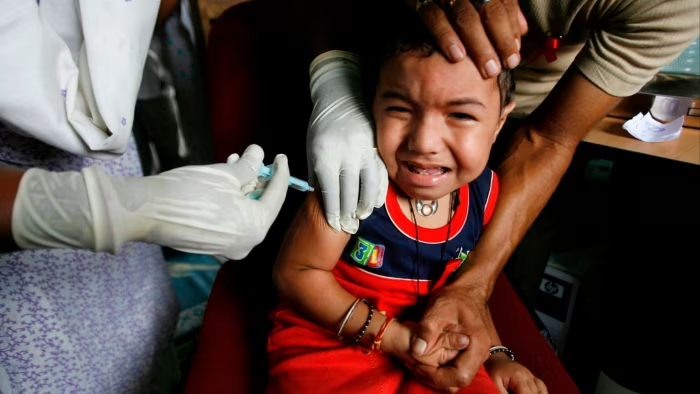
Gates issued a strong defence of childhood inoculation as the “biggest single factor” in the child mortality reduction since the millennium.
Vaccine effectiveness was “one of the most black and white things that there is,” he said, while noting that he had personally become a target of unsubstantiated conspiracy theories alleging he was “somebody who’s using vaccines to do bad things”.
Trump’s appointment of long-standing vaccine sceptic Kennedy has shifted the US government’s position on childhood inoculation. Kennedy’s statement to an international vaccine fundraising summit in June questioning the safety of the jab for whooping cough, diphtheria and tetanus “should be kind of shocking”, Gates said.
“It’s unexpected, it’s fairly stunning,” he added, although he tempered his criticism and said he still hoped to collaborate with Kennedy’s health and human services department.
“I do want to work with the US government on their global health generosity,” he said, adding that he could work with them on projects other than vaccination.
Data visualisation by Steve Bernard

