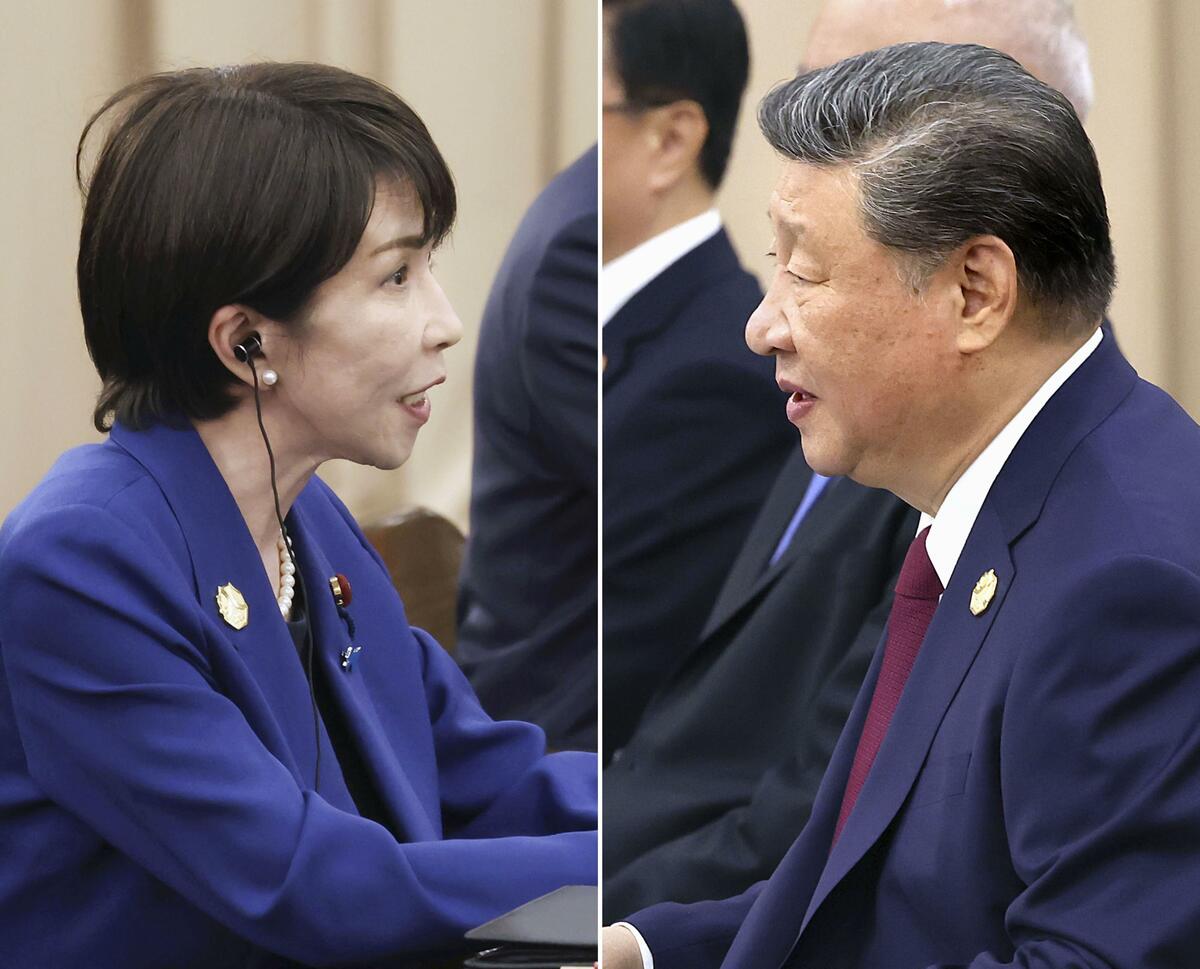
BEIJING – An escalating diplomatic row between China and Japan, sparked by Prime Minister Sanae Takaichi’s remarks on Taiwan, is expected to take time to settle, with experts stressing the need for Tokyo to take a calm approach in seeking understanding of its position.
The recent sharp deterioration in bilateral ties has begun to affect personnel exchanges and a wide range of Japanese industries, including tourism, trade, education and entertainment, as China ramps up pressure on Japan.
Some scholars said Takaichi should avoid taking measures that could be regarded as “further provocations” by Beijing, keep communication channels with China open and fully explain Tokyo’s stance both domestically and internationally to defuse tensions.
Naoko Eto, a political science professor at Gakushuin University and expert on Japan-China relations, said it may take more than a year for the bilateral spat to be resolved, describing the current situation as the two Asian neighbors “playing chicken.”
The dispute stems from Takaichi’s Nov. 7 parliamentary remarks indicating that a military attack on Taiwan, the self-ruled democratic island Beijing claims as its territory, could present a “survival-threatening situation” for Japan and potentially involve its Self-Defense Forces.
Beijing has repeatedly demanded that the Japanese leader retract her parliamentary remarks, but Tokyo has refused, maintaining that they do not contradict past government views.
Takaichi has said she will no longer express her views based on a “particular situation” and will not make her remarks a “collective view of the government.”
China will likely keep pressure on Japan, but Takaichi is not expected to “back off,” partly because her government, launched in late October, has a relatively high public support rate, Eto said.
“When a prime minister indicates that Japan would respond militarily in a Taiwan contingency, that is a major shift,” said Jeff Kingston, professor at Temple University in Tokyo.
Critics say Japanese government officials have not usually been so specific on the sensitive matter for Beijing, which aims to bring Taiwan into its fold, by force if necessary.
Takaichi, known as a China hawk advocating friendly ties with Taiwan, “knew what she was doing” and demonstrated her “hard-line views and willingness to stand up to China,” he added.
Kingston warned Beijing’s harsh responses, including a travel alert urging its citizens not to visit Japan, “could have severe economic consequences for an economy already stuck in the doldrums and battered” by tariffs imposed by U.S. President Donald Trump.
“If neither side backs down, that will harm both economies, but Xi (Jinping) doesn’t need to get elected,” he said. “At some point, Beijing might provide her with a ladder to climb down from her position, but I imagine that they want to inflict some pain before doing so.”
Gakushuin’s Eto pointed out that Japan “clearly has fewer bargaining chips” than China in addressing the dispute and that Takaichi could be “pushed into a corner and compelled to apologize” over her remarks, if not retract them.
Tokyo, for its part, could point to a recent social media post by Chinese Consul General in Osaka Xue Jian that included the line “cut a dirty neck without a moment of hesitation,” an intentional threat unbecoming of a diplomat, when countering Beijing’s criticism of her, Eto said.
The now-deleted post has drawn a protest from Japan and condemnation from the United States and Taiwan. A panel of the ruling Liberal Democratic Party, led by Takaichi, has urged the government to take firm action, including declaring Xue persona non grata and possibly expelling him.
Japan could also try to rally support from its security ally, the United States, and other countries, but Eto said it may not be enough to resolve the sprawling dispute, with Beijing resorting to a series of measures including the reimposition of its suspension on Japanese seafood imports.
On Thursday, U.S. Ambassador to Japan George Glass denounced China’s sharp response as “a classic case of Chinese economic coercion” and expressed support for Tokyo.
Shin Kawashima, a professor at the University of Tokyo, said that while China is again shifting blame onto Japan for “altering the status quo,” as it did in 2012 after Tokyo purchased the Senkaku Islands in the East China Sea from their private owner, its current responses appear somewhat restrained. China claims the islands and calls them Diaoyu.
In contrast to the large-scale anti-Japanese demonstrations held across China in 2012, the current reaction has been limited to government-level measures.
Unlike in 2022, when Beijing carried out large-scale military drills and cyberattacks targeting Taiwan after then U.S. House of Representatives Speaker Nancy Pelosi visited the island, the first such visit in 25 years, it has so far refrained from taking similar actions against Japan, he noted.
Kawashima said China strongly reacted to Takaichi’s comments as it took issue with close ties between the Japanese leader and Taiwan President Lai Ching-te, whom Beijing condemns as a separatist. Before assuming the premiership, Takaichi visited the island in April and held talks with Lai.
“China sees Japan and the United States as supporters of the Lai government, with Takaichi serving as one of its cornerstones,” he said.
Beijing lodged a protest with Tokyo after Takaichi met with a Taiwan representative during last month’s Asia-Pacific Economic Cooperation forum summit in South Korea. However, China did not do so when her predecessors similarly met with Taiwan representatives.
The angry reaction indicated China was “particularly sensitive” about Takaichi’s approach toward Taiwan, he said.
The University of Tokyo professor warned of China’s “malinformation” tactics, in which its media purposely avoid mentioning U.S. forces, even though Japan’s right to collective self-defense would apply only in support of the United States.
The omission, he said, gives a false impression that the Japanese SDF and the Taiwan military would jointly respond to a mainland invasion.
In Japan’s security legislation, a “survival-threatening situation” allows the country to exercise the right of collective self-defense.
Takaichi’s parliamentary remarks were taken to suggest the government could authorize the Self-Defense Forces to act in support of the United States if China attacks Taiwan.
Kawashima stressed that Japan needs to strengthen its communication strategy through social media and other channels to advance its narratives in the international community.
“Otherwise, China would claim it is Japan that has changed the status quo. If Japan fails to give a clear account, it will end up bearing all the blame,” he said.
(Hiroki Noda in Tokyo contributed to this story.)
