Keystone
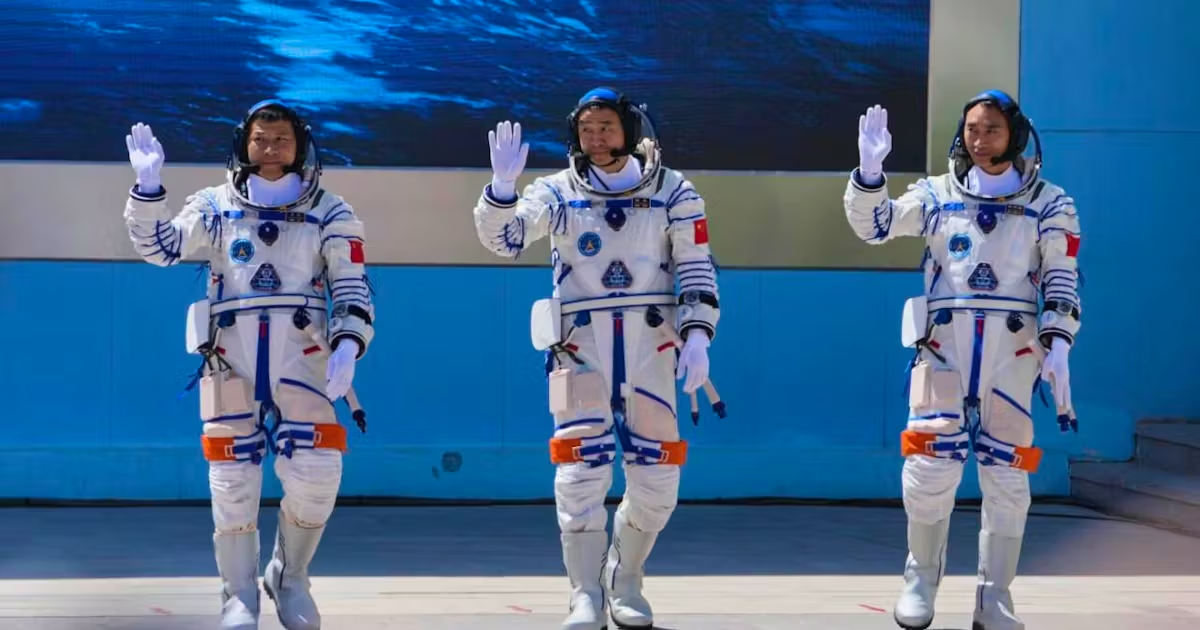
After days of uncertainty in space, the three stranded astronauts from China are due to return to Earth today.
According to the manned spaceflight authority, the men from “Shenzhou 20” are to return in the space capsule that had previously taken their successors from the “Shenzhou 21” mission to the “Tiangong” (Heavenly Palace) space station.
Chen Dong, Chen Zhongrui and Wang Jie are scheduled to arrive at the Dongfeng landing site in China’s autonomous Inner Mongolia region in the Gobi Desert. The authorities did not announce a planned time for the landing. The three astronauts were said to be in good condition.
What had happened?
China had previously postponed the return of the three astronauts from the “Tiangong” space station, originally planned for November 5. The background to this was the suspected collision of their space capsule, which is docked to the space station, with small pieces of space debris. Exactly when this incident might have occurred remained unclear. China therefore postponed the three men’s journey home indefinitely for the investigation.
Space debris has long been a problem in space. This refers to all objects that are no longer in use, such as satellites or fragments of satellites, which are the result of collisions or explosions. They can be tiny or several meters in size. Space debris orbits the earth in near-earth orbits. The European Space Agency (Esa) estimates that a total of more than one million pieces of debris larger than one centimetre are hurtling around the Earth.
How the mission management reacted on the ground
Initially, the experts on the ground said they had initiated investigations. On Tuesday, the Human Spaceflight Administration announced that it had initiated emergency measures and carried out further tests and simulations. The landing area was practiced for the crew’s landing.
The agency emphasized that the space station was in normal condition and could accommodate two astronaut crews. State media showed footage of the two crews living and working together on the space station. The authorities did not provide any further details on the condition of the capsule in question.
What the incident means for the crews
The abrupt change to its space travel plans is new for China. For the first time since the start of its manned space program in 2003, the astronauts had to unexpectedly abandon their original schedules while they were still in space. The retrieval operation now also shows how China reacts to unplanned incidents in space and what contingency plans the People’s Republic has in place.
The mission management decided to send the stranded astronauts back in the “Shenzhou 21” space capsule. Their original crew will not be able to return for the time being. “At a suitable time in the future”, China plans to send the “Shenzhou 22” spacecraft to the space station. It is unclear what will happen to the “Shenzhou 20”.
What are the astronauts doing on the “Tiangong”?
The “Shenzhou 20” astronauts left for the “Tiangong” on April 24 on a six-month rotation cycle and had now spent just over half a year in space. There they conducted scientific experiments and upgraded the space station’s protection against space debris. Before the three were able to return, China brought three new astronauts to the “Tiangong”, to whom the space station was handed over.
The new “Shenzhou 21” crew around Zhang Lu, who was already in space two years ago with the “Shenzhou 15”, as well as the space debutants Wu Fei and Zhang Hongzhang, are also to maintain the space station for around six months, carry out scientific experiments and complete spacewalks. The mission is part of China’s long-term space plans, which also include a manned moon landing by 2030.
Reminder of incident on the ISS
The postponed return of the Chinese is reminiscent of an incident involving a crew from the International Space Station (ISS), who had to extend their stay in space by months without planning. Barry Wilmore and his colleague Suni Williams had arrived at the ISS at the beginning of June 2024 and were only supposed to stay there for around a week.
However, due to technical problems with their Starliner spacecraft, NASA decided for safety reasons to let them return to Earth in a Crew Dragon and not until around nine months later.
