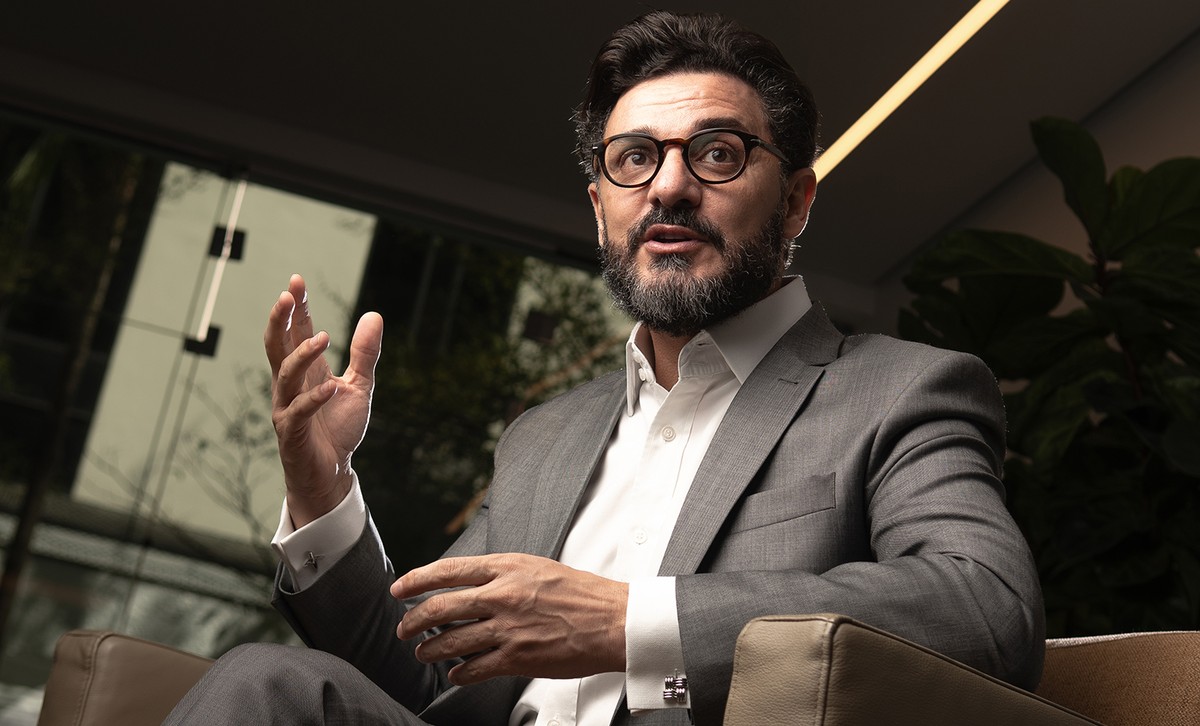
The relationship between Brazil and China is set to become even more relevant than it is today in the near future if the current protectionist scenario, resulting from tariffs imposed by Donald Trump, is maintained for an extended period. A closer alignment between Brazil and China will be a direct consequence of the new U.S. trade policy following the tariff surge, which has relegated bilateral agreements with other countries to second place, says Hussein Kalout, a researcher at Harvard University and international advisory counselor at the Brazilian Center for International Relations (CEBRI).
“The trend is for the relationship with China to become increasingly structural, increasingly synergistic,” said Mr. Kalout, who served as special secretary for strategic affairs under President Michel Temer’s administration in 2017. The practical result of this trade policy, says Mr. Kalout, will be to bring Brazil increasingly closer to China: “Today Brazilian business leaders have enormous distrust regarding the United States because they [the U.S.] have proven themselves to be an unreliable partner.”
Mr. Kalout continues: “If, in the past, Brazil was concerned about exercising balanced diplomacy between Washington and Beijing, this American strategy [of tariff surge] only damages U.S. interests.” The trend, adds Mr. Kalout, is for the perception among Brazilian entrepreneurs that China is a stable trading partner to strengthen, unlike the United States. This is because establishing agreements with China is not conditioned on a political agenda, as is currently the case with the U.S. government. And this reality is clear to Brazilian business leaders.
Changes in the global scenario, as a result of U.S. tariff policy, will also lead to geopolitical shifts, says Mr. Kalout. This is because China’s rapprochement with Brazil will occur parallel to the search for new trading partners.
On this topic, Mr. Kalout mentions a recent essay by him in Foreign Affairs, which argued that Brazil’s rapprochement with China will occur in a context where the country will not abandon its commitment to multilateralism.
“Crucially, Brazil’s foreign policy has consistently refrained from adopting an explicitly anti-American or anti-Western posture,” writes Mr. Kalout. And continues: “Rather, Brazil has preferred a multidirectional diplomatic approach, grounded in the principles of autonomy, pragmatism, and constructive engagement with a diverse array of global actors.”
Mr. Kalout adds that “For Brasília, Beijing constitutes an indispensable strategic partner, but Washington, even after its recent aggressions, remains an irreplaceable global power,” he emphasized. “As a result, Brazil has not found the idea of choosing between Beijing and Washington viable or desirable,” he added. “Still, the increasingly confrontational and coercive stance adopted by the Trump administration has shaken Brazil’s diplomatic calculus and accelerated its geopolitical tilting toward Beijing.”
Mr. Kalout also observed that the U.S. government’s moves are leading to a decentralization of global power, previously in the hands of the United States, with the consequent loss of U.S. worldwide influence.
Mr. Trump’s tariff policies, continues Mr. Kalout, consist of compulsorily raising import tariffs on various countries, in double digits, primarily for political motivations. This type of decision constitutes, in his words, a “violation of norms and rules of the international” trade system. The affected countries, he adds, need to seek new alliances, which also lead to new political partnerships. “The best alternative in the short and medium term is the diversification of partnerships. That’s why the desire grows, the thesis of inter-regional cooperation, of inter-regional forums, is strengthened,” he said. “The path of diversification is not a choice, it’s not an option. It’s mandatory.”
But this doesn’t mean that, with a possible decentralization of global power, the United States has become “a dispensable actor,” says Mr. Kalout. “It’s a relevant and important actor. But you can’t remain dependent on a highly unpredictable government,” he said, noting that Mr. Trump still has three and a half years of government ahead. And during this period, Brazil will have to deal with trade negotiations with Mr. Trump’s United States.
Mr. Kalout also considers that Brazil should be cautious in the face of President Trump’s tariff surge. “The United States scenario is volatile, it’s not a stable scenario. So, you need to have a lot of composure to operate, at this moment, foreign policy with the Trump administration. There’s no way to design a medium-term scenario with a government that changes its dialogue,” he stated.
The researcher observed that Brazil has already made three important moves. It first demonstrated that it wants to negotiate. “Many business delegations have gone to Washington with government support,” he recalled. The second move was to position itself as non-confrontational and open to negotiation, supporting business delegations on their trips. “The third was to go to the WTO [World Trade Organization].” In August, Brazil approached the WTO against tariffs imposed by the Trump administration. “It was symbolic, in the sense of showing that Brazil believes in an international [trade] system based on rules,” said Mr. Kalout.
The researcher doesn’t find it impossible that the U.S. government could impose new trade sanctions after the trial of former President Jair Bolsonaro, expected to conclude this month. The acquittal of Mr. Bolsonaro, a Trump ally, was put forward as one of the conditions by the United States for the tariffs imposed on Brazilian exports to be reviewed. “If a new package of sanctions comes, then we would have a new scenario.”
