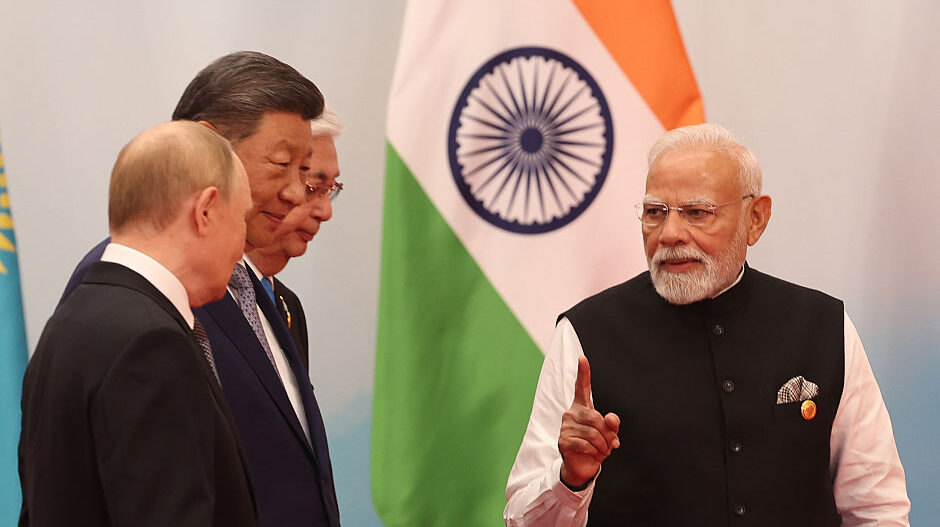
SYDNEY — While the autocratic triumvirate of Xi Jinping of China, Vladimir Putin of Russia and Kim Jong-un of North Korea basked in the reflected glory of what’s believed to be China’s largest military parade ever, one important figure was absent: Narendra Modi of India.
Modi made what analysts say was a clearly calculated appearance before the parade at the Shanghai Cooperation Organization Summit, probably intended as a message to US President Donald Trump that his tariffs and claims to have solved the recent Indo-Pakistan conflict were not welcome. But then the Indian prime minister pointedly left the country, rather than staying two more days to attend Xi’s event alongside other regional leaders.
Modi’s distance from Xi appeared to signal that while Modi sees economic benefits to improved relations, he’s not ready for a fundamental shift in the historically fraught dynamic between the two great powers, who share a disputed border where deadly clashes have taken place. Also, China’s increasingly close relations with Pakistan, India’s neighbor and periodic enemy, is also a point of contention.
“India had an armed confrontation with the PRC [the People’s Republic of China] a few years back,” Chong Ja Ian, an associate professor at Singapore National University, told Breaking Defense in an email. “They just came out of a conflict with PRC-backed Pakistan. Politically, Modi cannot be seen to be endorsing the glory of the PLA.”
RELATED: China showcases nuclear triad, new missiles and lasers at military parade
And there are other fundamental issues that drive the two countries apart, notes Raji Rajagopalan, a senior fellow at the Australian Strategic Policy Institute (ASPI).
“India is also very concerned about Chinese hegemony in Asia often calling for multipolarity, not only globally, but also in Asia,” he wrote in an email. “Moreover, India’s relations [with Taiwan] have also improved significantly over the last decades even though India does not recognize Taiwan formally.”
So it’s a balancing act. Modi is clearly trying hard to not provoke China, especially as Xi readied for his country’s biggest military parade. During the Shanghai Cooperation Organization Summit he and Xi talked about being “development partners” and resolving their sometimes deadly border disputes, an Indian statement said.
There were photos of Xi and Modi shaking hands and smiling, but neither side made any formal commitment to negotiations over the border disputes and neither side offered talks to bolster national security cooperation.
China’s Show Of Force, Under Scrutiny
Xi has held increasingly large military parades every two years since 2015, with China displaying “newer and more impressive weapons, and more sweeping statements of China’s power and ambition. This year is no exception, as this marks China’s largest military parade ever,” said Bethany Allen, the lead China analyst at ASPI.
“This is in keeping with China’s ever-growing defense budget, which has increased by between 6-8% every year for the past 10 years. So each year marks China’s largest defense budget ever — notable not so much for that year’s individual spending, but for Beijing’s commitment to steady increase over time,” she said.
That has allowed China to deploy the world’s largest navy by ship number, field a range of advanced aircraft including the J-35, build an array of hypersonic missiles, modernize its command and control systems and launch complex military satellites. But the People’s Liberation Army has not fought a war since it was outdone by relatively tiny Vietnam in 1979, something XI and other Chinese leaders have made clear they know. Now they are trying to train and equip troops to the standard needed.
“Clearly the PRC’s defense industrial base is immense,” Jong wrote. “They can certainly produce the numbers with very high levels of sophistication. What we do not know from the parade is how this equipment might actually function.”
The undeniably impressive spectacle of vast numbers of troops performing impeccably executed parade-ground drills does not answer the issue Jong raises. Australian Chinese analyst John Blaxland told Breaking Defense in an email that he believes Xi’s displays “compensate for a deep-seated sense of inadequacy.”
“The impeccable display suggests the fixation is more on the precision of massed appearances of goose-stepping soldiers than on the substance of a joint, networked and operationally honed fighting force,” said Blaxland, currently head of the DC office of The Australian National University. “Yes, the Chinese parade was an impressive spectacle. But like a Potemkin village, the CCP [Chinese Communist Party] is focused on messaging invincibility while hiding the gnawing sense of inadequacy that comes with a generation of military practitioners lacking operational experience.”
However, Putin and Kim may help counterbalance China’s thin experience. Putin and Kim’s troops are fighting together in Ukraine and almost certainly sharing their lessons with Xi. And that is what really makes this parade different from the ones that have gone before, Allen wrote.
“What IS new this year, is the sense of solidarity and common purpose between China, Russia, and North Korea, as the leaders of all [three] countries attended the parade together,” she wrote. “This symbolizes their growing confidence in an authoritarian, non-Western challenge to the liberal, democratic US-led order that has shaped the world for the past 80 years.”