00:00 Speaker A
Now time for some of today’s trending tickers, we’ll be watching precious metals, Uber and Lyft. Let’s start off with those metals. Like gold, silver and copper are all falling as the framework to a US China trade deal is announced. In this deal, China agrees to begin approving where earth metals required for technological development and manufacturing to be exported again to the United States. Gold, silver, copper and each respective minor declining as investors begin to sell off the safe haven assets they acquired in the midst of uncertainty over US tariffs and geopolitical tensions that are cooling in the Middle East. Julie, your thoughts on this space.
01:41 Julie
Yeah, I mean, it was so interesting, right, to see that flare up of tensions in the Middle East and initially a lot of concerns about the ripple effect that could potentially have. That really seems to have melted away very, very quickly, and there was already a bid for gold going into this, but that seems to be a reason, for the very least, for investors to have taken some profits in gold. Gold, by the way, is still up 25% year-to-date, but it’s heading for its second straight weekly loss as we see some rotation out of it. Miners, by the way, in contrast, I’m looking at the GDX, the ETF that tracks those gold miners, is still up 48% year-to-date. So it’s almost double the, uh, the action that we’ve seen, the performance that we’ve seen in the underlying metal. And one other thing I want to mention, Josh, is the underlying bid that we have seen in gold because we have had central banks outside of the Federal Reserve, that is, around the globe buying gold. So that’s been something that, uh, gold bulls or gold bugs, as we like to call them, have pointed to as something that has been an underpinning to some of the demand and the upside that we’ve been seeing for gold prices.
03:53 Speaker A
And Mark, you know, we were talking off camera, and you were saying, listen, let’s talk gold, let’s talk metal, but keep your eye on those rare earths.
04:06 Mark
Yeah, I mean, those things are are directly driven by, uh, trade talks that we’re having ongoing with China. So you see the second you, uh, you see positive movement trade talks, you see some of those precious, not precious metals, the the more mining, the the broader mining complex go down. Uh, we saw that today. They’re heavily weighted in in one or two of those companies that are rare earth miners. Uh, so not surprised to see that and see the industrial metals go down as trade talks progress with China.
05:03 Speaker A
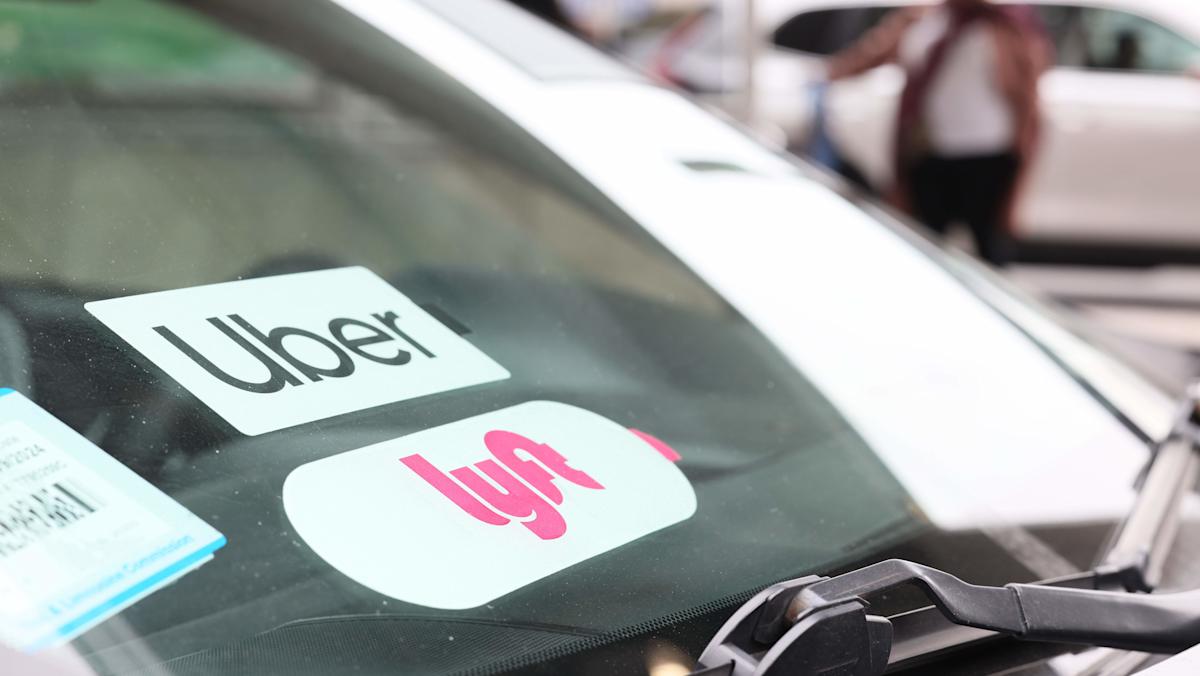
All right, meanwhile, Uber and Lyft, they’re sliding as Canaccord Genuity downgrades both those names to hold over uncertainty that comes with the exploding robo taxi industry. Analysts say that self-driving robo taxis, if expanded on a nationwide scale, could remove the need for human drivers behind Uber and Lyft rides. New York Times reporting, by the way, that Uber, alongside its former CEO, that would be Travis Kalanick, considering acquiring the US arm of Pony AI, another autonomous vehicle developer. Uh, Julie, over at Canaccord, they put it like this, they said, “Challenge for these names,” and they meant Uber and Lyft, uh, is, “How long a hybrid network will stay relevant, and then what value they can add over the long term in this new paradigm?”
06:32 Julie
Yeah, George Gianarikas over there, um, friend of the program, really taking the long view and trying to figure out what the future of autonomous driving and robo taxis is going to look like, and is it going to be ruled by what he calls the hybrids, that is, Uber and Lyft, or Uber Lyft, as he called them in the note, kind of lumping them together, or is it going to be sort of the Teslas and Waymos of the world? One of the things he points out is, under his assumptions, the cost for Uber Lyft per mile is much higher than it is under an eventual robo taxi scenario with Tesla and Waymo. So I thought that was an interesting situation here. So, indeed, he assumes coverage of these two with neutral ratings. On Uber, he’s got an $84 price target, $14 price target for Lyft, and he’s, but he really does leave room here to say he doesn’t know what the answer to the question is going to be. In other words, he doesn’t know which model is going to be more dominant, and the other thing he makes clear is, it is really going to take quite a long time to get to our more fully autonomous future. So, I’m sort of acknowledging the things we don’t yet know about this world while, at the same time, trying to game out how it’s going to work for these publicly traded companies.
08:53 Speaker A
All right, Julie.
