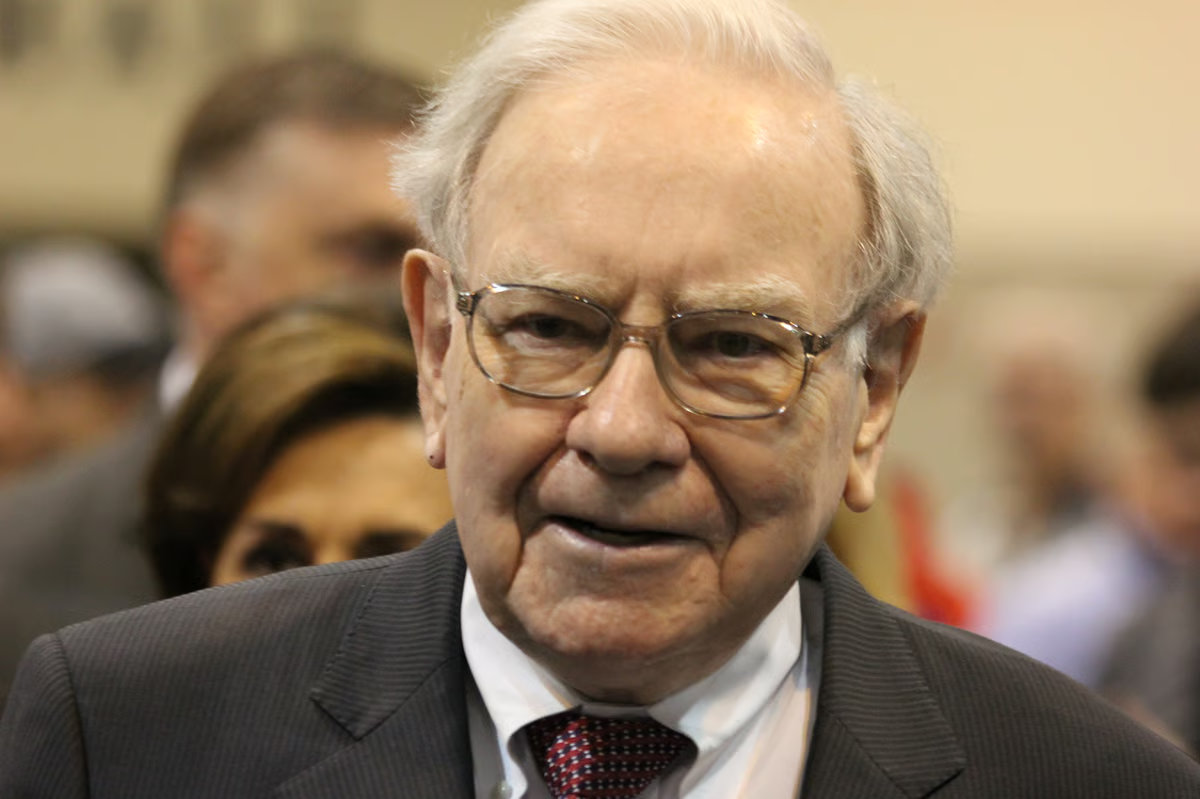
Warren Buffett served as the CEO of the Berkshire Hathaway (BRKA +1.43%)(BRKB +1.32%) holding company from 1965 to 2025. He built it into a $1 trillion conglomerate with numerous subsidiaries and a $330 billion portfolio of publicly traded stocks and securities.
Berkshire stock produced a compound annual return of 19.7% during Buffett’s 60-year tenure, meaning a $500 investment in 1965 would have grown to $24.2 million by the end of 2025. The conglomerate’s new CEO, Greg Abel, is a longtime student of Buffett’s simple strategy, which involves investing in companies with steady growth, reliable earnings, and shareholder-friendly initiatives like dividends and stock buyback programs.
You will never find Buffett or Abel chasing the latest stock market trends, not even one as powerful as artificial intelligence (AI). However, at least three of Berkshire’s current holdings are using AI to enhance their existing businesses, and they represent more than one-third of the value of its entire portfolio.
Image source: The Motley Fool.
1. Alphabet: 6.8% of Berkshire Hathaway’s portfolio
Alphabet (GOOG 1.04%)(GOOGL 1.19%) is home to Google, YouTube, Waymo, and a number of other subsidiaries. Wall Street was initially concerned that AI chatbots would drive traffic away from traditional internet search engines like Google Search, and since the platform accounts for half of Alphabet’s total revenue, that would have been very bad news.
But Alphabet is proving it can use AI to its advantage. It launched new features like AI Overviews and AI Mode to create a hybrid user experience in Google Search. Overviews combine text, images, and links to third-party sources to provide holistic answers to search queries, whereas AI Mode transfers users to an AI chatbot-style interface where they can dive deeper with follow-up questions.
Alphabet says these features are driving growth in overall search activity. As a result, Google Search generated a record $60.4 billion in revenue during the first quarter of 2026, which was a 19% increase from the year-ago period. It was the fourth straight quarter in which that growth rate accelerated, signaling significant momentum.

Today’s Change
(-1.19%) $-4.61
Current Price
$383.05
Key Data Points
Market Cap
$4.6T
Day’s Range
$381.78 – $388.75
52wk Range
$162.00 – $408.61
Volume
749.2K
Avg Vol
28.6M
Gross Margin
60.43%
Dividend Yield
0.22%
Berkshire first bought Alphabet stock during the third quarter of 2025, but it nearly tripled its position in the first quarter of this year under Abel’s leadership. Alphabet is now Berkshire’s fifth-largest holding, with a portfolio weighting of 6.8%.
2. Coca-Cola: 9.9% of Berkshire Hathaway’s portfolio
Building the world’s largest beverage company requires more than just tasty drinks. Coca-Cola (KO +0.38%) leans heavily on technology to make its manufacturing and logistics processes more efficient, but also to craft a better customer experience across its 200 brands. AI has become a major piece of the company’s technology stack.
Coca-Cola processed mountains of customer data through an AI engine to design promotional products like Y3000 and Zero Sugar Y3000, which preview what the company’s flagship sodas might taste like in the next millennium. This might sound like an abstract use-case for AI, but it’s a sign the technology could be used to formulate all kinds of different drinks in the future.
In 2024, Coca-Cola made a commitment to spend $1.1 billion on the Microsoft Azure cloud platform over five years. During the early stages of the partnership, Coca-Cola used a product called Azure OpenAI Service to craft marketing campaigns and improve supply chains, and it experimented with Microsoft’s Copilot virtual assistant to improve workplace productivity.

Today’s Change
(0.38%) $0.31
Current Price
$81.48
Key Data Points
Market Cap
$351B
Day’s Range
$80.92 – $81.67
52wk Range
$65.35 – $82.66
Volume
8.2M
Avg Vol
15.3M
Gross Margin
61.82%
Dividend Yield
2.53%
Coca-Cola is one of Berkshire’s oldest holdings. Buffett acquired 400 million shares for $1.3 billion between 1988 and 1994, and he never sold a single one. That position is now worth $32.7 billion, and it paid Berkshire $816 million in dividends last year alone.
3. Apple: 20.7% of Berkshire Hathaway’s portfolio
Apple (AAPL +1.26%) is Berkshire’s largest position with a hefty portfolio weighting of 20.7% — and that’s after Buffett sold around three-quarters of the conglomerate’s stake during 2024 and 2025.
Apple’s latest iPhone, iPad, and Mac computers are fitted with specialized chips the company designed to run its Apple Intelligence suite of AI features and applications. Apple Intelligence includes writing tools to help users draft and summarize text messages and emails, in addition to an upgraded version of the Siri voice assistant that can be integrated with OpenAI’s ChatGPT.
There are more than 2.5 billion active Apple devices worldwide, so the company could soon become the AI industry’s biggest gateway to consumers. This should create a variety of opportunities, many of which haven’t even been discovered yet.

Today’s Change
(1.26%) $3.83
Current Price
$308.82
Key Data Points
Market Cap
$4.5T
Day’s Range
$305.84 – $311.40
52wk Range
$195.07 – $311.40
Volume
43.7M
Avg Vol
43.7M
Gross Margin
47.86%
Dividend Yield
0.34%
But if Apple has so much potential, why did Berkshire sell three-quarters of its stake? Buffett and his team invested about $38 billion in the iPhone maker between 2016 and 2023, and by early 2024, that position was worth over $170 billion. It represented around half the value of the conglomerate’s entire portfolio, so Buffett started selling in order to reduce risk and cash in some gains.
In an interview with CNBC earlier this year, Buffett said he’s happy Apple remains Berkshire’s largest holding, and he said the conglomerate could buy more of it one day if the price is right.