
Although there has been an incredible rally in the AI sector since April, there are several stocks that it’s not too late to buy. The overall upside of these stocks is far higher than today’s prices, so the past month and a half’s rally doesn’t mean much.
Three stocks that I think are still strong buys despite the rally are Nvidia (NVDA 0.81%), Broadcom (AVGO 2.41%), and Micron (MU +2.24%). All three of these are set to cash in on the enormous data center spending spree, and that’s not expected to end anytime soon.
Image source: Getty Images.
Nvidia
Nvidia may be the world’s largest company by market cap, but that doesn’t mean it can’t get bigger. It has risen to the top thanks to insatiable AI demand and its leading AI computing equipment. Nvidia’s GPUs (graphics processing units) have become the industry standard in AI computing, and it’s the benchmark every competitor compares itself to. Demand for Nvidia’s products continues to rise, leading to impressive revenue growth figures.

Today’s Change
(-0.81%) $-1.80
Current Price
$220.52
Key Data Points
Market Cap
$5.4T
Day’s Range
$217.92 – $223.32
52wk Range
$129.16 – $236.54
Volume
1.7M
Avg Vol
170M
Gross Margin
71.07%
Dividend Yield
0.02%
For this fiscal year, Wall Street analysts project 73% revenue growth. That showcases incredible demand for Nvidia’s products, but it isn’t stopping there. Nvidia believes that global data center capital expenditures will rise from $600 billion in 2025 to $3 trillion to $4 trillion annually by 2030. That’s a major rise from today’s levels, and if that pans out, Nvidia’s run could truly just be getting started, making the stock a no-brainer buy today.
Broadcom
A rising challenger to Nvidia is Broadcom. Broadcom isn’t trying to beat Nvidia at its own game by offering another GPU. Instead, it’s taking a more focused route. GPUs excel at nearly any workload and have a ton of capabilities built into the unit to allow for a wide variety of workloads. However, sometimes a device will only see one type of workload during its service life, wasting its capabilities. The problem is, Nvidia doesn’t know what type of workloads its products will see, so it designs in all of these capabilities to cater to a wide variety.

Today’s Change
(-2.41%) $-10.14
Current Price
$410.57
Key Data Points
Market Cap
$2.0T
Day’s Range
$405.87 – $417.76
52wk Range
$226.18 – $442.36
Volume
590K
Avg Vol
24M
Gross Margin
64.96%
Dividend Yield
0.59%
Broadcom is partnering directly with AI hyperscalers to design chips based on the workloads they will see. This maximizes cost efficiencies and makes them ideal for repetitive tasks such as inference. However, they can also be used for training if the training data set comes in the same variety. The biggest example of Broadcom’s custom AI chip is the Tensor Processing Unit that it designed in collaboration with Alphabet (GOOG 2.36%) (GOOGL 2.66%). This has been a huge hit, and it will continue growing.
Broadcom believes that its custom AI chip business will hit $100 billion or more in revenue during 2027. That’s amazing growth from today’s levels, making it an excellent time to buy Broadcom stock.
Micron
During the past year, Micron has dramatically outperformed the other two stocks on this list. That’s because there has been a significant shortage of memory chips, boosting the price of this core product. This has driven Micron’s revenue to new highs.
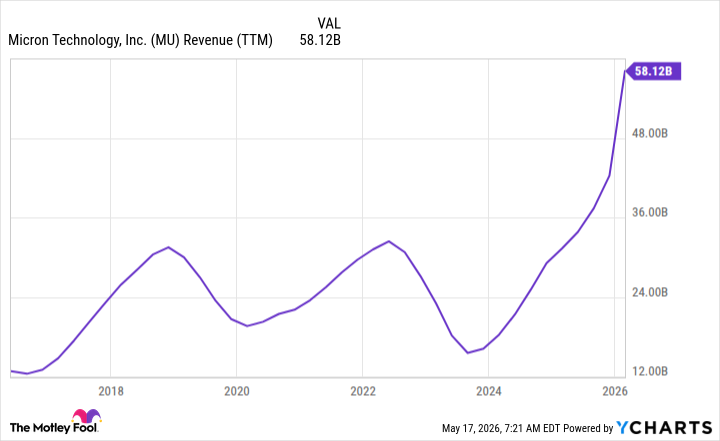
MU Revenue (TTM) data by YCharts
However, it’s not done yet. Wall Street analysts project Micron’s revenue will reach $109 billion by the end of this fiscal year (ending August 2026), and $171 billion by the end of next fiscal year. That’s incredible growth, and with companies like Nvidia telling investors that AI demand will keep rising, memory chip prices should stay elevated even as companies like Micron race to increase production capacity.
Micron may have gone through a major rally, but it’s still a great stock to own, as the run could just be getting started.
Keithen Drury has positions in Alphabet, Broadcom, and Nvidia. The Motley Fool has positions in and recommends Alphabet, Broadcom, Micron Technology, and Nvidia. The Motley Fool has a disclosure policy.